The lowest industrial machinery repair quote you receive is often the most expensive mistake your plant will ever make. You’ve likely been there before: a critical gearbox or centrifuge fails, production stops, and you’re under the gun to get back online. It’s tempting to grab the quickest, cheapest estimate just to stop the bleeding, but if that quote doesn’t account for empirical data and precision balancing, you’re just scheduling your next breakdown.
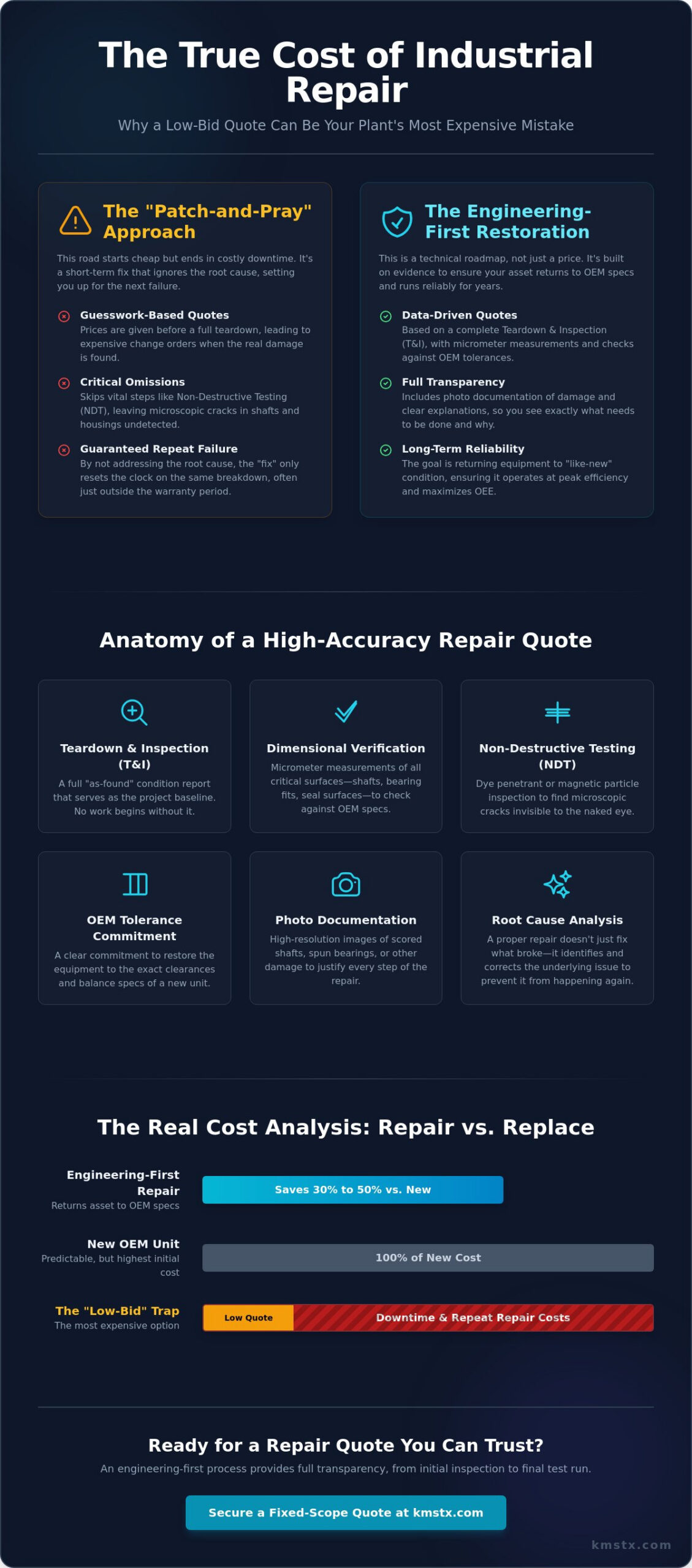
We understand that the real cost of a repair isn’t just the invoice; it’s the reliability of the equipment once it’s back on the shop floor. While refurbishing machinery can save you 30% to 50% compared to buying new units, those savings vanish the moment a “budget” fix leads to a repeat failure. This guide will teach you how to evaluate a technical restoration scope so you can ensure your equipment meets original OEM specifications. We’ll look at the essential components of a transparent, fixed-scope quote and how recent shifts in “Right to Repair” legislation are giving you more control over your maintenance strategy.
Key Takeaways
- Understand why a professional industrial machinery repair quote should serve as a technical roadmap based on a thorough teardown rather than just a surface-level price estimate.
- Identify the critical components of a high-accuracy quote, including dimensional verification of shafts and bearing fits to ensure equipment returns to OEM standards.
- Learn how to apply a strategic framework for calculating Total Cost of Ownership when deciding whether to repair or replace aging gearboxes, pumps, or centrifuges.
- Discover the specific documentation and tolerance commitments you must demand to prevent unforeseen costs and ensure long-term asset reliability.
- Explore how an engineering-first restoration process provides full transparency from the initial inspection to the final test run.
Navigating the Complexity of Industrial Machinery Repair Quotes
When you request an industrial machinery repair quote, you aren’t just asking for a price. You’re asking for a technical roadmap that outlines exactly how a critical asset will be returned to service. Treating a quote like a simple commodity is a mistake that often impacts a plant’s Overall Equipment Effectiveness (OEE) far more than the repair bill itself. A “patch-and-pray” approach might get the shaft spinning again, but technical restoration ensures the root cause of the failure is actually addressed. This distinction is vital for rotating equipment where even a minor misalignment can lead to catastrophic failure within weeks of being put back in the line.
To better understand the level of detail required for a successful equipment restoration, watch this helpful video on the daily maintenance and repair process:
Applying Maintenance Engineering Principles helps managers move away from “blind” quotes that rely on guesswork. Many shops provide fixed-price estimates before they’ve even opened the machine. While these look predictable on paper, they’re often a gateway to expensive change orders once the real damage is uncovered. A high-quality industrial machinery repair quote should be based on empirical data and a thorough teardown rather than optimistic assumptions. This transparency protects your budget and your production schedule.
The Risk of the Low-Bidder in Heavy Industry
The lowest bid often looks great on a spreadsheet but fails in the field. These quotes typically omit Non-Destructive Testing (NDT), such as dye penetrant or magnetic particle inspection, which are vital for finding microscopic cracks in shafts or housings. If a repair fails six months after the warranty expires, the “savings” from that low bid are wiped out by the cost of secondary downtime. A generic, one-page quote that doesn’t detail specific tolerances is a major red flag for any experienced maintenance lead.
Defining OEM Standards in Restoration
Restoring a piece of equipment to “like-new” condition means more than just a fresh coat of paint. It requires using original engineering drawings and verifying material certifications for every replacement part. For those looking for the high-level industrial centrifuge repair Texas facilities provide, the goal is reaching the exact clearances and balance specs the unit had when it first left the factory. Establishing a performance baseline before work starts ensures the final product isn’t just “running,” but operating at peak efficiency.
The Anatomy of a High-Accuracy Repair Quote
A high-accuracy industrial machinery repair quote is built on evidence, not estimates. If a shop hands you a price before they’ve even cracked the case, they’re playing a guessing game with your budget. A professional quote should look more like a forensic report than a simple invoice. It needs to detail exactly what went wrong and what measurements are required to fix it. This level of detail is the cornerstone of effective rotating equipment maintenance, ensuring that the repair doesn’t just treat the symptoms but actually solves the underlying mechanical issues.
To get to this point, a shop must perform dimensional verification on every critical surface. This includes checking shafts for straightness, inspecting bearing fits for egging or wear, and verifying seal surfaces for pitting. We document these findings with high-resolution photography. Seeing a scored shaft or a spun bearing race in a photo provides the necessary justification for component replacement. It removes the “take our word for it” element from the transaction and builds trust between the shop and the plant manager.
The T&I Process: The Foundation of Accuracy
The Teardown and Inspection (T&I) phase is where the real work begins. You should expect an “as-found” condition report that serves as the baseline for the entire project. This report isn’t just a list of parts; it’s a documentation of micrometer measurements, run-out checks, and side-by-side comparisons with OEM tolerances. It’s common for a quote to shift slightly after a unit is fully opened. A shop that’s honest about these potential adjustments is usually more trustworthy than one that hides costs in “miscellaneous shop fees” later in the process.
Material and Component Sourcing
Transparency in parts sourcing is another hallmark of a quality quote. You need to know if you’re getting OEM components or high-quality aftermarket equivalents. Logistics play a huge role here, especially when dealing with industrial machine spare parts Texas supply chains. If a specialized bearing has a six-week lead time, that needs to be highlighted in the quote immediately. Addressing these long-lead items early allows you to manage plant expectations and plan for extended downtime if necessary. If you’re currently staring at a broken unit, seeing how a professional repair shop documents these critical details can help you avoid a “blind” quote that blows your budget.
Evaluating Repair vs. Replacement: A Strategic Cost Analysis
Deciding whether to salvage a piece of rotating equipment or scrap it for a new unit is a high-stakes call for any maintenance lead. It’s easy to get tunnel vision and only focus on the immediate price on an industrial machinery repair quote, but the real math happens when you look at the Total Cost of Ownership (TCO). A new machine often brings along a host of “integration surprises” like modified piping layouts, electrical upgrades, or specialized training for your maintenance team. These hidden expenses can quickly double the actual cost of a new purchase compared to a high-quality restoration.
Refurbishment provides a rare window to actually upgrade your assets. While the machine is stripped down in the shop, you can utilize modern seal designs or advanced wear materials that weren’t standard when the unit was originally manufactured. This approach doesn’t just return the unit to service; it improves the mean time between failures (MTBF). Using a detailed technical quote to justify OPEX spending instead of a massive CAPEX hit is a smart way to manage your budget while maintaining high reliability across your plant floor.
When Restoration Outperforms New Procurement
One of the biggest advantages of restoration is the “drop-in” factor. You keep your existing footprints and piping configurations exactly where they are, avoiding weeks of millwright work and alignment headaches. In many cases, a 30-year-old centrifuge or pump features heavier castings and more robust frames than their modern, lightweight counterparts. These older units often handle vibration and thermal stress better, making them prime candidates for a technical rebuild rather than a replacement with a “value-engineered” modern equivalent.
The “Beyond Economical Repair” (BER) Threshold
Every piece of equipment has a breaking point where the mechanical integrity is too far gone. If a teardown reveals catastrophic housing cracks, warped frames, or severe cavitation that has eaten through the base metal, the unit is likely Beyond Economical Repair (BER). A trustworthy shop will be direct with you when replacement is the safer, more cost-effective option. Leveraging professional industrial gearbox repair Houston services ensures you have a partner who understands when to push for a rebuild and when it’s time to retire the asset for the safety of your operation.
Critical Documentation to Demand in Your Industrial Repair Quote
When you review an industrial machinery repair quote, you should look for absolute transparency. A “lump sum” estimate is a trap. It hides the details you need to hold a shop accountable for the quality of their work. You need a line-by-line breakdown that separates labor hours, specific machining processes, and individual parts costs. This clarity allows you to see exactly where your maintenance budget is going and ensures there aren’t any hidden “miscellaneous” fees tacked on at the end of the project.
Beyond the costs, the quote must commit to specific tolerances and clearance standards. If a shop says they’ll “fix” a bearing fit, ask them to define the final dimension in ten-thousandths of an inch. A professional quote will reference OEM specifications or industry-standard fits. This level of detail protects you from receiving a unit that “runs” but vibrates itself to death within a month because the clearances were just a little too loose. Precision is the only way to ensure long-term reliability for your rotating assets.
The Importance of Dynamic Balancing Reports
Balancing is the single most important factor in the longevity of any rotating machine. You should insist that precision dynamic balancing services Houston standards are explicitly included in your quote. Don’t settle for a vague promise of “balanced equipment.” Demand ISO G-grade balancing specs, typically G2.5 or G1.0 for high-speed assets. A high-quality quote will promise a final balancing report that shows the “as-found” and “as-left” vibration levels. This data validates that the repair was successful before the unit even leaves the shop.
Warranty and Post-Service Support
You need to know exactly what happens if something goes wrong after the unit is back in the line. Differentiate between a “parts-only” warranty and a full technical guarantee that covers the shop’s labor and machining. A strong quote will also outline expectations for field startup assistance. Knowing that you have access to emergency machine repair Gulf Coast support means you won’t be left hanging if a startup issue arises at 2:00 AM on a Tuesday. If you’re looking for a quote that covers every technical detail from teardown to the final test run, you can contact our shop team for a transparent restoration estimate today.
Securing a Quote from Kelsey Machine Services: Our Engineering-First Process
Securing a reliable industrial machinery repair quote shouldn’t feel like a negotiation. At Kelsey Machine Services, we’ve spent 40 years building a reputation for technical precision and engineering-led restoration. We don’t just swap parts; we analyze why they failed in the first place. Because we handle our own custom machining and dynamic balancing in-house, we have total control over the project timeline. This vertical integration means your quote isn’t subject to the whims of outside vendors, allowing us to maintain a fixed-scope approach that protects your plant’s bottom line. We prioritize technical credibility over marketing fluff because we know that a gearbox or pump that stays in the line is the only true measure of our success.
Our legacy in industrial centrifuge repair Texas facilities rely on is built on a foundation of empirical data. When you receive a quote from us, it’s backed by a comprehensive “as-found” report that details every micrometer measurement and run-out check. This transparency ensures that you’re never surprised by hidden costs mid-repair. We understand the day-to-day realities of industrial operations, where a single day of unexpected downtime can cost more than the repair itself. That’s why our quoting process is designed to be a technical consultation rather than a simple price estimate.
The Kelsey Teardown & Inspection Standard
Our proprietary inspection checklists are the heart of our operation. Whether it’s a high-speed centrifuge or a heavy-duty gearbox, every unit undergoes a rigorous T&I process before a final quote is issued. We provide digital documentation and photo evidence for every critical failure point we identify. This isn’t just about justifying a part replacement; it’s about giving you the data you need to make informed maintenance decisions. For critical path machinery, we offer a rapid technical response to ensure your equipment is back in service as quickly as possible without sacrificing OEM-quality standards.
Next Steps for Your Critical Equipment
Getting your equipment back to peak performance starts with a clear assessment. You can ship your units directly to our facility or request a field technician for an on-site evaluation. To help us provide the most accurate industrial machinery repair quote, please have your OEM tags, failure symptoms, and any recent maintenance history ready. We’ll use this information to build a restoration roadmap that addresses the root cause of your mechanical issues. If you’re ready to stop the “patch-and-pray” cycle and move toward precision reliability, you can Request an expert repair quote from Kelsey Machine Services today.
Restoring Reliability to Your Rotating Assets
Getting your facility back to peak OEE starts with looking past the bottom line of an estimate. You now know that a truly accurate industrial machinery repair quote is built on a foundation of empirical teardown data and dimensional verification. By demanding ISO-standard precision and comprehensive T&I reports, you protect your plant from the hidden costs of repeat failures and unverified tolerances. Reliability isn’t an accident. It’s the result of a technical roadmap that prioritizes engineering over shortcuts.
Choosing between restoration and replacement is a strategic decision that impacts your long-term operational budget. With 40+ years of heavy industrial experience, our team focuses on engineering-led solutions that return your equipment to OEM specifications. Whether you need ISO-standard precision machining and balancing or immediate 24/7 emergency field support, we’re here to ensure your rotating assets remain dependable. We focus on the data so you can focus on production.
Don’t leave your equipment’s longevity to chance or “blind” estimates. Take the next step toward a more reliable maintenance strategy by partnering with experts who understand the realities of your shop floor. Request a Technical Repair Quote from Kelsey Machine Services
We look forward to helping you optimize your equipment’s lifecycle and minimize your downtime.
Frequently Asked Questions
How long does it take to get a formal industrial machinery repair quote?
You can typically expect a formal quote within 2 to 5 business days after the unit arrives at our facility. The exact timing depends on the complexity of the teardown and the depth of the inspection required. While a standard pump might be quick, a large centrifuge requires more time for precise dimensional checks and NDT to ensure we don’t miss hidden issues.
Why do repair quotes sometimes increase after the unit is disassembled?
Hidden damage like internal housing cracks or spun bearing bores often remains invisible until the machine is fully opened. An initial estimate is usually based on external symptoms and “best-case” assumptions. Once we see the actual “as-found” condition, we update the quote with empirical data. This ensures the restoration actually solves the root cause rather than just patching a surface-level symptom.
What is the difference between a ‘repair’ and a ‘refurbishment’ in a quote?
A repair usually focuses on fixing a specific failure point to get your equipment back online quickly. A refurbishment is a complete technical restoration where every component is brought back to OEM specifications. Refurbishing can save you 30% to 50% compared to buying new units. It also provides an opportunity to utilize modern seal designs or advanced wear materials that weren’t available when the unit was first built.
Are spare parts included in the initial quote, or are they billed separately?
A professional industrial machinery repair quote should always include a line-by-line breakdown of necessary parts. We identify high-wear items and critical components during the inspection phase. If a specific bearing or seal has a long lead time, we call that out early. This allows you to decide whether to pull from your own spare parts inventory or have us source the components for you.
Can I get a quote for on-site field service instead of shop repair?
Yes, we provide quotes for emergency field support when pulling a unit from the line isn’t feasible. These estimates cover travel, labor hours, and the specialized tools needed for on-site work. However, major machining or precision dynamic balancing usually requires the controlled environment of our shop. This is the only way to meet strict ISO-standard tolerances and ensure a long-term fix for your asset.
How do I compare quotes from two different repair shops effectively?
Look past the total price and compare the technical scope of work. Check if both shops include Non-Destructive Testing and specific dimensional reports. If one quote is significantly lower, they might be skipping the dynamic balancing or using lower-grade bearings. A quality quote provides a roadmap for restoration. It shouldn’t just be a lump sum for labor without explaining what machining is being performed.
What kind of warranty should I expect on a major industrial gearbox repair?
You should expect a technical guarantee that covers both parts and workmanship for at least one year of operation. Be wary of “parts-only” warranties that leave you on the hook for labor costs if the unit fails. A trustworthy shop stands behind their machining and assembly. They should ensure the gearbox meets or exceeds the original factory performance standards before it ever leaves the shop floor.
Does the quote include dynamic balancing for high-speed rotating equipment?
It absolutely should be a standard line item for any high-speed asset like a centrifuge or blower. We include dynamic balancing in every industrial machinery repair quote for rotating equipment because it’s the only way to prevent premature bearing failure. Our quotes specify the ISO G-grade balancing level we will achieve. We also provide a final report that proves the unit is vibration-free before delivery.