Most “quick fixes” in a heavy industrial setting are just expensive Band-Aids that ignore the underlying engineering failures causing your equipment to vibrate itself to death. You’ve likely dealt with the cycle of a critical pump or centrifuge going down, only to find the OEM has a six-month lead time for spare parts. When you finally get it back online, it fails again because the balancing was off or the machining wasn’t precise. It’s a frustrating, costly reality that many plant managers accept as an inevitable part of the job. However, selecting the right industrial repair services for manufacturing plants can change that dynamic entirely.
Key Takeaways
- Learn why engineering-led restoration is more effective than standard part replacement for ending the cycle of repetitive mechanical failures.
- Understand the role of precision machining and scientific tolerances in maintaining the tight clearances required for high-speed rotating assets.
- See how specialized industrial repair services for manufacturing plants can return your critical assets to OEM specifications while avoiding long lead times.
- Discover how to leverage field services and emergency support to minimize the impact of catastrophic equipment failures on your production line.
- Identify the key technical capabilities, such as dynamic balancing and custom machining, that distinguish a true reliability partner from a basic repair shop.
The Role of Specialized Industrial Repair Services in Manufacturing
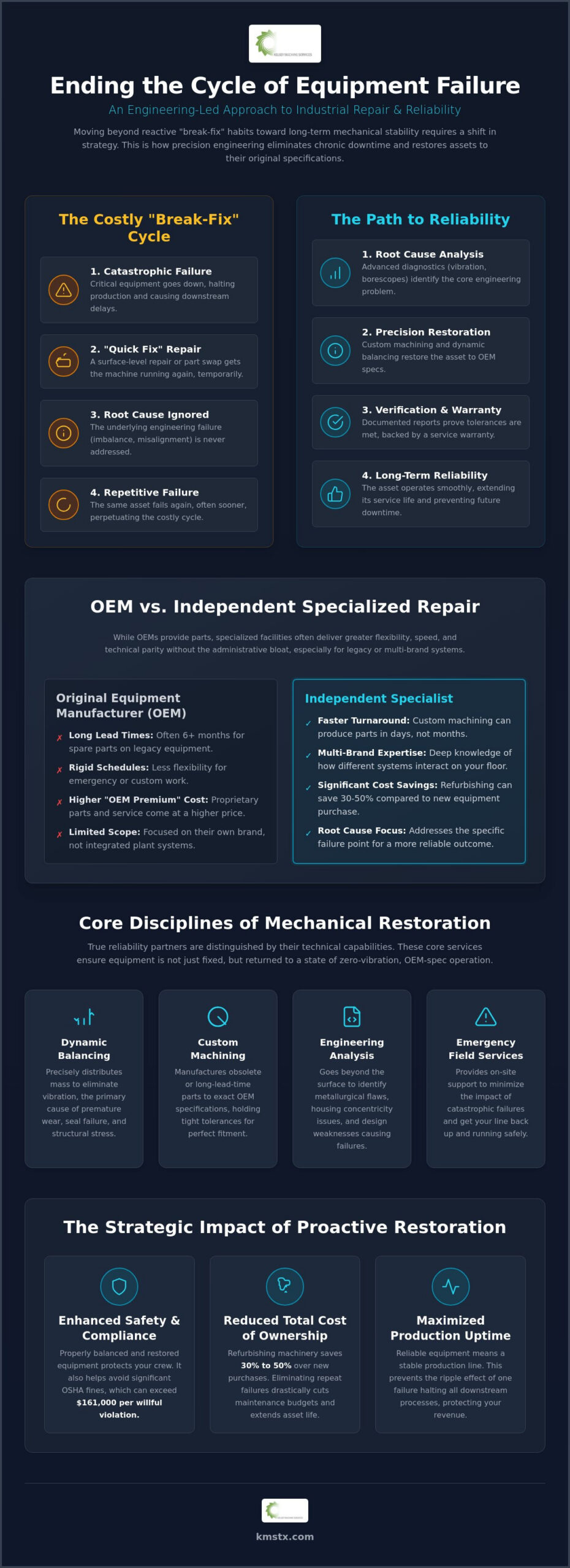
Applying Maintenance engineering principles helps plants move beyond the “run-to-fail” mentality that eats up maintenance budgets. While replacing a whole unit might seem faster on paper, component-level restoration often results in a more reliable machine because you’re addressing the specific root cause of the wear. This approach is the cornerstone of effective industrial repair services for manufacturing plants, focusing on precision over simple part swapping.
To better understand this concept, watch this helpful video showing the day-to-day reality of mechanical restoration:
OEM vs. Independent Specialized Repair Facilities
Original Equipment Manufacturers (OEMs) often have rigid schedules and long lead times for legacy equipment. This “OEM premium” doesn’t always translate to better service; in many cases, it just means waiting months for a proprietary part that could be manufactured in days. Independent facilities with 40+ years of experience provide technical parity without the administrative bloat. When dealing with industrial gearbox repair Houston experts, for example, you benefit from multi-brand expertise that understands how different systems interact on your specific floor. This flexibility is vital when you’re managing a plant with assets from five different manufacturers.
The Impact of Rotating Equipment Failure
When a gearbox starts overheating or a pump shows excessive vibration, it’s a warning shot. If ignored, these thermal and mechanical stresses cascade, leading to shaft misalignment or catastrophic housing failure. In 2026, OSHA’s focus on safety documentation means a failure isn’t just a production loss; it’s a liability. Willful violations can exceed $161,000 per incident. Establishing a baseline for operational stability through expert inspection and rotating equipment maintenance ensures you aren’t just fixing machines, but protecting your crew and your bottom line.
Core Disciplines of Mechanical Equipment Restoration
Mechanical restoration is a precise engineering discipline that goes far beyond basic part replacement. When you’re managing heavy rotating assets, the difference between a successful repair and a repetitive failure often comes down to the shop’s ability to hold tight tolerances. Effective rotating equipment maintenance requires a scientific approach where every measurement is verified against OEM specifications. This level of technical rigor is what separates high-tier industrial repair services for manufacturing plants from general machine shops that lack specialized experience with high-speed centrifuges or multi-stage pumps.
Diagnostics play a critical role before a single chip is cut. Utilizing advanced vibration analysis and borescope inspections allows technicians to identify the root cause of a failure rather than just treating the symptoms. Whether it’s a metallurgical flaw in a shaft or a housing that’s lost its concentricity, understanding the “why” behind the breakdown is essential. Adhering to OSHA safety standards during these diagnostic and repair phases ensures that the equipment isn’t just functional, but safe for your operators to stand next to once it’s back on the line.
Precision Machining and Component Fabrication
Restoring shaft journals and housing bores to exact specifications is the bread and butter of mechanical restoration. Over time, friction and heat can cause “egg-shaping” in bores or significant wear on bearing fits. Custom machining allows us to build up these surfaces and machine them back to a standard size, often using CNC technology to replicate obsolete or hard-to-find parts that the OEM no longer supports. During this process, verifying the metallurgical integrity of the base metal ensures the repair will hold up under the extreme stresses of 24/7 operation. If you’re dealing with a legacy asset that’s showing its age, custom machining can often extend its service life by another decade.
The Science of Dynamic Balancing
Unbalanced mass in a rotor creates centrifugal forces that increase exponentially with speed. Even a few grams of imbalance can generate hundreds of pounds of force on your bearings, leading to rapid heat buildup and premature failure. Dynamic balancing is the correction of mass distribution within a rotor so that the combined centrifugal forces are reduced to an acceptable level. By utilizing specialized dynamic balancing services Houston facilities provide, plants can achieve near-zero vibration levels. This precision significantly reduces the load on internal components, directly translating to a longer mean time between failures (MTBF) for your most critical manufacturing assets.
Engineering Standards for High-Speed Asset Refurbishment
High-speed rotating assets don’t give you much room for error. When a centrifuge bowl is spinning at several thousand RPM, even a minor oversight in reassembly can lead to a catastrophic event. This is why top-tier industrial repair services for manufacturing plants rely on strict engineering standards rather than shop-floor guesswork. Every project must begin with a complete teardown and non-destructive testing (NDT) to identify subsurface fatigue or stress cracks that aren’t visible to the naked eye. Using dye penetrant or magnetic particle inspection at this stage prevents you from machining a part that’s already structurally compromised.
Following a successful inspection, the reassembly protocols become the primary focus. Ensuring perfect shaft alignment and seal integrity is non-negotiable for long-term reliability. If the seals aren’t seated correctly or the alignment is off by even a few thousandths of an inch, the resulting heat and vibration will destroy your new bearings in weeks. Modern industrial repair services for manufacturing plants integrate these verification steps into every stage of the refurbishment process to ensure the asset meets or exceeds its original design intent.
Centrifuge and Decanter Specialized Services
Centrifuge and decanter repair is particularly demanding due to the abrasive nature of the materials they process. Technicians must carefully address wear patterns in bowl assemblies and the specialized tiling on conveyor scrolls. It isn’t just a matter of cleaning; it involves restoring hydraulic drives and complex planetary gear systems to their original torque ratings. Because of the extreme centrifugal forces involved, industrial centrifuge repair Texas facilities must utilize specialized balancing rigs. These rigs are designed to handle the unique geometry and high-speed requirements of decanter rotors, ensuring a smooth, zero-vibration operation once the unit returns to the plant.
Industrial Gearbox Failure Analysis
For heavy-duty gearboxes, the refurbishment process starts with a deep failure analysis. During the initial inspection, we look for specific indicators like pitting, spalling, and gear tooth fatigue. These signs tell a story about whether the unit failed due to contaminated lubrication, chronic overloading, or simple end-of-life wear. The process for industrial gearbox repair Houston involves a methodical cycle of chemical cleaning, component replacement, and final load testing. We also verify lubrication system efficiency post-repair; a rebuilt gearbox is only as good as the oil flow reaching its critical mesh points.
Implementing a Proactive Maintenance and Repair Strategy
Moving toward engineered reliability requires a partner that understands the logistics of a working plant. It’s one thing to have a machine shop; it’s another to have a service provider that can integrate with your existing maintenance team to provide documented repair reports and actionable data. This collaboration ensures that every repair isn’t just a one-off fix but a step toward extending the overall lifespan of your rotating assets.
Field Services and On-Site Troubleshooting
When a critical blower or pump fails in the middle of a shift, you don’t always have the luxury of shipping it to a shop for a two-week turnaround. This is where emergency machine repair Gulf Coast teams become essential for maintaining production quotas. On-site troubleshooting allows technicians to use real-time diagnostics to decide if a machine can be fixed in place or if it requires full shop-based restoration. Utilizing 24/7 emergency support ensures that your facility has access to expert help exactly when the downtime clock starts ticking. If you’re facing a sudden mechanical failure, you can reach out for immediate field support to get your line back in operation.
Strategic Spare Parts Inventory Management
Lead times for OEM parts can often stretch into months, which is unacceptable for critical infrastructure. A smart industrial machine spare parts Texas strategy involves more than just keeping a few boxes on a shelf. It requires stocking high-wear components like specialized seals, bearings, and gearbox internals that are verified for metallurgical integrity. Evaluating the quality of these parts is vital; sometimes an aftermarket part with better material specifications can outperform the original. By leveraging a provider with a large inventory of spare parts, you can bypass the OEM waiting game and reduce your total downtime during both planned and unplanned outages.
Selecting a Reliability Partner for Manufacturing Stability
Transparency is a non-negotiable part of this relationship. A trustworthy partner provides detailed inspection reports, metallurgical verification, and final testing data before the equipment ever leaves their floor. You shouldn’t have to guess about the condition of your internal components or the quality of the machining work performed. If a shop can’t provide a documented trail of their process, they aren’t a reliability partner; they’re a liability.
Evaluating Technical Credentials and Facilities
The Kelsey Machine Services Advantage
Kelsey Machine Services (KMS) has built a legacy of scientific precision over 40+ years of industrial experience. We don’t just swap parts; we provide high-level engineering alternatives to the OEM that prioritize long-term stability over quick fixes. Our facility is equipped to handle the most demanding technical restorations, from complex hydraulic drive repairs to precision dynamic balancing of high-speed rotors. We understand the day-to-day realities of industrial operations, which is why we back our technical expertise with 24/7 emergency support and a large inventory of spare parts to keep your downtime to an absolute minimum.
If you’re tired of repetitive failures and long OEM wait times, it’s time to shift your strategy toward engineered reliability. You can take the next step by consulting with our engineering team to plan your next major overhaul or to address a chronic equipment issue that’s been dragging down your production quotas. Let’s work together to restore your manufacturing assets to their full potential.
Moving Toward Engineered Reliability
Maintaining mechanical stability in a high-speed production environment requires more than just reactive fixes. It demands a commitment to precision engineering and a deep understanding of how rotating assets fail. By prioritizing component-level restoration and adhering to scientific tolerances through dynamic balancing and custom machining, you can significantly extend the service life of your equipment. Effective industrial repair services for manufacturing plants bridge the gap between catastrophic downtime and consistent operational uptime.
When you partner with a team that has 40+ years of heavy industrial expertise, you gain access to the specialized tools and field support necessary to keep your plant running. Whether it’s a planned overhaul or a 24/7 emergency response for a critical failure, having a technical authority on your side makes all the difference. Don’t let repetitive failures or long OEM lead times dictate your production schedule.
Consult with a Kelsey Machine Services Expert for Your Repair Needs to restore your assets to OEM specifications and secure your facility’s long-term reliability. Your equipment is the backbone of your operation; it’s time to treat it with the technical rigor it deserves.
Frequently Asked Questions
What is the typical turnaround time for industrial gearbox repair?
Turnaround times for gearbox repair vary based on the extent of gear tooth damage and bearing availability, but most shop-based restorations are completed significantly faster than OEM lead times. While a simple bearing and seal swap might take a few days, a full refurbishment involving custom machining can take longer. We focus on getting the unit back to specifications without the months of waiting often associated with factory service centers.
Can decanter centrifuges be repaired on-site at the manufacturing plant?
While field technicians can handle initial diagnostics and minor component swaps on-site, major decanter centrifuge overhauls usually require a specialized shop environment. This is because high-speed rotors need to be placed on a dynamic balancing rig to ensure zero-vibration operation. Attempting a full mechanical restoration on the plant floor often lacks the precision machining tools and controlled conditions necessary for long-term reliability in industrial repair services for manufacturing plants.
How does dynamic balancing improve the lifespan of rotating equipment?
Dynamic balancing extends equipment life by eliminating the centrifugal forces that cause excessive vibration and heat buildup. When a rotor is perfectly balanced, the load on bearings and mechanical seals is minimized, which directly prevents the fatigue and premature failure of these critical internal components. Reducing vibration levels to near-zero ensures that the machine operates within its intended engineering parameters, significantly increasing the mean time between failures.
Do independent repair services provide warranties equivalent to the OEM?
Independent repair facilities typically offer warranties that match or exceed OEM standards, backed by detailed documentation of the restoration process. Because these shops rely on their technical reputation, the warranty is often supported by rigorous final load testing and vibration analysis data. You should always verify the specific terms, but a high-level engineering partner provides the same peace of mind as the factory while offering more personalized technical support.
What are the most common causes of industrial pump failure in manufacturing?
The most frequent causes of pump failure in a manufacturing setting include shaft misalignment, bearing fatigue, and mechanical seal leaks often caused by cavitation. If the pump isn’t properly aligned with the motor, the resulting stress destroys internal fits and causes repetitive breakdowns. Regular monitoring of thermal signatures and vibration levels can catch these issues early, allowing for a planned repair before a catastrophic housing or shaft failure occurs.
How do you handle obsolete parts for older manufacturing machinery?
Obsolete parts are managed through custom machining and reverse engineering to replicate the original component’s metallurgy and dimensions. When the OEM no longer supports a legacy machine, we use CNC technology to fabricate new shafts, gears, or sleeves from scratch. This capability allows manufacturing plants to keep older, reliable assets in service for decades longer than the original manufacturer intended, avoiding the massive capital expense of a total unit replacement.
Is 24/7 emergency support available for all types of rotating equipment?
Yes, 24/7 emergency support is available for critical rotating assets including gearboxes, centrifuges, pumps, and blowers to minimize the impact of unplanned downtime. Field service teams are equipped to provide real-time diagnostics and on-site troubleshooting to determine the fastest path to restoration. This rapid response is a core part of industrial repair services for manufacturing plants, ensuring that production quotas are protected even during a sudden mechanical failure.
What technical documentation should I expect after a major equipment repair?
After a major repair, you should receive a comprehensive technical package that includes initial inspection findings, non-destructive testing results, and final balancing certificates. This documentation provides a documented history of the asset’s restoration and verifies that all work meets specific engineering tolerances. Having these reports on file is essential for your maintenance records and helps in future predictive maintenance scheduling by establishing a new operational baseline for the machine.