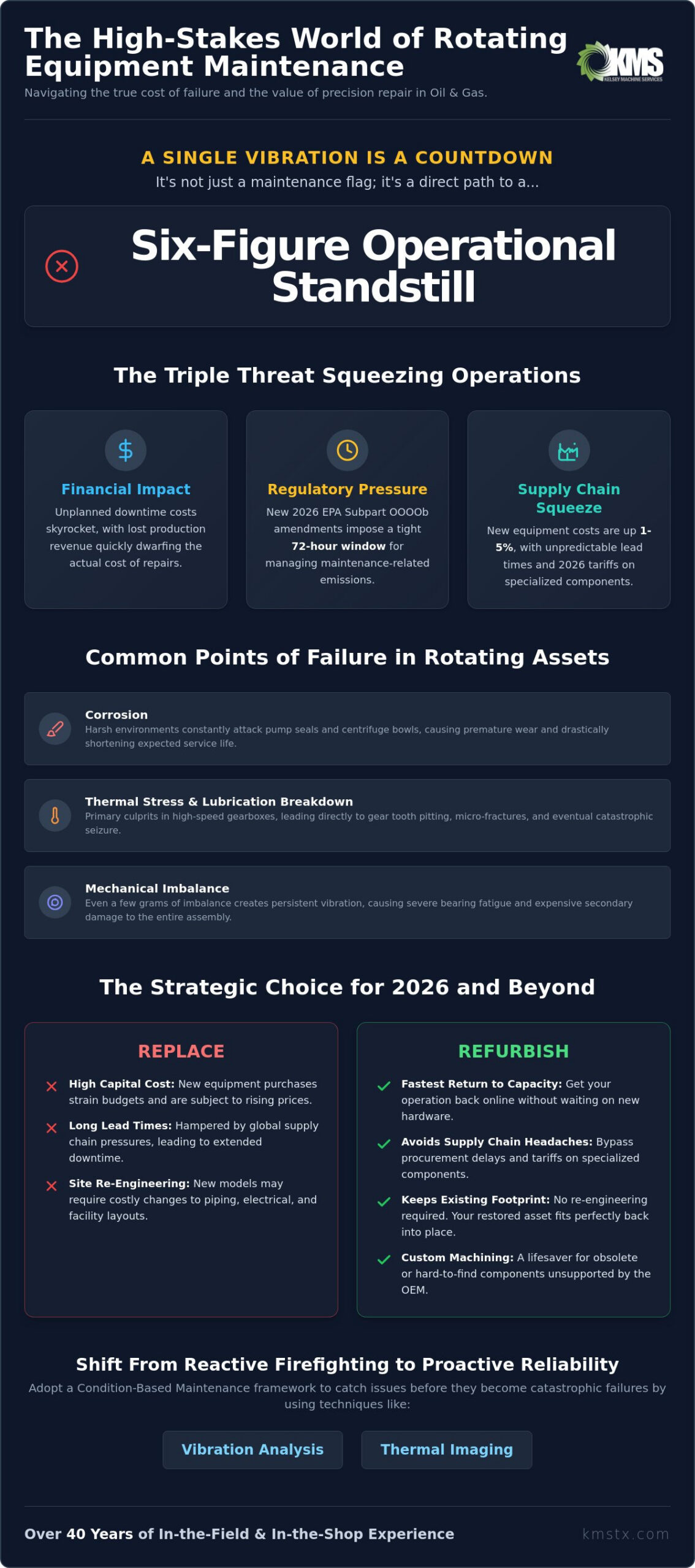
A single vibration in a high-speed centrifuge isn’t just a maintenance flag; it’s a countdown to a six-figure operational standstill. You’ve likely felt the pressure of keeping aging infrastructure online while hardware costs climb and new regulations like the 2026 EPA Subpart OOOOb amendments tighten the window for necessary maintenance. Finding reliable oil and gas equipment repair services that actually understand the tight tolerances of a specialized gearbox or a high-speed blower is becoming increasingly difficult. It’s a common frustration when poor balancing leads to premature failure just months after a supposed fix.
We’ve spent over 40 years in the shop and the field, so we understand that “good enough” doesn’t cut it for critical rotating assets. This guide explains how precision engineering, dynamic balancing, and expert refurbishment can push your equipment’s lifecycle far beyond the original OEM expectations. You’ll learn about the technical realities of restoring asset integrity and why verified operational stability is the only way to ensure your facility handles 24/7 demands without another middle-of-the-night emergency.
Key Takeaways
- Learn how to evaluate the true cost of downtime by weighing lost production against the long-term ROI of high-precision component restoration.
- Understand the technical stages of professional oil and gas equipment repair services, including non-destructive inspection and custom machining for exact tolerances.
- Discover specialized refurbishment techniques for industrial centrifuges and heavy-duty gearboxes that can return aging machinery to peak operational stability.
- Identify how to build a condition-based maintenance framework using vibration analysis and thermal imaging to prevent catastrophic failures.
- See how a 24/7 rapid-response partner with 40 plus years of field experience can support critical infrastructure during midstream or downstream emergencies.
The High Stakes of Rotating Equipment Maintenance in Oil and Gas
In the oilfield, rotating assets aren’t just parts of the process; they’re the heartbeat of the entire operation. Whether it’s a high-speed centrifuge separating solids or a heavy-duty gearbox driving a pump, these machines work in some of the harshest conditions on the planet. When one of these critical components falters, the ripple effect moves through the production chain immediately. Relying on expert oil and gas equipment repair services is no longer just a line item in the budget; it’s a strategic necessity to prevent the kind of catastrophic failure that stalls a site for weeks.
To better understand the scope of these services, watch this helpful video:
Transitioning from a reactive “firefighting” mode to a structured reliability program is the only way to stay ahead of these risks. Many facilities are shifting toward Condition-based maintenance to catch issues before they turn into headlines. By monitoring the health of your assets in real-time, you can schedule repairs during planned outages rather than reacting to a midnight blowout. This proactive approach relies heavily on technical expertise to interpret data and execute precision repairs that meet or exceed original specifications.
Common Failure Modes in O&G Rotating Assets
Corrosive environments are a constant threat, often eating away at pump seals and centrifuge bowls long before their expected service life ends. In high-speed gearboxes, thermal stress and lubrication breakdown are the primary culprits for gear tooth pitting and eventual seizure. We also see a high volume of bearing fatigue caused by persistent mechanical imbalance. If a rotor is out of balance by even a few grams, the resulting vibration can shake a machine to pieces over time, leading to secondary damage that’s much more expensive to fix than a simple rebalance.
Why Industrial Repair Trumps Replacement in 2026
Choosing to refurbish rather than replace is often the fastest way to get back to full capacity. New equipment procurement is currently hampered by supply chain pressures and rising hardware costs, driven by 2026 tariffs on specialized components. Technical refurbishment allows you to keep your existing footprint without the headache of re-engineering your piping or electrical layouts for a different model. For those running older sites, custom machining is a lifesaver for obsolete or hard-to-find components that the original manufacturer doesn’t support anymore. It’s about keeping the iron moving without waiting six months for a crate to arrive from overseas.
Specialized Repair Services for Critical Oilfield Machinery
General oilfield tools like tongs and slips are vital, but they don’t require the same level of engineering precision as a high-speed decanter centrifuge or a multi-stage compressor. High-tier oil and gas equipment repair services focus on these complex rotating assemblies where tolerances are measured in thousandths of an inch. When a critical separator or hydraulic drive starts showing signs of wear, you aren’t just looking for a welder. You need a machinist who understands how equipment reliability matters to the total output of your facility.
Industrial Centrifuge and Separator Refurbishment
Gearbox and Power Transmission Restoration
Heavy-duty gearboxes from brands like Falk or Lufkin are built to last decades, provided they are maintained correctly. A diagnostic teardown often reveals that a simple bearing replacement isn’t enough to solve the root cause of a failure. We look at re-shimming for proper backlash and restoring the gear tooth profile to ensure efficient power transfer. This level of industrial gearbox repair Houston ensures that your drive systems don’t become the weak link in your production chain.
Midstream operations rely heavily on high-performance pump and compressor overhauls to keep product moving through the line. Whether it’s a blower system for vapor recovery or a hydraulic drive for a specialized winch, these components need a steady hand during refurbishment. With over 40 years of experience, we’ve seen how a small oversight in a pump seal or a compressor valve can lead to a site-wide shutdown. Our in-house custom machining capabilities allow us to fabricate parts that are no longer available, keeping your legacy equipment running long after the manufacturer has moved on.
The Technical Repair Process: Engineering Precision for Reliability
Once the components are inspected and the plan is set, we move into precision restoration. This often involves custom machining to bring worn surfaces back to their original dimensions or fabricating new parts entirely when the supply chain falls short. After the components are ready, the assembly moves to the most critical stage for high-RPM machinery: dynamic balancing. Finally, the equipment is reassembled and undergoes rigorous load testing. We verify that everything runs at the correct temperature and vibration levels under operational conditions before the unit leaves the shop. You don’t want to find out a pump seal is leaking when it’s already bolted down at a remote site.
The Role of Precision Machining in Equipment Repair
In an era where OEM lead times for a new pump shaft can stretch into months, in-house machining is a critical asset. We utilize CNC technology to fabricate sleeves, bushings, and shafts that meet or exceed original specs. It’s not just about making a part that fits; it’s about restoring the exact tolerances required for high-speed rotating assemblies to run cool and quiet. Whether it’s a specialized hydraulic drive or a massive centrifuge rotor, precision machining allows us to control the quality and the timeline, getting your iron back in the field faster.
Dynamic Balancing: The Key to Operational Longevity
Mechanical balance is non-negotiable for any equipment spinning at high RPMs. Even a few grams of imbalance at high speeds creates centrifugal forces that hammer away at your bearings and seals. This vibration-related wear is the leading cause of premature failure in the oilfield. By utilizing dynamic balancing services Houston operators can trust, we eliminate that hidden stress. It’s the difference between a machine that lasts two years and one that lasts ten. We ensure every rotor and gear set is balanced to strict standards, protecting your investment and ensuring your 24/7 operations stay stable.
Preventive Maintenance Strategies for the Modern Oilfield
“Firefighting” is a term we use for reactive maintenance, and it’s the most expensive way to run a site. When you’re constantly chasing blowouts, you’re losing money on labor, parts, and production. A modern reliability strategy moves the needle from “fix it when it breaks” to a condition-based maintenance (CBM) framework. This isn’t about doing maintenance more often; it’s about doing it at the right time. By integrating high-quality oil and gas equipment repair services into a predictive schedule, you can address minor wear during a planned turnaround rather than during a peak production window.
Thermal imaging and regular inspections are part of this, but the real data comes from how the machine moves. If you can see a heat signature rising in a gearbox housing, you know you’ve got a lubrication or friction issue before the gears start grinding. Managing this data allows your team to make informed calls on when to pull a unit for refurbishment. It’s about having the technical confidence to run your equipment to its safe limit without crossing into the “catastrophic failure” zone.
Vibration Analysis and Diagnostic Monitoring
Using data to predict failure is the gold standard for rotating assets. Every machine has a unique vibration signature. When that signature changes, it tells a story. A spike at one frequency might mean a simple imbalance, while a different pattern indicates a bearing race is starting to pit. Differentiating between these issues is key because it determines if you need a quick field fix or a full shop overhaul. Catching these signatures early prevents the secondary damage that happens when a vibrating shaft destroys its own seals. For a deeper look at how to set up these protocols, check our rotating equipment maintenance guide.
Strategic Spare Parts Procurement
Even the best maintenance plan can’t stop every failure. When a seal blows or a bushing wears out, the clock starts ticking. The biggest bottleneck in repair is often waiting on a piece of iron that’s sitting in a warehouse halfway across the world. You need to balance your on-site inventory with a vendor who keeps a deep stock of critical components. Having a partner with a large, ready-to-ship inventory can turn a week-long shutdown into a 24-hour fix. You can see how we manage this in our industrial machine spare parts Texas procurement guide.
Training your field teams to spot early warning signs, like a new rattle or a slight change in operating temperature, is your first line of defense. If your operators know what “normal” looks and sounds like, they become your most valuable diagnostic tools. If you’re ready to move away from reactive repairs and toward a reliable maintenance partner, explore our full range of 24/7 support at KMS Technologies.
Partnering for Reliability: 24/7 Field Service and Support
Deciding between on-site troubleshooting and a full-service shop restoration depends on the failure’s severity and the environment. Field technicians can often handle seal replacements or minor adjustments to hydraulic drives and blowers right on the pad. However, if the inspection reveals structural fatigue or severe rotor imbalance, pulling the unit to a controlled shop environment is the only way to ensure a warranty-backed repair. This flexibility allows you to keep your infrastructure moving while maintaining the high safety standards required in 2026. Every repair we handle is backed by a commitment to technical precision, giving you peace of mind that the asset won’t fail again the moment it’s put back under load.
24/7 Emergency Field Response
Dispatching technicians round-the-clock isn’t just a convenience; it’s a lifeline for operations facing steep downtime penalties. Our team focuses on minimizing the window of risk by providing rapid-response repairs for pumps, blowers, and hydraulic drives directly at your facility. By following our emergency machine repair Gulf Coast protocols, we ensure that every field intervention is documented and technically sound, regardless of the hour. We don’t just patch the problem; we stabilize the asset so you can maintain production continuity.
The Kelsey Machine Services Standard
Accountability is a lot easier to find in a family-owned operation where technical heritage is a point of pride. We don’t just “fix” equipment; we provide documented performance data to prove that your rotating assets are back to peak efficiency. This commitment to precision has allowed us to support national oil and gas operations from our specialized facilities since 1981. We understand the day-to-day realities of industrial operations, from the pressure of regulatory audits to the need for 24/7 reliability. When you partner with us, you’re getting a field expert who knows that your uptime is the only metric that truly matters.
Securing Your Site’s Operational Future
Maintaining rotating asset reliability is a constant battle against friction, corrosion, and mechanical stress. The difference between a decade of stable service and a sudden, expensive breakdown often comes down to the precision of your dynamic balancing and the quality of your custom machining. By moving toward a condition-based maintenance framework, you can stop “firefighting” and start making data-driven decisions that protect your bottom line. When you prioritize technical restoration over temporary patches, you’re investing in the long-term integrity of your entire facility.
Kelsey Machine Services brings 45 years of industrial restoration experience to every project, ensuring your gearboxes, centrifuges, and pumps meet strict engineering tolerances. We understand that downtime isn’t just an inconvenience; it’s a massive financial risk. That’s why we maintain a comprehensive spare parts inventory and provide 24/7 emergency response for critical infrastructure. If you’re ready to stabilize your operations with a partner who understands the high stakes of the oilfield, request a quote for expert oil and gas equipment repair services today. Let’s keep your iron moving and your production on schedule.
Frequently Asked Questions
What types of oil and gas equipment can be repaired instead of replaced?
Most heavy rotating assets like industrial centrifuges, gearboxes, pumps, compressors, blowers, and hydraulic drives are prime candidates for repair. Instead of waiting on long OEM lead times, these components can be restored to original specifications through precision machining and component replacement. This approach is especially effective for aging infrastructure where you need to maintain the existing footprint while restoring operational integrity.
How long does a typical industrial centrifuge refurbishment take?
A standard refurbishment typically takes between two to four weeks, though the timeline depends on the extent of bowl wear and the specific parts required. Emergency repairs can often be expedited if the core components are structurally sound and only require bearing or seal replacements. We use our extensive spare parts inventory to minimize these windows and get your solids control equipment back on site as fast as possible.
What is the importance of dynamic balancing for oilfield rotating assets?
Dynamic balancing is critical because it eliminates the centrifugal forces that cause excessive vibration, which is the primary killer of bearings and seals. For high-speed machinery used in oil and gas equipment repair services, even a tiny imbalance can lead to catastrophic failure under load. Proper balancing ensures the unit runs cool and stable, which significantly extends the time between your scheduled service intervals.
Do you provide 24/7 emergency field services for oil and gas operations?
Yes, we provide 24/7 emergency field service response to address critical infrastructure failures that can’t wait for a scheduled turnaround. Our technicians are dispatched to handle on-site troubleshooting and repairs for pumps, blowers, and hydraulic drives. This round-the-clock support acts as a lifeline for midstream and downstream operations where every hour of downtime translates to a significant loss in production revenue.
Can you fabricate custom parts for obsolete industrial machinery?
We can fabricate custom shafts, sleeves, and bushings using our in-house precision machining capabilities when OEM parts are no longer manufactured. This is a common necessity for legacy gearboxes and pumps that have been in service for decades. By utilizing CNC technology, we ensure these custom components meet or exceed the original manufacturer’s tolerances, keeping your older assets operational without needing a full system redesign.
What is the difference between a basic repair and a technical refurbishment?
A basic repair usually focuses on fixing a specific broken component to get the machine spinning, while a technical refurbishment is a comprehensive restoration of the entire assembly. Refurbishment includes a full teardown, non-destructive inspection, precision machining of all wear surfaces, and dynamic balancing. This process effectively resets the lifecycle of the asset, often providing much better reliability than a simple “patch” repair in harsh oilfield environments.
How does vibration analysis help in preventing equipment failure?
Vibration analysis allows us to identify specific mechanical issues like bearing pits, gear tooth wear, or misalignment before they cause a total shutdown. By monitoring the vibration signature of your oil and gas equipment repair services, we can differentiate between a simple balance issue and a more serious structural problem. This data-driven approach is the foundation of a condition-based maintenance strategy that prevents unplanned downtime and catastrophic site failures.
Are your repair services backed by a warranty for oil and gas equipment?
All our shop repairs and refurbishments are backed by a warranty to ensure your heavy industrial assets perform reliably after being returned to service. We stand behind our 45 years of experience and our rigorous, documented load testing results. This guarantee provides peace of mind for site managers who need to know their critical machinery won’t fail the moment it’s put back into 24/7 production.