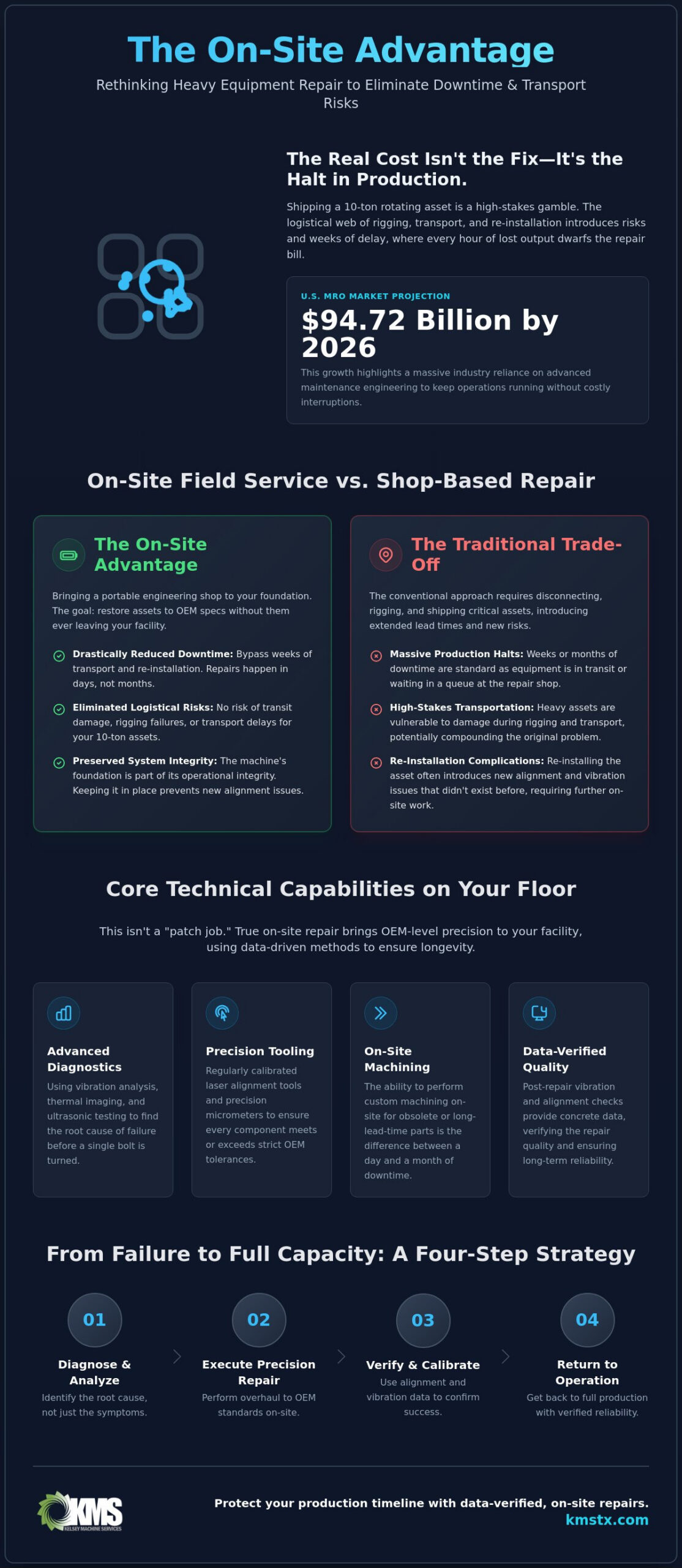
Shipping a 10-ton rotating asset across the state isn’t just a logistical headache; it’s a high-stakes gamble with your production timeline. You’ve likely felt the pressure of unplanned downtime where every hour of lost output dwarfs the actual cost of the fix. It’s common to be skeptical of on-site industrial equipment repair if you’ve seen “field patches” that fail to meet OEM standards. With the U.S. maintenance and operations market projected to reach $94.72 billion in 2026, the technology behind field service has evolved into a precision-first discipline that rivals shop-based overhauls.
We’re here to show you how precision engineering restores critical assets like gearboxes, pumps, and centrifuges to factory specs without them ever leaving your facility. This guide covers the technical methods used to minimize downtime while ensuring equipment longevity through data-verified results. We’ll also discuss how to stay compliant with 2026 OSHA heat injury prevention rules during these intensive on-site repairs. By the end, you’ll know exactly how to verify repair quality using vibration and alignment data so you can get back to full production with confidence.
Key Takeaways
- Learn why on-site industrial equipment repair is the most efficient strategy for restoring heavy rotating assets without the logistical risks of transport.
- Identify the specialized mobile infrastructure and precision engineering tools required to meet strict OEM tolerances right on your shop floor.
- Evaluate the technical and financial trade-offs between field service and traditional shop-based restoration to protect your production timeline.
- Discover how to utilize vibration data and alignment checks to verify repair quality and ensure the long-term reliability of your machinery.
- Understand the essential site preparation and safety protocols needed to facilitate a seamless transition from failure to full operational capacity.
What is On-Site Industrial Equipment Repair?
In the heavy industrial world, on-site industrial equipment repair is the practice of performing complex mechanical overhauls and precision engineering directly at the machine’s foundation. Unlike traditional shop-based models that require disconnecting, rigging, and transporting 10-ton assets, this approach brings specialized tooling and field engineers to your facility. It’s a strategic shift designed to bypass the logistical risks and extended lead times associated with off-site restoration. The primary goal is simple: restore the asset to OEM specifications while keeping it exactly where it belongs. When you’re dealing with a decanter centrifuge or a multi-stage pump, the foundation is part of the machine’s operational integrity. Moving it often creates new alignment issues you didn’t have before.
The Critical Role of Field Service in Modern Industry
Field service has evolved significantly from basic troubleshooting and “grease-and-go” maintenance. With the U.S. MRO market expected to hit $94.72 billion in 2026, the reliance on advanced field engineering has never been higher. Modern lean manufacturing leaves no room for the weeks of downtime often required for shop turnarounds. For industries like wastewater treatment or energy production, a failed blower or high-speed gearbox can halt operations entirely. Applying Maintenance Engineering Principles in the field allows teams to diagnose and fix issues like bearing failure or shaft misalignment in real time. This keeps production lines moving and meets the 58.10% market demand for on-site maintenance solutions seen in 2025.
Defining the Scope: Rotating Equipment vs. Static Assets
It’s vital to distinguish between simple structural repairs and the high-complexity work required for rotating assets. We aren’t talking about patching a tank or welding a bracket. This guide focuses on critical machinery such as centrifuges, compressors, pumps, and hydraulic drives. These machines operate under high stress and tight tolerances. A true engineering-led restoration goes far beyond a temporary “patch job” by utilizing dynamic balancing and custom machining to solve the root cause of vibration or heat. Integrating rotating equipment maintenance into your field strategy ensures that when a technician opens a gearbox or pulls a pump impeller on your floor, they’re working to the same tolerances you’d expect from a factory floor. This level of on-site industrial equipment repair protects the long-term health of your most expensive assets without the risk of transit damage.
Core Technical Capabilities of Field Repair Teams
High-level on-site work isn’t about having a few wrenches in a toolbox; it requires a mobile infrastructure that functions as a portable engineering shop. To maintain OEM tolerances outside of a controlled factory floor, technicians use laser alignment tools and precision micrometers that are regularly calibrated. This ensures that a rebuilt gearbox or pump performs exactly as the manufacturer intended. If a critical component is obsolete or has an extreme lead time, the ability to perform custom machining becomes the difference between a minor delay and a month of lost production. With the U.S. MRO market expected to reach $94.72 billion in 2026, the demand for this level of on-site industrial equipment repair continues to grow as facilities look for ways to bypass long factory lead times.
Speed is the priority during a failure, but accuracy can’t be sacrificed. Establishing the Core Technical Capabilities of Field Repair Teams involves a deep understanding of hydraulics, electrical systems, and mechanical tolerances. This expertise allows for 24/7 emergency response that actually solves the problem rather than just providing a temporary fix. If you’re managing a facility where every minute of downtime is a massive expense, having a partner who can handle these technical complexities on-site is a major operational advantage.
Advanced Diagnostics and Root Cause Analysis
Before any bolts are turned, we use vibration analysis to “listen” to the machine. This identifies specific bearing or gear mesh issues that aren’t visible to the naked eye. We also utilize thermal imaging and ultrasonic testing to find hot spots or internal leaks on the plant floor. It’s about finding the root cause so the repair actually sticks and the failure doesn’t repeat itself two weeks later. This data-driven approach is essential for high-speed assets like blowers and centrifuges.
Mechanical Overhauls and Component Replacement
Once the problem is identified, the on-site teardown begins. This involves cleaning and inspecting every component of the rotating assembly to ensure no hidden damage exists. Having access to a robust industrial machine spare parts inventory is essential here. It allows for the immediate replacement of seals, bearings, and gears, which is the backbone of successful on-site industrial equipment repair. This process ensures that assets like compressors and hydraulic drives are returned to service with the same reliability as a new unit.
On-Site Field Service vs. Shop-Based Repair
Choosing between field service and a shop overhaul often comes down to a balance of risk and time. While a shop offers a controlled environment, the clock starts ticking the moment you begin the teardown for transport. In 2025, on-site maintenance accounted for 58.10% of the industrial market, largely because plant managers can’t afford the “dead time” of transit. Beyond just the schedule, there’s a technical phenomenon known as the foundation effect. A high-speed blower or pump might test perfectly on a level shop floor; however, once it’s bolted back onto its aging concrete pad and connected to stressed piping, the vibration often returns. Performing on-site industrial equipment repair allows technicians to account for these real-world variables, ensuring the machine actually works in its specific environment. Deciding which path to take requires a clear framework. You should opt for on-site service when the asset is critical to immediate production, weighs over five tons, or requires precision alignment to fixed piping.
Evaluating the Logistics and Transportation Risks
The true cost of a shop repair isn’t just the labor; it’s the rigging, the specialized freight permits, and the inherent risk of secondary damage. Every time a 10-ton rotor is lifted and moved, you’re risking bearing brinelling or shaft distortion. These logistical hurdles often add days or weeks to a project that could have been handled in-place. By choosing an on-site industrial equipment repair, you eliminate the need for heavy-haul trailers and the potential for transit-related failures that aren’t covered by standard warranties. The risk of a crane mishap during loading or a strap failure on the highway is a variable that most plant managers would prefer to avoid entirely.
When In-Place Repair is the Superior Engineering Choice
There are times when field work isn’t just a convenience; it’s the better engineering path. Testing a machine under real-world load and temperature conditions provides data you simply can’t replicate in a shop. This is especially true for assets like industrial centrifuges, where the interaction between the bowl, the base, and the process fluid is critical. Aligning the machinery to its actual piping and electrical connections prevents the “piping strain” that often leads to premature seal failure. Developing a robust On-Site Repair Strategy ensures that the asset is optimized for the specific stresses of your facility, not just a theoretical ideal. This approach allows for immediate verification of the repair through live vibration monitoring as the machine returns to full speed.
Optimizing Reliability with Precision Field Maintenance
Shifting from emergency fixes to long-term reliability is the most effective way to manage a facility’s bottom line. A well-executed on-site industrial equipment repair strategy should ideally include a proactive maintenance component designed to extend the mean time between failures (MTBF). By addressing minor misalignments or lubrication issues early, you prevent the catastrophic failures that lead to high-pressure emergency calls. Precision field maintenance isn’t just a checklist; it’s an engineering discipline that keeps your machinery running within its designed tolerances for years rather than months. This approach requires a steady commitment to routine inspections and data collection.
Routine inspections are the backbone of this approach. Instead of waiting for a bearing to seize, technicians use advanced condition monitoring to track performance trends over time. This data-driven mindset is becoming the industry standard, especially as the global maintenance services market is projected to grow at a 5.31% CAGR through 2033. Documenting every inspection and adjustment in a formal maintenance log is also essential for maintaining equipment warranties and staying compliant with increasingly strict safety regulations. Clear documentation ensures that every technician who steps onto your floor has a complete history of the asset’s performance and past repairs.
The Role of Dynamic Balancing and Laser Alignment
High-speed rotating assets are incredibly sensitive to even the smallest mass imbalances. Utilizing dynamic balancing in the field allows us to correct these issues without pulling the rotor or shipping the unit to a shop. Portable laser alignment systems provide shop-level precision, reducing the uneven stress on couplings and bearings that typically causes premature wear. This precision work is what separates a professional field team from a general mechanic. By aligning the machine to its actual foundation and piping, we eliminate the “piping strain” that often leads to seal failures in pumps and compressors.
Developing a Proactive Field Inspection Framework
A solid inspection framework covers specific checkpoints for gearboxes, pumps, and blowers. This includes on-site oil analysis to check for metal particulates and lubrication degradation before they cause internal damage. Field technicians also play a role in training your plant staff to recognize early warning signs, such as subtle changes in vibration patterns or abnormal heat signatures. If you want to move from reactive fixes to a precision-based reliability model, schedule a field assessment for your critical rotating assets to identify potential issues before they stop your production line.
Executing a Successful On-Site Repair Strategy
A successful on-site industrial equipment repair doesn’t happen in a vacuum. It requires a coordinated effort between your plant operations and the field engineering team. When a critical asset like a centrifuge or high-speed blower fails, the speed of the restoration depends heavily on the preparation done before the service truck even arrives. Evaluating a provider should go beyond a simple rate sheet; you need to look at their technical heritage and their ability to source components immediately from a dedicated spare parts inventory. A long-term partnership with a field service team that understands your facility’s specific foundation challenges and process stresses is the best way to ensure your machinery returns to OEM specifications every time.
Preparing Your Facility for a Field Service Response
The Importance of a 24/7 Emergency Support Model
Industrial failures rarely happen during a quiet Tuesday morning; they tend to occur at 2:00 AM on a holiday weekend when production is at its peak. You need a partner who understands the urgency of these situations and maintains their own emergency machine repair protocols for rapid dispatch. Having a provider that can handle the entire scope of the job—from advanced diagnostics to custom machining—eliminates the need for multiple contractors and streamlines the path back to full production. If you’re facing a critical equipment failure or want to schedule a precision maintenance audit, contact Kelsey Machine Services for expert on-site industrial equipment repair and get your facility back to operational excellence.
Maximizing Asset Longevity Through Precision Field Engineering
Precision on-site industrial equipment repair is more than a quick fix; it’s a strategic investment in your plant’s long-term reliability. By keeping your critical rotating assets on their foundations, you bypass the logistical nightmares and secondary risks inherent in heavy-haul transport. You’ve seen how advanced diagnostics like vibration analysis and laser alignment provide the data needed to verify that a repair meets OEM standards before the team ever leaves your floor. This approach ensures that your machinery is optimized for its specific environment, not just a theoretical shop ideal. It’s about solving the root cause of the failure while minimizing the impact on your production schedule.
When production is on the line, you need a partner with the technical heritage to handle the job correctly the first time. We bring over 40 years of industrial mechanical expertise and a 24/7 emergency field service response to every project. With an extensive inventory of OEM and aftermarket spare parts, we’re prepared to resolve complex failures without the wait for factory lead times. Request an On-Site Equipment Repair Quote today to protect your assets and your schedule. We’re ready to help you keep your facility running at peak performance.
Frequently Asked Questions
What types of industrial equipment can be repaired on-site?
Most critical rotating assets, including centrifuges, gearboxes, pumps, compressors, and blowers, are prime candidates for in-place service. We also handle hydraulic drives and perform custom machining or dynamic balancing directly at your facility. If the machine is integrated with complex plant piping or mounted on a heavy concrete foundation, it’s usually better to service it where it sits rather than risking a disconnect.
Is on-site repair as accurate as a shop-based overhaul?
Yes, modern field engineering uses calibrated precision tools like laser alignment systems and vibration analyzers to meet or exceed OEM specifications. In many cases, on-site industrial equipment repair is actually more accurate because the machine is restored on its actual foundation. This allows technicians to account for real-world variables like piping strain and baseplate resonance that a shop floor simply can’t replicate.
How long does a typical on-site repair take compared to shop service?
Field repairs are almost always faster because they eliminate the “dead time” spent on rigging, transportation, and waiting in a shop’s production queue. A project that might take three weeks at a traditional repair shop can often be completed in three to five days on-site. This speed is a major advantage for facilities where unplanned downtime costs thousands of dollars for every hour of lost production.
What are the safety requirements for on-site field technicians?
Technicians must strictly adhere to OSHA standards, including Lockout/Tagout (LOTO) and the 2026 heat injury prevention rules for industrial settings. Depending on your facility, they may also need TWIC cards for port access or MSHA certifications for mining sites. A professional team arrives with all necessary PPE and coordinates with your plant’s safety officers to ensure the job site remains compliant and incident-free.
Can dynamic balancing be performed on-site for high-speed equipment?
Absolutely, portable vibration analysis equipment allows for precision dynamic balancing while the rotor is running in its own bearings. This specialized service corrects mass imbalance in high-speed blowers or centrifuges without the risk of shaft distortion during transport. It’s often more effective than shop balancing because it evaluates the entire rotating assembly under actual operational loads and speeds.
What information should I have ready when calling for emergency field service?
You should have the machine’s make, model, and serial number ready, along with a clear description of the failure symptoms. If you have recent vibration data or oil analysis reports, those are incredibly helpful for the initial diagnostics. You should also confirm that the asset is accessible for the field team and that any necessary lifting equipment, like an overhead crane, is currently operational.
How do on-site repair costs compare to shipping equipment to a machine shop?
While hourly field labor rates can be higher than shop rates, the total project cost is often lower when you factor in the savings on rigging and specialized freight. The biggest financial benefit is the massive reduction in downtime. When you look at the total cost of ownership, on-site industrial equipment repair is usually the more economical choice for large assets that are difficult to move.