Peeler centrifuge reliability isn’t actually a byproduct of your cleaning schedule; it’s a direct result of how you manage the mechanical tolerances of high-cycle scraping and hydraulic precision. If you’ve spent an afternoon fighting residual heel buildup or chasing a vibration that just won’t quit, you know that these machines are as temperamental as they are essential. It’s frustrating to watch a scraper assembly wear down prematurely when you’re trying to hit production targets, but effective peeler centrifuge maintenance is about more than just reacting to the latest alarm code.
We’re here to help you move from reactive fixes to a framework that ensures operational uptime and mechanical longevity. You’ll learn the technical requirements for maintaining high-cycle units, including how to handle the specific wear patterns of peeler knives and scraper assemblies. We’ll also cover the critical indicators that tell you when a field repair isn’t enough and a full mechanical restoration is required to restore filtration efficiency and stop bearing failure before it starts. By the end of this guide, you’ll have a clear path to extending equipment life and reducing the mechanical vibration that threatens your bottom line.
Key Takeaways
- Understand the mechanical toll that high-torque scraping and constant batch cycles take on your centrifuge’s structural integrity.
- Establish a proactive peeler centrifuge maintenance routine that uses vibration monitoring and hydraulic checks to catch small issues before they turn into major repairs.
- Learn how to spot early signs of knife edge degradation and basket blinding so you can maintain precise tolerances and high filtration quality.
- Discover the root causes behind excessive vibration and learn the right way to manage residual heel buildup using high-pressure systems.
- Identify the specific technical triggers that signal when field repairs aren’t enough and it’s time for a full mechanical restoration to original OEM specs.
The High-Stress Nature of Peeler Centrifuge Operations
A peeler centrifuge is a horizontal basket unit specifically engineered for high-speed batch filtration and mechanical solids discharge. Unlike continuous decanters that maintain a steady state for long periods, these machines operate in a punishing cycle of starts and stops. Each batch involves feeding the slurry, washing the cake, spinning at maximum G-force for dewatering, and finally engaging the mechanical scraper. For a foundational look at these systems, this Peeler centrifuge overview provides a solid breakdown of the different horizontal and siphon designs used in the field today.
The mechanical toll of this process is immense. The constant acceleration and deceleration create massive inertial loads that test the limits of your motor and drive systems. During the scraping phase, the machine doesn’t just spin; it fights against the resistance of the compacted cake. This is where peeler centrifuge maintenance becomes a different animal compared to other separation equipment. You aren’t just managing wear from friction; you’re managing the cumulative fatigue of high-torque events that happen dozens of times every hour. Keeping the unit within OEM specifications isn’t just a matter of performance, it’s about ensuring a high-speed rotating asset doesn’t become a safety hazard.
The Batch Filtration Cycle and Component Fatigue
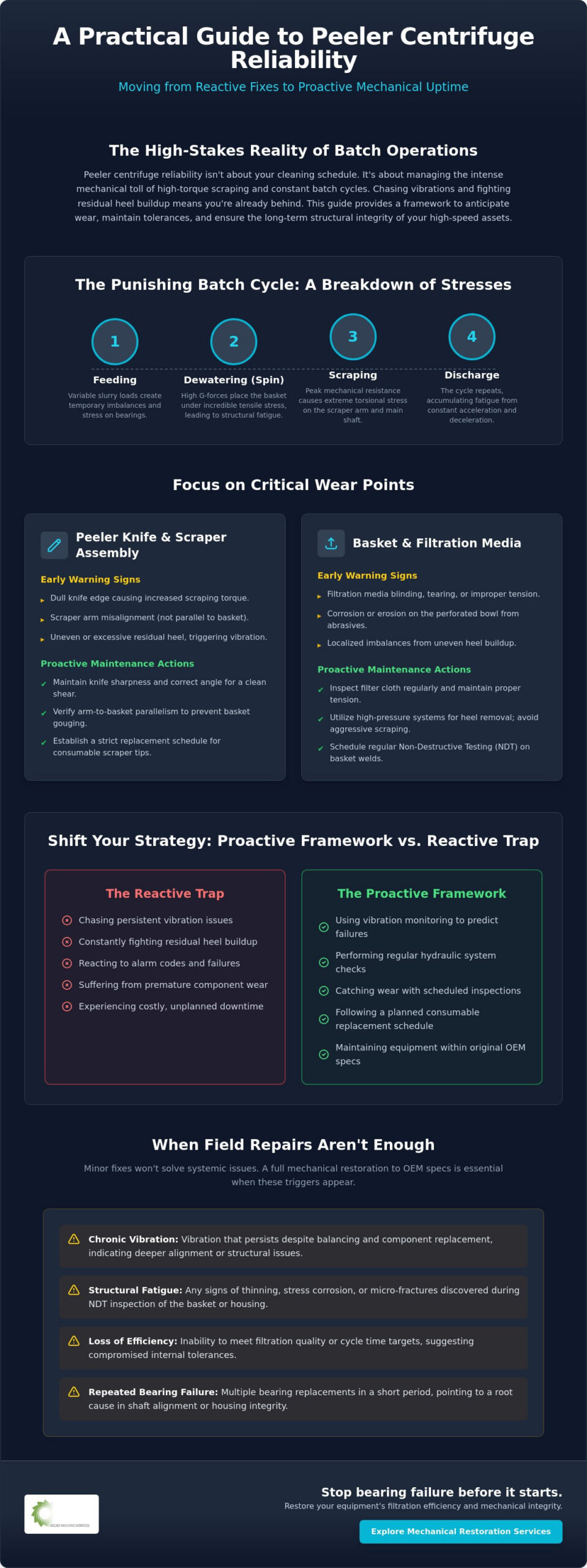
Rapid cycle times are the primary driver of component failure in these units. The feeding and washing phases introduce variable load stresses as the slurry distributes across the basket, often creating temporary imbalances that the bearings have to soak up. Scraping torque is the peak mechanical resistance encountered when the peeler knife penetrates the consolidated solids at high velocity, which places extreme torsional stress on the scraper arm and main shaft. Over time, this constant flexing leads to micro-fractures and alignment shifts in the drive system that field repairs often miss.
Centrifugal Force and Structural Integrity
To achieve maximum moisture removal, these centrifuges rely on high G-forces that put the horizontal basket under incredible tension. Thousands of cycles of loading and unloading cause structural fatigue that isn’t always visible to the naked eye. This makes regular Non-Destructive Testing (NDT) on the basket welds a non-negotiable part of your long-term maintenance plan. If the structural integrity of the basket is compromised, the resulting vibration won’t just ruin your seals; it can lead to a catastrophic failure of the entire housing. Checking for signs of thinning or stress corrosion cracking is the only way to stay ahead of the curve.
Critical Components: Identifying Wear Patterns in Knives and Baskets
The high-stress environment of batch processing eventually leaves its mark on specific mechanical assemblies. While the motor and drive system handle the load, the peeler knife and basket assembly are on the front lines of material separation. Effective peeler centrifuge maintenance requires a trained eye to spot subtle wear patterns before they manifest as a system-wide failure. Neglecting these components doesn’t just lower your filtration efficiency; it puts the structural integrity of the entire machine at risk.
Peeler Knife and Scraper Assembly Precision
The relationship between the knife angle and the “residual heel” thickness is the pulse of your operation. If the knife edge loses its sharpness, it won’t cleanly shear the cake, leading to increased scraping torque and potential scraper arm deflection. You should regularly check the alignment of the scraper arm to ensure it remains parallel to the basket wall. Any deviation can cause the knife to dig too deep or leave an uneven heel, which triggers the very vibration issues we’re trying to avoid. Establishing a strict replacement schedule for consumable scraper tips is much cheaper than replacing a gouged basket.
Basket and Filtration Media Health
Your basket is the heart of the machine, and its health is tied directly to the filtration media. Signs of blinding, tearing, or improper cloth tension are often the first indicators of a problem. When a “heel” builds up unevenly, it creates localized imbalances that can rattle the bearings to pieces over time. You also need to watch for corrosion or erosion on the perforated bowl, especially if you’re running abrasive slurries. When it’s time for cleaning, avoid aggressive mechanical scraping that could damage the basket structure; instead, use validated CIP (Clean-In-Place) procedures to maintain the media without compromising the metal.
The hydraulic drive system is another area where many teams fall behind. Detecting small leaks or slight pressure drops in the scraper actuator is critical. If the hydraulic system is sluggish, the scraper timing will be off, leading to poor discharge and increased mechanical stress. If you notice heat signatures around the bearing housing or see lubrication degrading faster than usual, it’s a sign that the internals are fighting too much friction. For complex issues like these, a professional Centrifuge Repair can restore the tight tolerances that field adjustments simply can’t reach.
- Knife Edge: Inspect for rounding or chipping every 500 cycles.
- Hydraulic Seals: Check for weeping at the actuator rods during every shift.
- Basket Welds: Look for hairline cracks or pitting during every cloth change.
- Bearing Temperature: Monitor for spikes that exceed 15% of your baseline operating temp.
Establishing a Proactive Maintenance Schedule
Consistency is what keeps a high-cycle operation from turning into a repair nightmare. You can’t just wait for a vibration alarm to tell you something is wrong; by then, the damage to your bearings is already done. Effective peeler centrifuge maintenance relies on a tiered approach that separates quick daily checks from the deeper technical work required once or twice a year. If you treat these intervals as suggestions rather than requirements, you’re essentially gambling with your uptime.
Daily and Weekly Operational Checks
Start every shift with a visual sweep. You’re looking for solids accumulation in the discharge chute, which is a classic sign that your scraper isn’t clearing the basket properly. It’s also vital to monitor the clarity of your “mother liquor” discharge. If you see cloudiness where there shouldn’t be any, your filtration cloth has likely torn or slipped its tension. Don’t overlook the basics: verify that your emergency stops and vibration sensors actually respond. A sensor that’s been bypassed or caked in debris won’t save your machine when an imbalance occurs.
- Shift Start: Verify hydraulic reservoir levels and check for weeping seals at the actuator.
- Mid-Shift: Monitor bearing housing temperatures for any sudden spikes above the baseline.
- Weekly: Inspect filtration media for blinding and test the scraper’s full range of motion without a load.
Major Service Intervals and Technical Restoration
Monthly and quarterly tasks move into the realm of precision. This is when you should be lubricating main bearings and scraper pivot points to prevent the scraping torque issues mentioned earlier. Quarterly, it’s time to calibrate your scraper limit switches and check the hydraulic timing. If the scraper moves too fast or too slow, you’ll either damage the basket or leave too much residual heel. These adjustments are fine for the field, but they have their limits after a certain number of cycles.
Once a year, or according to your cycle count, you need to perform an annual overhaul. This involves a complete teardown and a deep inspection of all rotating elements. This is where the principles of rotating equipment maintenance become critical. You’re looking for micro-fatigue and wear in the bearing seats that field inspections can’t find. If your logs show a pattern of increasing vibration or frequent seal failures, it’s a signal that field maintenance isn’t enough and you need a full shop refurbishment. Documenting these logs isn’t just busywork; it’s the data you need to predict a failure before it shuts down your entire production line.
Troubleshooting Vibration and Residual Heel Failures
Vibration is the most common headache in peeler centrifuge maintenance, and it’s usually a tug-of-war between process issues and mechanical fatigue. To solve it, you first have to determine if the problem is the product or the machine. If the vibration disappears after a thorough wash cycle, you’re dealing with a cake imbalance. However, if the shaking persists when the basket is empty, you’re likely looking at mechanical wear in the bearings, drive shaft, or a loss of structural balance in the basket itself.
The “residual heel” is a frequent culprit. This layer of solids is left in the basket to protect the filter media, but if it becomes too thick or “glazes” over, it prevents proper drainage. This uneven saturation creates a massive weight imbalance. Many operators manage this by using high-pressure nitrogen or air blow-back systems to keep the heel permeable. If these systems fail, the heel can harden into a “brick” that forces the machine out of alignment during the next feed cycle.
Managing Cake Distribution and Imbalance
Slurry consistency is your starting point for a stable run. If your feed rate surges or the solids concentration fluctuates, the cake won’t distribute evenly across the basket length. You can sometimes compensate by adjusting the peeler knife stroke to “level” a stubborn heel, but you have to watch for “chatter.” This high-frequency rattling during the scraping phase usually means the knife is digging too deep or the scraper arm is flexing under the load. If you can’t smooth out the cake through process adjustments, the mechanical tolerances have likely shifted beyond what field tuning can fix.
Advanced Vibration Analysis for Peeler Units
We use frequency spectra to distinguish between different failure modes. A peak at the basket’s primary rotational frequency almost always points to an imbalance, while peaks at higher frequencies suggest defects in the inner or outer bearing races. Don’t overlook the foundation; loose mounting bolts or a cracked base can amplify a minor vibration into a catastrophic failure. Dynamic balancing must be performed at operational speeds because the centrifugal forces at play can shift the center of mass in ways that a low-speed shop balance simply won’t catch. When your vibration levels exceed safe thresholds, utilizing precision dynamic balancing services is the only way to protect your asset.
If you’re fighting persistent vibration that process changes won’t fix, it’s time to bring in the experts for professional Dynamic Balancing to restore your machine’s stability.
Professional Refurbishment: Restoring OEM Specifications
Field repairs are fine for keeping the lights on, but they can’t replace a full mechanical restoration when your machine has reached its cycle limit. Professional peeler centrifuge maintenance eventually requires moving the unit into a controlled shop environment where a complete teardown is possible. This isn’t just a cleaning exercise; it involves a deep dive into the machine’s structural health through NDT inspection and dimensional verification of every critical surface. We’re looking for the kind of micro-wear in bearing seats and scraper pivots that a field tech simply can’t measure with standard tools.
Restoring the hydraulic scraper system is a major part of this process. Over years of operation, internal seals wear down and valves drift, causing the scraper timing to lose its precision. During a shop overhaul, we bring these systems back to original pressure and timing specs so your discharge cycle is as efficient as the day the machine was commissioned. Once the mechanical and hydraulic systems are tight, the final step is testing and balancing the rotating assembly to ensure “like-new” performance before it ever leaves the shop floor.
Why Technical Expertise Trumps Field Patches
The risks of using non-OEM parts or ignoring “close enough” tolerances in high-speed equipment are too high to ignore. When a basket is spinning at thousands of RPM, a slightly off-spec bearing or an improper scraper arm clearance can lead to a catastrophic failure. A professional industrial centrifuge repair restores the safety margins that keep your operators safe. This process also includes recalibrating all safety interlocks and control systems, ensuring that your vibration sensors and emergency stops are fully integrated and functioning according to the original design.
Minimizing Downtime through Planned Refurbishment
Protecting Your High-Cycle Separation Assets
Mastering peeler centrifuge maintenance is a matter of managing the fine line between process efficiency and mechanical fatigue. We’ve covered how punishing batch cycles impact your scraper assembly and why vibration is often a symptom of deeper structural issues. By sticking to a rigid inspection schedule and addressing knife wear early, you can avoid the unplanned downtime that ruins production targets. However, when field adjustments no longer solve the chatter or heel buildup, a professional shop refurbishment is the only way to restore OEM-level safety and performance.
With 40+ years of industrial rotating equipment expertise, our team provides the comprehensive dynamic balancing and NDT inspection capabilities needed to keep your plant running smoothly. We also offer 24/7 emergency support for critical infrastructure because we know that industrial operations don’t always follow a standard clock. Don’t wait for a bearing failure to take the decision out of your hands. Request a Technical Evaluation for Your Centrifuge Repair today and let’s make sure your equipment is ready for the next ten thousand cycles.
Frequently Asked Questions
What is the most common cause of peeler centrifuge failure?
The most common cause of failure is cumulative mechanical fatigue resulting from the rapid acceleration and deceleration cycles inherent to batch processing. When these inertial loads are combined with uneven cake discharge, the resulting vibration quickly degrades seals and bearings. Ignoring early signs of structural stress in the basket or scraper assembly often leads to catastrophic mechanical breakdowns that require extensive shop refurbishment to correct.
How often should the peeler knife be inspected for wear?
You should inspect the peeler knife for edge rounding or chipping every 500 cycles or during every filter cloth change, whichever comes first. Maintaining a sharp edge is critical for clean cake removal and reducing the torque applied to the scraper arm. If you’re processing abrasive slurries, you might need to check the knife more frequently to prevent the scraper from digging into the residual heel or damaging the basket.
Can a peeler centrifuge be dynamically balanced on-site?
While basic field balancing can address minor issues, a peeler centrifuge should ideally be balanced in a shop environment to achieve OEM-level precision. On-site balancing is often limited by the machine’s foundation and surrounding interference, which can mask subtle imbalances. For high-speed rotating assets, shop-based dynamic balancing at operational speeds ensures that the center of mass is perfectly aligned, protecting your bearings from premature wear.
What is a “residual heel” and why is it important for maintenance?
The residual heel is a thin layer of product deliberately left in the basket to act as a protective barrier for the filter cloth. It’s vital for maintenance because if this layer becomes too thick or impermeable, it causes massive weight imbalances and high vibration levels. Proper peeler centrifuge maintenance involves monitoring this layer’s consistency and using blow-back systems to keep it from hardening into a solid mass.
Why is hydraulic pressure dropping during the scraping cycle?
A drop in hydraulic pressure during the scraping cycle is usually caused by worn internal seals in the actuator or a failing hydraulic pump. If the system can’t maintain pressure, the scraper knife won’t penetrate the cake consistently, leading to “chatter” and uneven discharge. You should check for weeping at the rod seals and verify that the hydraulic reservoir hasn’t been contaminated by process fluids, which degrades the fluid’s lubricating properties.
How does cake imbalance affect the main bearings of a horizontal centrifuge?
Cake imbalance creates severe radial loads that force the main bearings to operate outside their intended design tolerances. This localized stress generates excessive heat and accelerates the breakdown of the lubricant, leading to pitting in the bearing races. In a horizontal centrifuge, these forces are particularly damaging because they can cause the shaft to flex, eventually ruining the bearing seats and requiring precision machining to restore the unit.
What safety standards should be followed during centrifuge maintenance?
Maintenance must adhere to the OSHA machine guarding standard, 29 CFR 1910.212(a), which requires protection from rotating parts and mechanical hazards. You must follow strict lockout/tagout procedures for both electrical and hydraulic power sources before opening the housing. Additionally, always verify that the basket has come to a complete stop using a zero-speed switch, as the high inertia of these units makes them dangerous long after the power is cut.
Is it better to repair or replace a worn peeler centrifuge basket?
Deciding whether to repair or replace a basket depends on the extent of the erosion and the results of NDT weld inspections. If the structural integrity is sound, precision machining can often restore the basket to its original specifications for a fraction of the replacement cost. However, if repair costs exceed 50% of a new unit’s price or if stress corrosion cracking is widespread, replacement is generally the safer financial and operational choice.