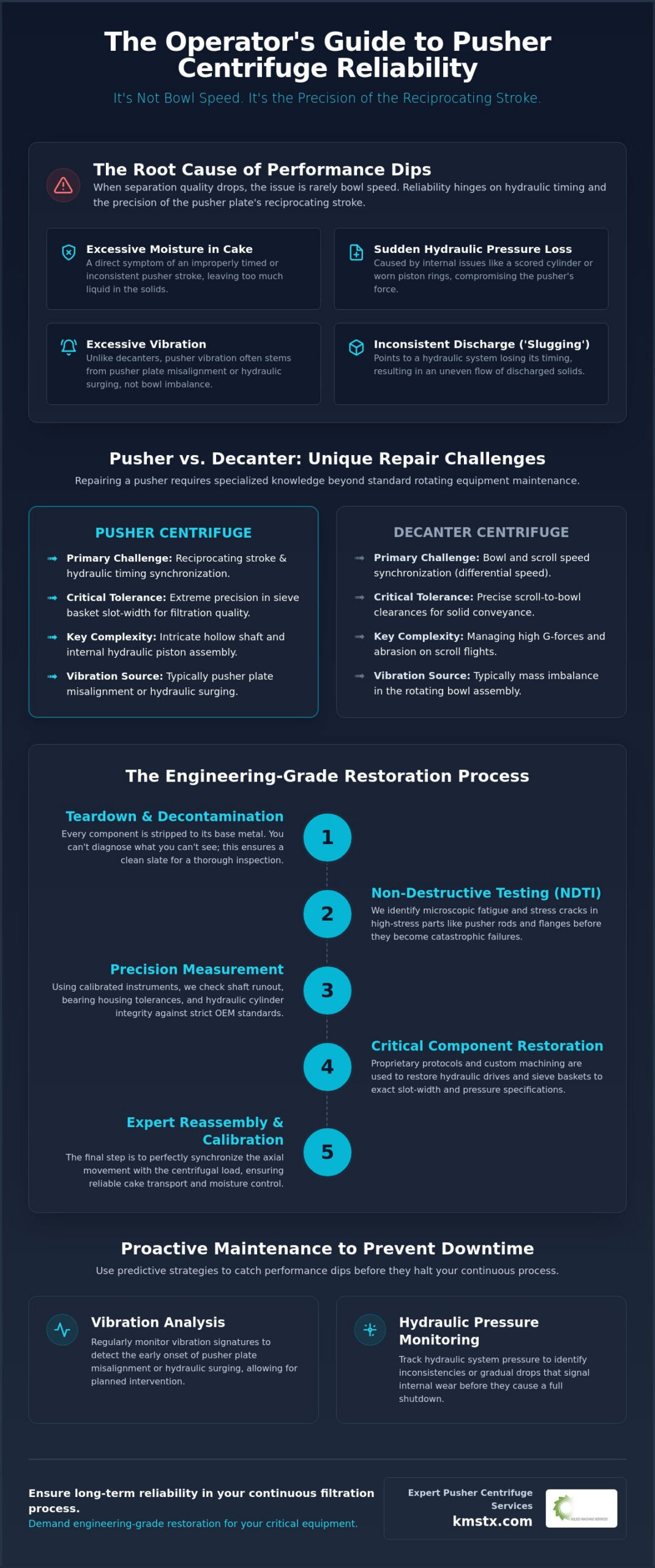
Most operators focus on bowl speed when separation quality dips, but pusher centrifuge reliability is actually determined by the precision of the reciprocating stroke and hydraulic timing. If you’ve spent a shift managing excessive moisture in the discharged cake or troubleshooting a sudden pressure loss, you know that these machines are only as good as their internal synchronization. When you’re evaluating pusher centrifuge repair services, it’s critical to look beyond basic maintenance and focus on the engineering-grade restoration of these complex hydraulic systems.
It’s frustrating when hydraulic fluid contamination or a worn sieve leads to unplanned downtime in a continuous process that can’t afford to stop. This guide offers a comprehensive engineering overview of failure analysis, hydraulic system restoration, and precision sieve maintenance tailored for industrial operators. We’ll examine the specific steps required to overhaul a unit so it meets strict OEM tolerances and avoids the catastrophic vibration that threatens your facility’s safety and output. From diagnosing reciprocating stroke irregularities to ensuring compliance with IEC 61010-2-020 standards, we’ll cover the technical realities of keeping your separation equipment at peak performance.
Key Takeaways
- Understand how the reciprocating pusher plate acts as the linchpin for cake transport and why precise stroke timing is the primary factor in moisture control.
- Learn how Non-Destructive Testing (NDTI) identifies microscopic fatigue in high-stress reciprocating components before they lead to catastrophic mechanical failure.
- Discover the technical requirements for restoring hydraulic drives and sieve baskets to exact slot-width specifications through expert pusher centrifuge repair services.
- Master predictive maintenance strategies that utilize vibration analysis and hydraulic pressure monitoring to catch performance dips before they cause unplanned downtime.
- Explore how proprietary repair protocols and custom machining can restore your equipment to OEM tolerances, ensuring long-term reliability in continuous filtration processes.
Understanding Pusher Centrifuge Mechanics and Reciprocating Failure Modes
Pusher centrifuge repair services aren’t just about swapping bearings or balancing a bowl. It’s a specialized restoration of continuous filtration equipment where the machine’s heart is a reciprocating pusher plate. This plate is responsible for transporting the solids cake through the basket while managing moisture levels. If the stroke isn’t perfectly timed, your moisture control goes out the window, and your continuous process turns into a bottleneck. Most general shops can handle a spin test, but they lack the expertise to sync the axial movement with the centrifugal load.
A foundational grasp of Pusher Centrifuge Mechanics shows that these units rely on a delicate balance between centrifugal force and axial movement. Whether you’re running a single-stage unit or a more complex multi-stage system, the mechanical requirements are unforgiving. Standard rotating equipment shops often fail because they don’t have the specialized rigs to calibrate the hydraulic timing correctly. It’s not just about spinning; it’s about the rhythm of the push. Without that calibration, you’ll see uneven cake thickness and premature wear on the sieve.
To see a practical example of how these components are handled during a teardown, watch this video:
Common Failure Indicators in Continuous Filtration
When cake washing becomes inefficient, it’s often a red flag that your pusher stroke frequency is off. You’ll also see vibration issues that are easy to misdiagnose. While a decanter might vibrate due to bowl imbalance, a pusher often shakes because of plate misalignment or hydraulic surging. These surges kill your separation efficiency and can lead to internal component fatigue if left unchecked. If you’re noticing ‘slugging’ or inconsistent discharge, the hydraulic system is likely losing its timing or pressure consistency.
Pusher vs. Decanter: Unique Repair Challenges
Repairing a pusher is a different animal than working on a decanter. The complexity of the hollow shaft and the internal hydraulic piston assembly requires a high level of precision. Unlike decanters where scroll clearances are the main concern, pusher centrifuges demand extreme sieve basket tolerances. Even a slight deviation in slot width can ruin the filtration quality. Plus, you have to deal with material buildup in the discharge housings, which is a specific headache for these units. Maintaining these systems falls under the broader umbrella of rotating equipment maintenance, but the hydraulic reciprocating cycle adds a layer of complexity most generalists won’t touch.
The Technical Inspection and NDTI Process for Industrial Units
Once a unit arrives at the facility, the restoration begins with a rigorous teardown and decontamination procedure. You can’t see the real issues under layers of product buildup or grease. We strip every component down to the base metal to ensure a clean slate for inspection. This is where we transition into Non-Destructive Testing (NDTI), a step that’s often glossed over by generalists. For pusher centrifuges, we’re looking specifically for fatigue in high-stress reciprocating parts like the pusher rod and the basket mounting flange. Identifying these micro-cracks early prevents a small hairline fracture from becoming a catastrophic failure on the plant floor.
Precision measurement is next on the list. We check shaft runout and bearing housing tolerances using calibrated micrometers and dial indicators. If your housing is out of round by even a few thousandths, you’re looking at premature bearing failure and increased vibration. We also evaluate the integrity of the internal hydraulic cylinder and piston rings. Even minor scoring on a cylinder wall can cause pressure bypass, which directly impacts the force of your pusher stroke. Ensuring these standards are met is a core part of our pusher centrifuge repair services. This forensic approach to inspection ensures that every potential failure point is documented before the first part is machined.
Advanced Diagnostic Methods for Pusher Components
We utilize dye penetrant and magnetic particle testing specifically for sieve basket welds. These areas take a beating from constant vibration and abrasive solids. If a weld is starting to craze, it’s better to catch it now than during a production run. We also perform ultrasonic thickness testing on high-wear discharge areas to see how much steel is left on the housing. Hardness testing of shafts and reciprocating rods ensures that previous thermal events haven’t compromised the structural integrity of the metal. These tests aren’t optional; they’re the only way to guarantee the machine can handle the stresses of continuous operation.
Hydraulic System Pressure and Flow Analysis
The hydraulic system is the brain of the pusher. We bench test the hydraulic pump and control valves to check for internal leakage that might not be visible from the outside. A key focus is the synchronization of the reversing valve with the pusher stroke. If that timing is off, you’ll get short-stroking or erratic movement. We also look for thermal degradation in hydraulic seals and O-rings, which often indicates the system has been running too hot. Following established Preventive Maintenance and Field Service protocols helps identify these issues before they lead to a complete system shutdown. If your internal diagnostics suggest a loss of pressure, it might be time to look into a professional hydraulic drive repair to get your timing back on track.
Critical Component Restoration: Hydraulics, Sieve Baskets, and Seals
Restoring a pusher unit to its original performance levels requires a deep dive into the components that actually do the work: the sieve baskets and the hydraulic drive. While many shops suggest simply ordering new parts, high-quality pusher centrifuge repair services often involve Custom Machining to refurbish existing segments. This approach doesn’t just save money; it allows for a level of precision fitment that off-the-shelf parts sometimes lack. We focus on the exact slot-width specifications because even a tiny deviation can ruin your filtration efficiency or lead to excessive solids in the filtrate.
Beyond the filtration surface, we look at the ‘soft goods’ and the rotating balance. We replace standard O-rings and gaskets with high-performance elastomers that are specifically chosen for your chemical load, whether you’re dealing with caustic salts or acidic slurries. Once the assembly is back together, Dynamic Balancing of the entire rotating mass is mandatory. This includes the pusher plate itself, which must be balanced to account for its reciprocating motion. If you skip this, the resulting vibration will tear through your new bearings in weeks, not years.
Sieve Basket Alignment and Slot Precision
Repairing damaged sieve segments is a delicate process. You can’t just weld a patch and call it a day; you have to maintain the filtration gap across the entire circumference. In multi-stage units, concentricity is the name of the game. If the baskets aren’t perfectly aligned, the pusher plate will clip the sieve, leading to catastrophic metal-on-metal contact. For abrasive salt applications, slot tolerances must typically be maintained within ±0.02mm of the original design to prevent bypass while resisting the high-velocity erosion characteristic of crystalline solids. We use specialized jigs to ensure every segment sits exactly where it should, keeping the cake moving smoothly without blinding the screen.
Hydraulic Drive and Piston Overhaul
The internal hydraulic drive is the most complex part of the restoration. We don’t just swap seals; we hone the internal cylinders to restore a mirror-finish for the reciprocating motion. If the pusher rod has scores that act as ‘seal killers,’ we perform precision grinding to bring it back to size. Integrating modern, multi-lip hydraulic seals can significantly extend your MTBF, especially in high-cycle environments. This level of detail is what separates a basic centrifuge repair from a true industrial restoration. When you’re investing in pusher centrifuge repair services, it’s about making sure the piston moves with zero hesitation, providing the consistent force needed to move heavy cakes through the basket.
Preventive Maintenance and Field Service Strategies
Keeping a pusher centrifuge running isn’t just about following a manual; it’s about listening to the machine’s operational rhythm. While you might be tempted to run until something breaks, establishing a predictive maintenance schedule based on vibration analysis and hydraulic pressure monitoring is the only way to avoid the high costs of unplanned downtime. If you’re noticing a creeping increase in vibration or a slight drop in hydraulic force, you’re already behind the curve. Professional pusher centrifuge repair services should be part of a larger strategy that includes regular field inspections to catch these issues before they lead to a total reciprocating failure.
Lubrication management is often where things go wrong in heavy industrial environments. These machines don’t just need generic oil; they require specific viscosity grades and high-level filtration to protect the internal hydraulic drive from premature wear. Contaminated oil is a death sentence for piston rings and control valves. We also focus on training operators to recognize early signs of pusher stroke stuttering. If the plate isn’t moving with a smooth, consistent cadence, you’ve likely got a hydraulic timing issue or internal binding that needs immediate attention. Catching these signs early can be the difference between a simple seal swap and a full-scale rebuild.
On-Site Troubleshooting and Minor Service
On-site troubleshooting doesn’t always require a full shutdown. You can check hydraulic oil quality and filter status while the machine is idling or during a brief window in the production cycle. A visual inspection of the cake discharge can tell you a lot about the health of the internal pusher plate. If the cake is unevenly distributed or has wet spots, your stroke might be failing or the sieve might be blinded. For plants in high-stakes environments, having access to emergency machine repair Gulf Coast ensures that a minor stutter doesn’t shut down your entire production line for days.
Major Shop Service vs. Field Repair
There’s a limit to what you can fix in the field. Determining when a unit must be pulled for industrial centrifuge repair Texas depends on the severity of the wear and the precision required for the fix. If the main shaft is scored or the bowl shows signs of fatigue, shop-based dynamic balancing services Houston are necessary to restore OEM-level stability. Logistics for transporting these heavy units require specialized rigging and careful planning, but the long-term reliability gained from a full shop restoration far outweighs the temporary inconvenience of the pull. If your unit is showing signs of stroke instability, contact us for expert centrifuge repair before a minor timing issue turns into a major overhaul.
Engineering-Grade Restoration: The Kelsey Machine Services Advantage
Kelsey Machine Services brings over four decades of hands-on experience to the table when it comes to heavy rotating equipment. When you’re looking for pusher centrifuge repair services, you aren’t just looking for a shop that can turn a wrench; you’re looking for a partner that understands the nuances of rotating equipment maintenance on a deep, technical level. Our team has developed proprietary repair protocols that don’t just mimic the original manufacturer’s steps. We often find ways to exceed OEM specifications by addressing the specific environmental stressors found in your facility. Whether you’re operating a chemical processing plant or a mineral refinery, we tailor the restoration to the actual stresses your machine faces every day.
Reliability isn’t a happy accident. It’s the result of a methodical approach to engineering that treats every rebuild as a mission-critical project. We provide a comprehensive warranty on all labor and precision-machined components because we have confidence in our process. We know that every hour of downtime is lost revenue, so our focus is always on minimizing critical downtime and getting the machine back to you in a condition that prevents the same failure from happening twice.
The KMS Quality Assurance Protocol
Every unit that passes through our shop undergoes a final run test and vibration certification before it’s released to the field. This isn’t a superficial check. We push the machine to its operational limits to ensure the hydraulic timing and bowl stability are flawless. You’ll receive detailed documentation of all tolerances, NDTI results, and every part replaced. Because we maintain an extensive industrial machine spare parts Texas inventory, we can often complete these high-precision pusher centrifuge repair services faster than shops that are stuck waiting on overseas shipping for critical components.
Partnering for Long-Term Reliability
Restoring Precision to Your Continuous Filtration Process
Reliability in continuous separation isn’t just about keeping the bowl spinning; it’s about the technical synchronization of the hydraulic stroke and the structural integrity of the sieve basket. Success depends on identifying micro-fatigue through rigorous testing and maintaining exact slot tolerances to prevent moisture carryover and catastrophic vibration. When you invest in professional pusher centrifuge repair services, you’re choosing to restore your equipment to a standard that meets or exceeds original OEM specifications.
Kelsey Machine Services brings over 40 years of industrial rotating equipment expertise to every rebuild, backed by full NDTI and vibration certification for every unit that leaves our shop. Whether you require a comprehensive shop-based overhaul or 24/7 emergency field service to address a sudden hydraulic timing failure, our team has the technical depth to get your process back on track. Don’t let a minor reciprocating stutter turn into a major production bottleneck that compromises your facility’s output.
Request a Technical Consultation for Your Pusher Centrifuge today and ensure your facility operates with the precision and reliability it deserves.
Frequently Asked Questions
How often should a pusher centrifuge undergo a major inspection?
An industrial pusher centrifuge should have at least one annual inspection performed by a qualified technician to ensure long-term reliability. Between these major events, you should maintain a logbook to track run durations and total rotor revolutions while performing daily cleanings and monthly checks on hydraulic fluid levels. This proactive approach helps you identify early wear signs before they require more intensive pusher centrifuge repair services.
What causes a pusher centrifuge to vibrate excessively?
Excessive vibration is typically caused by bowl imbalance or a misalignment of the reciprocating pusher plate within the basket. In many continuous processes, you’ll also see vibration if the cake distribution is uneven or if the hydraulic system is surging. If you don’t address these issues quickly, the resulting forces will destroy your bearings and lead to premature failure of the internal shaft seals.
Can a damaged sieve basket be repaired, or must it be replaced?
A damaged sieve basket can often be restored through custom machining and segment replacement if the main frame remains structurally sound. We can refurbish individual segments and repair cracked welds to bring the basket back to its original slot-width specifications. It’s a practical way to save on costs and avoid the long lead times often associated with ordering new OEM filtration components.
What are the signs of hydraulic failure in a reciprocating centrifuge?
Signs of hydraulic failure include stroke stuttering, inconsistent pressure readings, and visible oil contamination in the process stream. You might also notice that the discharged cake has excessive moisture because the pusher isn’t providing enough force to move the solids effectively through the basket. If the system is running hot, it’s a strong indicator that hydraulic fluid is bypassing internal seals or that the reversing valve is failing.
Why is dynamic balancing critical for pusher centrifuges?
Dynamic balancing is essential because these units combine high rotational speeds with a heavy reciprocating mass that shifts during every stroke. Any imbalance in the pusher plate or bowl assembly creates massive centrifugal forces that can lead to catastrophic rotor failure. Proper balancing ensures your machine meets IEC 61010-2-020 safety standards and protects the high-precision bearings from unnecessary fatigue.
What is the typical turnaround time for a full centrifuge overhaul?
A full overhaul typically takes between two to four weeks, depending on the extent of the custom machining and parts procurement required. We focus on a methodical restoration process that includes a full teardown, NDTI testing, and final vibration certification. Specialized pusher centrifuge repair services require this time to ensure every internal tolerance meets or exceeds the original OEM specifications for continuous operation.
Do you provide on-site emergency repair for pusher centrifuges?
We provide 24/7 emergency field service to help industrial operators minimize unplanned downtime during critical process failures. Our field technicians can often troubleshoot hydraulic timing issues or replace external seals without pulling the entire unit. If the problem requires a shop-level fix, we can assist with the logistics of getting your machine to our facility for a precision rebuild.
Are the repairs covered by a warranty?
All repair work and precision-machined components are backed by a comprehensive warranty that covers both labor and parts. We provide you with a full documentation package that includes all measurement tolerances, NDTI results, and final run-test data. This transparent approach ensures you have a reliable record of the restoration and can trust the equipment to perform under the heavy loads of your specific application.