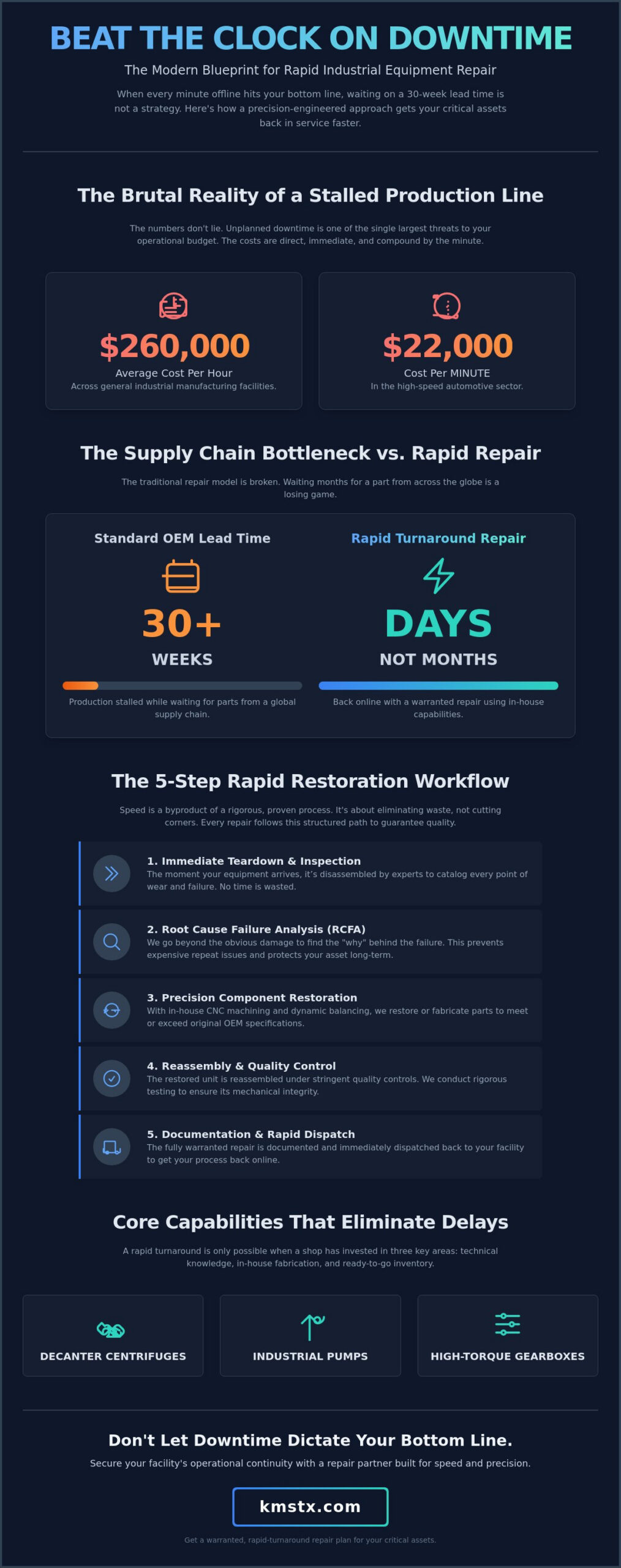
Did you know that in 2026, the average cost of an hour of industrial equipment downtime has reached $260,000? In the automotive sector, that price tag jumps to a staggering $22,000 every single minute. It’s a brutal reality for any facility manager, especially when a critical pump or gearbox fails and the OEM quotes a 30-week lead time for a standard replacement part. You’ve likely experienced the stress of a stalled production line while waiting for a repair shop that can’t provide a clear timeline or a technical breakdown of the work.
We agree that the traditional model of waiting on global supply chains is no longer sustainable for modern operations. You need a partner that treats your downtime like the emergency it is. This guide shows you how rapid turnaround equipment repair is achieved through a combination of deep technical expertise, precision in-house machining, and a massive on-site parts inventory. We’ll walk through how these capabilities work together to restore your rotating equipment to OEM specifications quickly, ensuring you get a warranted repair that minimizes your total cost of failure and gets your process back online.
Key Takeaways
- Understand why rapid turnaround equipment repair requires a precision-engineered approach rather than a temporary patch to protect your bottom line.
- Learn how Root Cause Failure Analysis (RCFA) during the initial teardown identifies the “why” behind a failure to prevent expensive repeat issues.
- Discover how in-house machining and a strategic spare parts inventory can bypass the months-long lead times currently plaguing global supply chains.
- Gain specialized insights into restoring critical assets like decanter centrifuges, high-torque gearboxes, and industrial pumps to OEM specifications.
- Identify the best criteria for choosing between field service and a full shop overhaul to maximize your facility’s operational continuity.
Why Rapid Turnaround Equipment Repair is Critical for Industrial Continuity
Rapid turnaround equipment repair isn’t just a marketing buzzword; it’s a calculated engineering strategy. In the world of heavy industry, “rapid” doesn’t mean a slapped-together patch that fails three weeks later. It refers to a precision-engineered response where technical readiness and inventory management allow a shop to bypass the traditional supply chain bottlenecks that currently paralyze many facilities. In 2026, managing your Mean Time to Repair (MTTR) is often the difference between a profitable quarter and a massive financial hit.
Let’s look at the reality on the ground. Standard OEM lead times for critical components have stretched into months, with some electronic and specialized rotating parts seeing delays of 30 weeks or more. When a primary blower or compressor goes down, you don’t have half a year to wait for a factory replacement. A specialized rapid turnaround equipment repair service fills this gap by utilizing in-house machining and deep parts inventories to restore assets to OEM specifications in days, not months.
To better understand the logistics behind this high-speed service, watch this video on rapid response protocols:
The Economic Impact of Unplanned Downtime
The numbers in 2026 are sobering. Research indicates the average cost of an hour of equipment downtime has climbed to $260,000 across general manufacturing. For high-output sectors like oil and gas or wastewater treatment, the compounding costs are even higher. A single stalled pump can trigger a domino effect, forcing downstream operations to halt and potentially leading to a total plant shutdown. When you’re losing hundreds of thousands of dollars every hour, the investment in a high-speed, expert repair is negligible compared to the revenue lost to a dead production line. Rapid response doesn’t just fix a machine; it preserves your facility’s operational continuity.
Balancing Speed with Mechanical Precision
There’s a dangerous misconception that speed sacrifices quality. In a professional repair environment, the opposite is true. Speed is a byproduct of established protocols and technical rigor, not shortcuts. By following a methodical workflow, shops can accelerate timelines while strictly adhering to OEM tolerances. It’s about having the right tools and the right people ready to go the moment the equipment hits the floor. Every rapid turnaround equipment repair should come with a warranty. This provides the peace of mind that even though the work was finished on an accelerated schedule, the mechanical integrity of the centrifuge, gearbox, or hydraulic drive is fully restored for the long haul.
The Technical Workflow of High-Speed Rotating Equipment Restoration
Speed in a repair shop isn’t about running faster; it’s about eliminating wasted motion. A true rapid turnaround equipment repair follows a methodical, five-step workflow that starts the moment the truck hits the dock. We don’t let equipment sit in the yard. The process begins with an immediate teardown and comprehensive inspection to catalog every point of wear. Once the components are laid out, we conduct a Root Cause Failure Analysis (RCFA). It’s useless to replace a bearing if the shaft is misaligned, as you’ll just be back in the shop in a month. We fix the source of the problem, not just the symptoms.
The restoration phase involves precision component work using CNC machining and dynamic balancing to return parts to their original dimensions. After the heavy lifting is done, reassembly happens under stringent quality control testing to ensure everything meets OEM specifications. We finish the job with final documentation and rapid dispatch back to your facility. This structured approach ensures that the repair is fast, but more importantly, it’s right the first time.
Teardown and Diagnostic Precision
Diagnostics are the foundation of a reliable repair. We utilize non-destructive testing (NDT), such as dye penetrant or magnetic particle inspection, to hunt for micro-fractures in shafts and housings that aren’t visible to the naked eye. Our engineers look for specific wear patterns on gears and bearings that tell a story about lubrication failure, overloading, or installation errors. Identifying these issues during the teardown prevents catastrophic failures down the road. We provide transparent reporting during this diagnostic phase so you know exactly what we found before we start the restoration process.
Dynamic Balancing and CNC Machining
High-speed rotating assets like centrifuges and blowers are incredibly sensitive to weight distribution. Even a few grams of imbalance can cause vibration-induced wear that kills your bearings and seals. Utilizing precision dynamic balancing significantly extends the mean time between failures (MTBF) by smoothing out those destructive forces and keeping the machine within tight vibration tolerances.
Sometimes, the parts you need simply don’t exist in a warehouse. If an OEM part is obsolete or stuck in a 40-week lead time, we use our in-house CNC machining to fabricate custom components to exact tolerances. This capability is a core pillar of rapid turnaround equipment repair, allowing us to bypass global logistics delays. If you’re noticing increased vibration in your rotating assets, addressing it now with precision dynamic balancing can prevent a total plant shutdown later.
Eliminating Lead Time Traps with Spare Parts and In-House Fabrication
Having parts on the shelf is the only real way to guarantee speed when a machine fails. This deep network of components is what allows for effective emergency machine repair across the country. Instead of making phone calls to overseas suppliers and hoping for a shipping window, we pull the necessary gears, seals, or shafts directly from our warehouse. This localized approach turns a potential months-long shutdown into a matter of days.
The Inventory Advantage: Bearings, Seals, and Gears
We focus on keeping high-wear items in stock for major brands of centrifuges, pumps, and compressors. This includes everything from specialized lip seals to heavy-duty planetary gears. By reducing the “waiting game” from weeks to hours, we provide a level of reliability that OEMs simply can’t match in the current economic climate. A robust industrial machine spare parts inventory is the backbone of any rapid turnaround strategy. It’s the difference between a shop that talks about speed and one that actually delivers it.
Custom Machining for Obsolete Equipment
Sometimes, an “off the shelf” solution isn’t an option. This is common with legacy equipment where the OEM has either gone out of business or stopped supporting older models. In these cases, our in-house CNC capabilities are essential. We don’t just “make a part”; we reverse engineer the component to ensure it meets or exceeds the original specifications.
Metallurgical compatibility is a priority during this process. When we’re fabricating replacement shafts or bushings, we select materials that match the thermal and mechanical stresses of your specific application. Precision machining allows us to restore critical bearing fits and seal surfaces that have been damaged by years of abrasive wear. This ensures that even if your equipment is decades old, it can still benefit from a rapid turnaround equipment repair that keeps it running at peak efficiency.
Specialized Strategies for Centrifuges, Gearboxes, and Pumps
Every piece of rotating equipment has its own set of mechanical “personalities.” A centrifuge doesn’t fail the same way a high-torque gearbox does, and your repair partner should treat them differently. While the general workflow remains consistent, the technical nuances of each asset class dictate the success of a rapid turnaround equipment repair. You can’t just apply a general maintenance mindset to machines that operate at 3,000 Gs or transmit thousands of foot-pounds of torque. You need a strategy tailored to the specific physics of the machine.
Centrifuge Refurbishment and Maintenance
Decanter and disc stack centrifuges are the workhorses of the wastewater and oil sectors, but they’re also prone to extreme abrasive wear. When we pull these apart, we’re looking for bowl wear and scroll damage that can throw the entire unit out of balance. Managing those high G-forces is critical. Because of the extreme rotational speeds, industrial centrifuge repair requires specialized balancing equipment that can handle the massive inertia of the bowl assembly. We also focus on gearbox synchronization; if the scroll and bowl aren’t perfectly timed, you’ll see immediate performance drops or catastrophic failure. Preventive measures, like hard-surfacing the scroll flights, can significantly extend the life of the unit between shop visits.
High-Torque Gearbox Engineering
Industrial gearboxes from brands like Falk or Lufkin are built to last decades, but they aren’t invincible. The most common failure modes we see are pitting, spalling, and gear tooth breakage, often caused by lubrication breakdown or misalignment. The industrial gearbox repair process often involves more than just swapping bearings. It requires case boring to restore alignment and precision gear cutting to ensure proper tooth contact. During reinstallation, we prioritize lubrication systems and laser alignment to prevent the vibration issues that lead to early failure. If your gearbox is running hot or making noise, don’t wait for it to seize. You can request a technical consultation for your gearbox repair today to catch these issues before they stop your line.
Pumps and compressors require a different focus entirely, centering on flow efficiency and pressure integrity. We look for cavitation damage in impellers and wear in mechanical seals that bleed off your head pressure. Similarly, hydraulic drives and blowers serve as the lifeblood of auxiliary plant systems. Whether it’s restoring the tolerances on a blower lobe or rebuilding a hydraulic motor, the goal is always to return the asset to its original performance curve. This specialized attention ensures that a rapid turnaround equipment repair delivers long-term reliability rather than just a quick fix.
Establishing a 24/7 Response Protocol for Your Facility
When a critical asset fails at 2:00 AM, that isn’t the time to start vetting vendors or looking for a phone number. A successful rapid turnaround equipment repair depends on having a pre-established response protocol. This means your facility managers and maintenance leads already know the logistics of extraction and have a direct line to a shop that’s ready to receive the machine. The goal is to move from the initial failure to the repair floor as fast as possible, eliminating the hours or days usually lost to administrative delays and shipping hurdles.
Preparation is the key to speed. You should have a plan for rapid extraction, which includes keeping specialized lifting rigs accessible and ensuring your team knows how to properly cap lines and drain fluids. This prep work reduces the “gate-to-gate” time, getting the equipment into the hands of engineers who can begin the teardown immediately. By treating every major failure as a coordinated logistical event, you significantly cut down on the total duration of your unplanned downtime.
Field Service and On-Site Troubleshooting
Proactive Maintenance to Prevent Emergency Repairs
The best way to handle a midnight emergency is to make sure it never happens. Integrating rotating equipment maintenance into your yearly reliability plan allows you to stay ahead of the wear curve. By utilizing vibration analysis and regular oil sampling, you can detect the early signs of bearing fatigue or gear pitting months before a catastrophic failure occurs.
Scheduling major overhauls during your planned shutdowns is a strategic move that avoids the high costs of emergency shipping and unplanned labor. Kelsey Machine Services supports this long-term reliability through engineering consultations, helping you analyze performance data to determine the optimal time for a refurb. This proactive approach doesn’t just save money on the repair itself; it protects your facility’s reputation and ensures your production targets are met without the threat of a sudden, expensive shutdown.
Protecting Your Operational Continuity in 2026
Success in modern industrial maintenance isn’t just about how fast you can turn a wrench; it’s about how well you’ve prepared for the inevitable. As we’ve discussed, a truly effective rapid turnaround equipment repair is built on a foundation of in-house technical depth and a massive inventory that bypasses global supply chain delays. By combining precision engineering with a pre-established response protocol, you can transform a potential multi-month shutdown into a manageable, short-term maintenance event.
Kelsey Machine Services brings over 40 years of industrial engineering expertise to every project. Whether you’re dealing with a high-torque gearbox failure or an imbalanced centrifuge, our team provides 24/7 emergency field and shop support to keep your facility running. We maintain a massive in-house spare parts inventory to ensure that we aren’t just waiting on a shipping container while your revenue stalls. Don’t let unplanned downtime dictate your production schedule. When the pressure is on, Request an Emergency Repair Quote from Kelsey Machine Services to get your critical assets back in the line. We’re ready to help you restore your equipment to OEM specifications and get your crew back to work.
Frequently Asked Questions
How quickly can you begin an emergency equipment repair?
Emergency repairs begin the moment the asset arrives at our facility. Our 24/7 response protocol ensures that teardown and inspection aren’t delayed by administrative processing or backlogs. We prioritize immediate diagnostics to identify the full scope of work, allowing us to move straight into the restoration phase. This level of readiness is essential for maintaining a high-speed workflow during critical production windows where every hour counts.
What types of rotating equipment do you specialize in repairing?
Do you provide on-site field services for emergency breakdowns?
Yes, we provide on-site field services for immediate diagnostic work and troubleshooting. Our technicians can often handle minor repairs, such as seal replacements or alignment adjustments, directly at your facility to get you back online quickly. If the diagnostic data reveals a deeper mechanical failure that requires precision machining or dynamic balancing, we coordinate the logistics to transport the equipment to our shop for a full overhaul.
Can you repair obsolete or older machinery without OEM parts?
Yes, we utilize in-house custom machining to repair legacy or obsolete equipment that OEMs no longer support. By reverse engineering damaged components, we can fabricate replacement shafts, bushings, and gears to exact tolerances. This capability allows us to bypass the 30-week lead times often associated with specialized factory parts, ensuring your older machinery continues to operate at peak performance without the need for a total system replacement.
What is the difference between dynamic balancing and static balancing?
Static balancing corrects the heavy spot on a part while it’s at rest, whereas dynamic balancing corrects imbalances that only appear during rotation. High-speed industrial assets require dynamic balancing to eliminate centrifugal forces that cause destructive vibration. This process is a core part of rapid turnaround equipment repair, as it significantly extends the life of your bearings and seals by smoothing out mechanical stresses across the entire assembly.
Is there a warranty provided on rapid turnaround repairs?
Every repair we perform comes with a professional warranty to ensure long-term reliability. We don’t believe that speed should ever come at the cost of mechanical integrity. Even though we utilize accelerated timelines, every asset undergoes stringent quality control testing to meet or exceed OEM specifications. This provides you with the peace of mind that your equipment is restored correctly and backed by our decades of technical expertise.
Do you maintain an inventory of spare parts for major industrial brands?
We maintain a massive inventory of spare parts, including bearings, seals, and gears for major industrial brands. Strategic inventory management is the backbone of our speed, allowing us to pull critical components immediately rather than waiting months for overseas shipments. This local parts availability is what guarantees a faster return to service when global supply chain volatility makes OEM ordering unpredictable and slow.
How do you ensure equipment is restored to OEM specifications?
Restoration to OEM specifications is achieved through Root Cause Failure Analysis (RCFA) and precision measurement. We use non-destructive testing (NDT) to find micro-fractures and CNC machining to return worn surfaces to their original dimensions. By identifying why a part failed, we can ensure the repair addresses the underlying issue, resulting in an asset that performs exactly as the manufacturer intended when it was first commissioned.