Buying a brand-new pump isn’t always the fastest route back to reliability, and in many cases, it’s actually the riskier financial move. Most maintenance managers have felt the frustration of a “patched” unit failing just weeks after being reinstalled, or the headache of trying to justify a massive CAPEX spend when the budget is already tight. Performing a rigorous repair or replace industrial pump analysis is about more than just comparing a quote to a catalog price. It’s about understanding why the asset failed and whether a precision refurbishment can actually deliver a longer mean time between failures than a new unit.
You’ll master the technical and economic variables needed to make a defensible decision that minimizes unplanned downtime. We’ll look at the Total Cost of Ownership (TCO), including the 2027 DOE efficiency standards that might make your older motors obsolete sooner than you think. This guide provides a clear framework to help you restore operational reliability without overspending on assets that don’t fit your long-term goals.
Key Takeaways
- Identify pump criticality levels to determine the necessary depth of your asset audit and avoid over-analyzing non-essential equipment.
- Implement Root Cause Analysis during the teardown phase to prevent repeat failures and ensure the repair addresses the source of the issue.
- Use a data-driven repair or replace industrial pump analysis that incorporates the 50% Rule and projected energy efficiency gains.
- Discover how precision dynamic balancing and refurbishment to OEM specifications can restore a rotating asset’s reliability to better than new condition.
- Set a performance baseline through vibration and thermal monitoring after re-installation to catch potential issues before they cause unplanned downtime.
The Industrial Pump Dilemma: Understanding the Repair vs. Replace Framework
When a critical asset fails, the pressure to get back online often leads to reactive decisions. However, you should treat the situation as a strategic reliability audit rather than a simple procurement hurdle. A thorough repair or replace industrial pump analysis looks past the immediate repair quote to see how that asset fits into your long-term production goals. It’s a choice between a quick fix that might fail again in six months and a precision refurbishment that could extend the asset’s life by another decade.
Whether you’re dealing with a centrifugal unit or a specialized industrial pump designed for high-viscosity fluids, the goal is the same: predictable performance. Buying new isn’t always the safest bet. New equipment often comes with long lead times, unforeseen installation costs, and the risk of “infant mortality” failures. Sometimes, the heavy-duty housing you already have is better built than the lighter-weight castings coming off many modern assembly lines.
To see how a complex teardown and inspection looks in a shop environment, watch this video on progressive cavity pump repair:
Criticality Mapping for Rotating Assets
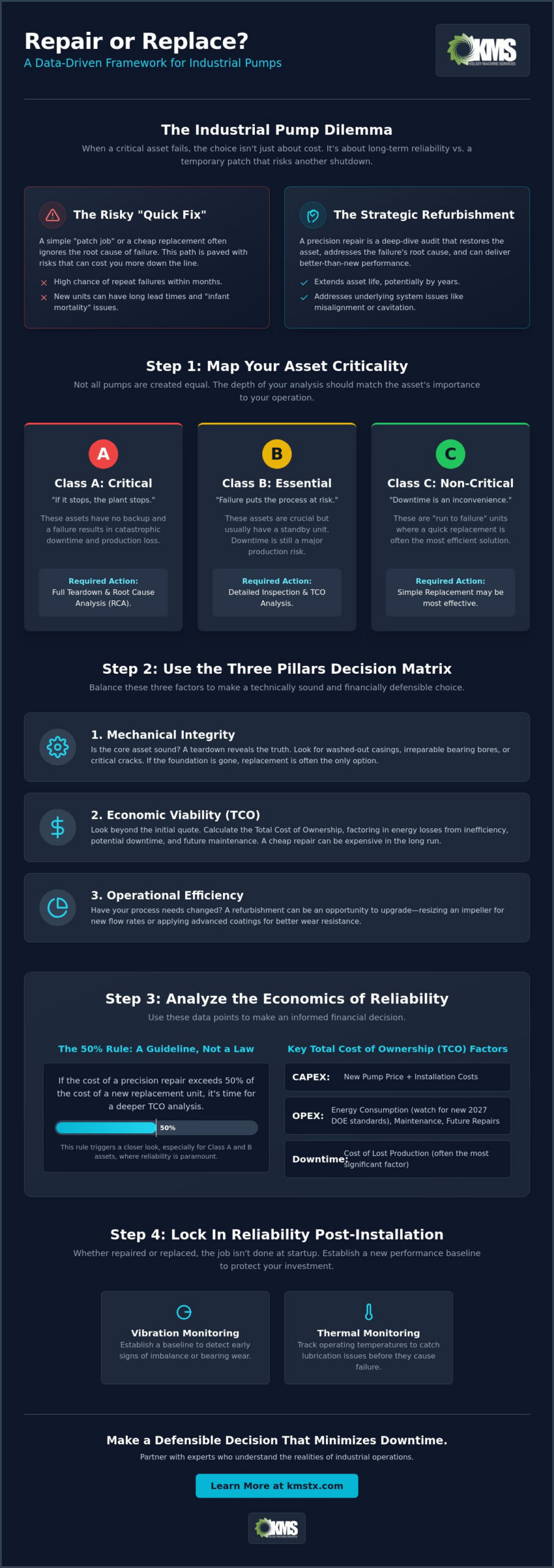
You can’t treat every pump the same way. It’s best to categorize them by their impact on your process. Class A assets are critical; if they stop, the whole plant stops and there’s no backup. Class B assets are essential and usually have a standby unit, but a failure still puts the process at risk. Class C assets are non-critical “run to failure” units where downtime is an inconvenience rather than a disaster. The depth of your repair or replace industrial pump analysis should match the asset’s rank. For Class A equipment, you need a full teardown and root cause inspection. For Class C, a simple replacement might be the most efficient use of your team’s time.
The Three Pillars of the Decision Matrix
Making the right call requires balancing three specific factors. First, check the mechanical integrity. If the casing is washed out or the bearing bores are beyond repair, the decision is usually made for you. Second, look at the economic viability. This isn’t just about the repair cost. You have to look at OPEX versus CAPEX and how much energy you’re losing to an inefficient, worn-out unit. Finally, consider operational efficiency. If your process requirements have changed since the original installation, a refurbishment might include custom machining to resize the impeller, or you might find that a different pump style altogether is required to meet current flow and pressure demands.
Technical Diagnostic Phase: Moving Beyond Surface-Level Inspection
A visual inspection of a leaking seal or a noisy bearing only tells a fraction of the story. To perform a valid repair or replace industrial pump analysis, you have to get the unit on a bench for a full teardown. This phase is where the “truth” of the machine is revealed through a detailed teardown report. We aren’t just looking for what broke; we’re looking for why it broke. Without this technical deep dive, you’re just guessing at the remaining lifecycle of the asset. A proper Industrial Pump Condition Assessment should document every clearance, fit, and surface finish to provide a data-driven path forward.
Root Cause Analysis (RCA) Protocols
If you don’t identify the source of the failure, any repair you perform is just a countdown to the next shutdown. We look for specific wear patterns that point to system issues like cavitation, chronic misalignment, or improper lubrication. By cross-referencing shop findings with your historical rotating equipment maintenance logs, it’s possible to spot recurring themes. For example, specific heat checking on a seal face often indicates a dry-run condition or a cooling plan failure rather than a defective seal. This level of detail ensures the repair or replace industrial pump analysis addresses the root cause instead of just treating the symptoms.
Metallurgical and Structural Assessment
The casing and volute are the most expensive parts of the pump to replace. We use non-destructive testing (NDT), such as dye penetrant or ultrasonic thickness testing, to check for internal cracks and wall thinning. Erosion and corrosion can often be managed through specialized coatings or hard-facing, but there’s a limit to how much metal can be lost before the pressure boundary is compromised. If the pump is an older model and parts are no longer available from the OEM, we evaluate whether custom machining can restore the bearing bores or shaft sleeves to their original specs. When the diagnostic data shows a clear path to restoration, leveraging professional pump repair services can often return a unit to service with better-than-new tolerances.
Evaluating the rotating assembly is the final piece of the puzzle. We check shaft runout to ensure it hasn’t been permanently bowed by a high-heat event and inspect the impeller for vane integrity. If the shaft is true and the casing is sound, refurbishment is almost always the more reliable and cost-effective route compared to the long lead times of a new replacement.
The Economics of Reliability: Calculating Total Cost of Ownership (TCO)
When you’re staring at a repair quote that’s creeping up in price, the decision often feels like a coin flip. To get it right, you need a structured repair or replace industrial pump analysis that moves beyond the initial invoice. Most shops use the “50% Rule” as a starting point; if the cost to refurbish the unit exceeds half the price of a new one, replacement is usually on the table. However, in our current market, a new pump might have a 20 week lead time while a precision repair can be finished in two. That gap in production often makes the repair the smarter financial move, even if the quote is higher than you’d like.
The availability of industrial machine spare parts also plays a massive role in your TCO. If you’re running a legacy asset and the OEM has discontinued support, your “simple” replacement might actually require expensive piping changes and baseplate modifications. In these cases, custom machining to restore the original pump is often the path of least resistance for your budget. You aren’t just paying for parts; you’re paying to avoid the “cost of inaction,” which includes the energy wasted by a worn-out pump running ten points off its efficiency curve.
Direct vs. Indirect Cost Analysis
You have to look at both sides of the ledger to see the full picture. Direct costs are easy to track: they include shop labor, technical parts, and specialized machining required to hit OEM tolerances. Indirect costs are the silent killers of a maintenance budget. These include emergency shipping fees, labor redirection for your millwrights, and the massive revenue loss from a stalled process line. Total Cost of Ownership is the sum of purchase, operation, and maintenance over the asset life. When you calculate TCO this way, a precision repair often looks much better than a “cheap” new unit that requires a total system overhaul to install.
Energy Efficiency and Technological Upgrades
Efficiency standards are shifting, and your analysis needs to account for them. For instance, new DOE regulations will require many 3-phase industrial motors to meet IE4 efficiency levels by June 1, 2027. If your current pump is paired with an old, inefficient motor, replacing the entire setup might be the only way to stay compliant and lower your power bill. However, don’t assume a new pump is the only way to save energy. Upgrading a legacy unit with a high-efficiency impeller or applying specialized low-friction coatings can often bring an older pump’s Best Efficiency Point (BEP) close to modern standards. We also evaluate if your current housing is compatible with modern VFD systems, which can cut energy use by 15% to 20% by matching pump speed to the actual process demand.
The Refurbishment Advantage: When Restoration Surpasses Replacement
Don’t fall for the trap of thinking a shiny new box always equals a better pump. In many cases, your repair or replace industrial pump analysis will show that your older asset is actually the sturdier piece of equipment. Many legacy pumps were manufactured with heavy-walled castings that offer superior vibration damping and corrosion allowance compared to the “optimized” lightweight designs coming off production lines today. When we take these heavy-duty units and apply modern precision engineering, we aren’t just fixing them; we’re often making them better than they were on day one.
A major part of this process involves precision dynamic balancing of the entire rotating assembly. While many OEMs balance components individually, a technical refurbishment balances the shaft and impeller together as a single unit. This eliminates the “stack-up” of tolerances that often causes vibration in new, off-the-shelf pumps. If your pump is discontinued, we don’t just scrap it. We use custom machining to create new sleeves, wear rings, or shafts, ensuring the unit fits your existing baseplate and piping perfectly without the need for expensive field modifications.
Engineering Beyond OEM Standards
Refurbishment gives you the chance to fix design flaws that the original manufacturer might have overlooked. We often upgrade internal components from standard cast iron to 316 stainless steel or specialized duplex alloys to handle aggressive fluids. We also look at the seal chamber. By enlarging the bore or adding specialized cooling jackets, we can significantly extend the life of your mechanical seals. These same industrial gearbox repair principles, focusing on bearing fits and thermal stability, ensure that the drive end of your pump is just as reliable as the wet end.
Mitigating Supply Chain Disruptions
The most compelling argument for refurbishment right now is the calendar. We’ve seen OEM lead times for new units stretch out to 20 weeks or more for specialized configurations. In contrast, a comprehensive technical refurbishment can usually be completed in a 2-week window. Choosing a local, warranted repair solution means you’re back in production months sooner. By utilizing a deep spare parts inventory and in-house machining, we can bypass the global supply chain bottlenecks that leave your process lines sitting idle.
If you’re ready to see how a technical overhaul can outperform a new replacement, contact our team today to schedule a professional pump inspection and start your reliability audit.
Executing the Decision: Strategic Maintenance for Rotating Equipment
Once the technical data is in hand and you’ve finalized your choice, the execution phase begins. The repair or replace industrial pump analysis shouldn’t end once the purchase order is cut; it needs to inform the entire commissioning process. A precision-rebuilt pump is only as good as its installation. If your millwrights don’t achieve near-perfect laser alignment, you’re just setting the stage for another bearing failure in six months. It doesn’t matter if the unit is brand new or freshly refurbished; the stresses of pipe strain and soft foot will destroy a rotating asset regardless of its pedigree.
Executing the decision also means closing the loop on the Root Cause Analysis (RCA) findings. If the teardown report showed that the previous failure was caused by system-side issues like chronic cavitation or solids build-up, simply reinstalling a “fixed” pump won’t solve the problem. You have to take those shop findings back to the floor. Use the data to train operators on the specific conditions that killed the last unit. This turns a single maintenance event into a long-term reliability upgrade for the entire plant.
Post-Repair/Replacement Commissioning
Establishing a baseline is non-negotiable for long-term stability. You need to record vibration levels and thermal signatures on day one to have a reference point for future predictive maintenance. For high-speed rotors, verify that dynamic balancing was performed to a tight tolerance, as even minor imbalances will shorten seal life exponentially. We also recommend verifying the Net Positive Suction Head (NPSH) requirements during the initial run-in. If the system head has changed due to piping modifications or process shifts, the pump might be operating far from its Best Efficiency Point, leading to the same internal turbulence that caused the initial failure.
Developing a Proactive Reliability Culture
By integrating your repair or replace industrial pump analysis into a broader asset management plan, you stop reacting to failures and start predicting them. This proactive stance reduces the Total Cost of Ownership by extending the time between overhauls and ensuring that when a pump does come out of service, it’s for a scheduled refurbishment rather than a catastrophic failure. Reliability isn’t a one-time purchase; it’s the result of disciplined installation, operator training, and a commitment to precision engineering at every stage of the asset lifecycle.
Optimizing Your Rotating Asset Strategy
Making the right call on a failing asset requires looking past the immediate crisis. A structured repair or replace industrial pump analysis ensures you’re choosing the path that maximizes uptime while keeping your Total Cost of Ownership in check. We’ve seen how heavy legacy castings often provide better stability than modern replacements, and why precision balancing can restore a unit to better-than-new performance. Reliability isn’t accidental; it’s engineered. By focusing on root cause diagnostics rather than just swapping parts, you protect your budget from repeat failures and long OEM lead times.
When your process is on the line, you need technical expertise you can trust. With over 40 years of rotating equipment experience and a 24/7 emergency response team, we’re ready to provide the on-site support and specialized machining your facility demands. We maintain a comprehensive inventory of OEM and aftermarket spare parts to ensure your turnaround is measured in days, not months. Request a Technical Pump Analysis and Repair Quote from Kelsey Machine Services to get your operations back on track with confidence.
Frequently Asked Questions
What is the “50% rule” in industrial pump repair?
The 50% rule is a common industry benchmark stating that if a repair estimate exceeds half the cost of a new unit, you should consider replacement. While this is a helpful starting point for your repair or replace industrial pump analysis, it shouldn’t be the only factor. You also have to consider the cost of modifying your baseplate for a new model and the immediate production losses caused by longer OEM lead times.
How do current OEM lead times affect the repair vs. replace decision?
Current OEM lead times for new industrial pumps can often reach 20 weeks or more, making refurbishment a much more attractive option for critical processes. When your plant is losing revenue every hour an asset is down, waiting months for a replacement usually isn’t an option. A technical repair can often be completed in 10 to 14 days, providing a faster path back to full operational capacity.
Can an old pump be more efficient than a new one after refurbishment?
Yes, an older pump can often achieve better efficiency than a generic new model if it undergoes a technical refurbishment. By applying specialized low-friction coatings and custom machining the impeller to match your actual process flow, we can often improve the Best Efficiency Point. This approach allows you to keep your heavy-duty legacy castings while benefiting from modern hydraulic performance and reduced energy costs.
What are the primary signs that an industrial pump is beyond repair?
A pump is generally beyond repair when the structural integrity of the casing or volute is compromised by severe erosion or internal cracking. If non-destructive testing reveals that the wall thickness has dropped below safe pressure-containment limits, the unit is a safety risk. Additionally, if a high-heat event has permanently warped the housing or bowed the shaft beyond what machining can correct, replacement is the only viable solution.
How does Root Cause Analysis (RCA) differ from a standard pump inspection?
Root Cause Analysis (RCA) looks for the underlying reason for a failure, whereas a standard inspection only identifies the broken parts. A standard check might find a failed mechanical seal, but an RCA determines if that seal failed due to improper cooling, shaft deflection, or system cavitation. This deeper repair or replace industrial pump analysis prevents you from wasting money on repeat repairs that don’t fix the actual problem.
Why is dynamic balancing critical for repaired industrial pumps?
Dynamic balancing is essential because it removes the centrifugal forces that cause vibration, which is the primary killer of bearings and seals. Even a tiny mass imbalance at high operating speeds creates significant stress on the internal components. By balancing the rotating assembly as a complete unit, you ensure a smoother run and a much longer mean time between failures compared to an unbalanced assembly.
Is it possible to upgrade a pump’s performance during a repair?
It’s entirely possible to upgrade a pump’s performance during the repair process by utilizing superior materials and custom engineering. We can swap out standard wear parts for high-performance alloys or modify the impeller diameter to better suit your current head and flow requirements. This turns a standard maintenance event into a strategic upgrade, allowing your older equipment to meet modern production demands without a full system redesign.
What role does energy consumption play in the replacement analysis?
Energy consumption is often the largest factor in a replacement analysis because power costs can account for the majority of a pump’s total life cycle expense. If an older unit is significantly less efficient than modern IE4-rated equipment, the energy savings alone might pay for a new pump within a couple of years. However, you must weigh these savings against the upfront CAPEX and the potential for long installation delays.