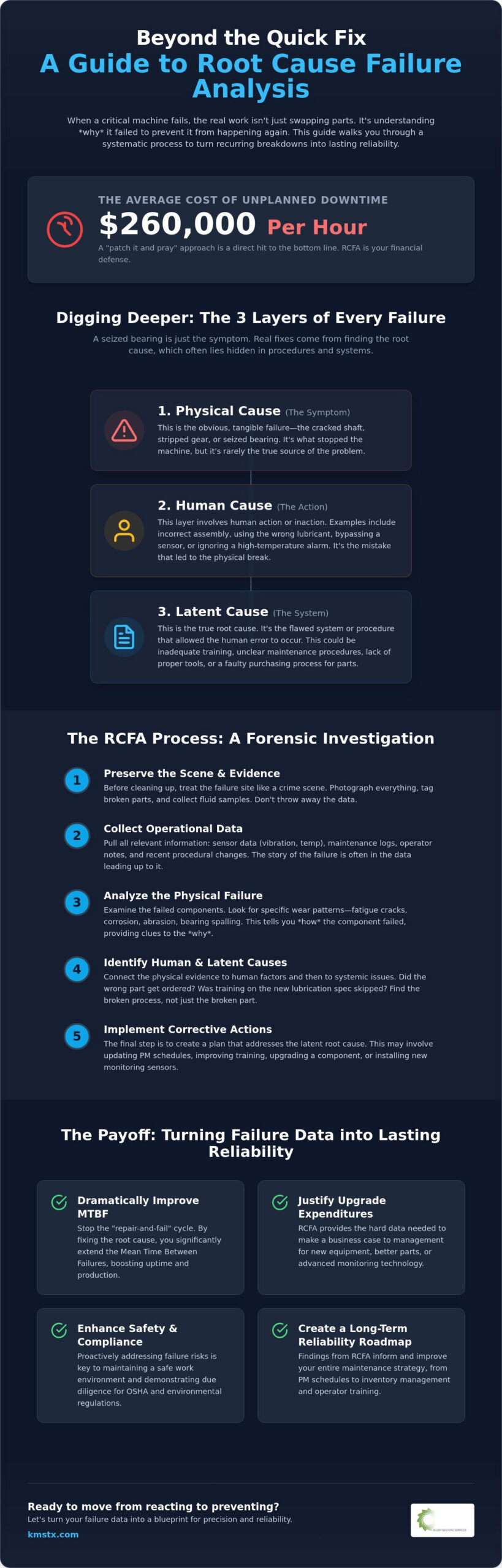
With the average cost of unplanned machinery downtime now reaching $260,000 per hour, the pressure to keep equipment running has never been higher. It’s incredibly frustrating to watch a critical gearbox or pump fail just weeks after a major overhaul, especially when management is pushing for a higher Mean Time Between Failures. If you’re stuck in a “repair-and-fail” cycle, implementing a systematic root cause failure analysis for machinery is the only way to break it. This process isn’t just about documenting what broke; it’s about uncovering the physical and latent issues that led to the fault so they don’t happen again.
You already know that swapping out a bearing without checking the lubrication system or shaft alignment is just a temporary fix. A “patch it and pray” approach is a recipe for another 3:00 AM emergency call. This guide promises to show you how to move beyond surface-level symptoms and use RCFA as a blueprint for precision restoration. We’ll walk through a repeatable process for identifying underlying faults, giving you the data-driven justification needed to explain specific repair or upgrade costs to the front office. It’s time to stop treating the symptoms and start fixing the disease.
Key Takeaways
- Learn how to move beyond basic troubleshooting by using root cause failure analysis for machinery to pinpoint the exact source of recurring equipment downtime.
- Discover the three layers of every failure, physical, human, and latent, so you can fix the procedural issues that often lead to mechanical breakdowns.
- Master the forensic steps of an investigation, including how to preserve evidence and use sensor data to inform your repair strategy.
- See how RCFA applies to complex assets like centrifuges and gearboxes to identify specific wear patterns and lubrication blockages.
- Turn your post-mortem data into a long-term reliability roadmap that helps update maintenance schedules and justifies necessary repair expenditures.
What is Root Cause Failure Analysis (RCFA) for Industrial Machinery?
Most maintenance teams are excellent at troubleshooting. When a pump stops or a blower starts vibrating, they find the broken part and swap it out. That’s fine for getting back online, but it doesn’t solve the “why.” Root cause failure analysis for machinery is a systematic engineering process that looks past the broken metal to find the physical, human, and latent triggers of the event. It’s the difference between replacing a blown fuse and figuring out why the circuit is overloading in the first place.
RCFA is the process of identifying why a component failed to ensure it never fails for that reason again. In high-stakes rotating equipment like industrial centrifuges or high-speed gearboxes, this level of detail is non-negotiable. A simple bearing failure in a decanter centrifuge might be caused by imbalance, but the root cause could be a flaw in the cleaning procedure or a vibration sensor that was bypassed months ago. Without a deeper look, you’re just waiting for the next breakdown.
To better understand how failure analysis improves long-term reliability, watch this technical overview:
RCFA vs. General Root Cause Analysis (RCA)
While people often use the terms interchangeably, there’s a distinction in the field. General Root Cause Analysis (RCA) is a broad methodology used across many industries to address everything from supply chain delays to administrative errors. RCFA is a specialized subset that focuses strictly on the technical and mechanical failure of the asset. For industrial maintenance teams, prioritizing the “Failure” aspect means looking at metallurgy, fatigue, and mechanical forces rather than just organizational charts. It’s about the physics of the machine.
The Economic Impact of Recurring Failures
The numbers behind downtime are staggering. Research from February 2026 shows that unplanned machinery downtime costs manufacturers an average of $260,000 per hour. When you look at those figures, the cost of a forensic investigation is a rounding error. By using root cause failure analysis for machinery, you can significantly improve your Mean Time Between Failures (MTBF). Instead of budgeting for the same repair every six months, you invest that capital into upgrades that prevent the failure entirely. This approach also keeps you in the clear for OSHA safety and environmental compliance, as it proves you’re managing risks rather than just reacting to them.
The Three Layers of Machinery Failure: Physical, Human, and Latent
When a critical blower or centrifuge goes down, the immediate reaction is usually to get it back in service as fast as possible. You find the seized bearing, press in a new one, and hit the start button. But if that’s where your investigation ends, you’ve only addressed the physical cause. Effective root cause failure analysis for machinery requires looking deeper into the human and latent layers that set the stage for the breakdown. If you don’t, you’re just resetting the clock on the next failure.
Think of it as a chain of events. The physical cause is the tangible reason the machine stopped, like a cracked shaft or a gear with stripped teeth. The human cause involves the actions, or lack thereof, that triggered that physical damage. This might be a technician using the wrong torque spec or an operator ignoring a high-temp alarm. However, the most important layer is the latent cause. These are the systemic issues, such as poor training or lack of vibration monitoring tools, that allowed the human error to happen in the first place. While the concept of a structured method for analyzing serious adverse events is often associated with high-stakes fields like medicine, the same logic applies to your shop floor. It helps you move from blaming a person to fixing the underlying system.
Physical Failure Mechanisms in Rotating Equipment
In heavy rotating assets, the physical culprits are usually easy to spot but hard to interpret. Fatigue, corrosion, and simple overload are the usual suspects. For instance, a bearing might show signs of pitting that suggest electrical discharge, but the real issue could be a lack of proper grounding. We often see that chronic vibration is the silent killer of these components. Utilizing dynamic balancing services can reveal physical imbalances that lead to premature bearing failure before they turn into catastrophic events. It’s vital to distinguish between the primary failure point and the consequential damage that happens when parts start flying.
Identifying Latent Systemic Weaknesses
This is where most shops miss the mark. A latent cause is often a management or procurement decision. For example, buying sub-standard industrial machine spare parts to save a few dollars on the front end can be a direct latent cause of a major outage later. If your procurement team isn’t aligned with your reliability goals, you’ll keep seeing the same “repeat offenders” on the repair stand. Inadequate maintenance intervals on high-speed assets also fall into this category. If you’re seeing a pattern of failures across similar machines, it’s time to look at your PM schedules and data logs rather than just the broken metal. If your team is struggling to keep up with these repeat issues, a professional gearbox repair and analysis can help reset your reliability baseline.
The RCFA Process: A Step-by-Step Forensic Investigation
- Step 1: Preservation of evidence. Keep everything exactly as it was at the moment of failure. Don’t clean the housing, don’t wipe away the grease, and definitely don’t discard any fractured components.
- Step 2: Data collection. Pull the vibration logs and temperature sensor data from the weeks leading up to the event. Review the maintenance history to see if any recent work might have contributed to the fault.
- Step 3: The physical teardown. This is where the mechanical reality sets in. As you disassemble the unit, you must meticulously note tolerances, fitments, and wear patterns. A bearing that’s difficult to remove tells a different story than one that slides off the shaft.
- Step 4: Hypothesis testing. Use tools like the “5 Whys” or Fishbone Diagrams to narrow down the possibilities. If you think it’s a lubrication issue, does the wear pattern on the gears support that theory?
- Step 5: Final reporting and corrective action. The end result isn’t just a list of broken parts; it’s a prescribed repair scope that addresses the root cause so the machine stays in the field longer.
Preserving the Evidence on the Shop Floor
Cleaning up the mess is the worst thing you can do for a failure analysis. Valuable clues are often found in the debris or the way the oil looks in the sump. Before you pull the equipment, take high-resolution photographs of it in situ. Look for external signs like loose mounting bolts, leaking seals, or frayed wiring. Collecting oil samples and metal debris for lab analysis can reveal if the failure was caused by external contamination or internal component fatigue. If you skip this, you’re just guessing during the teardown.
Advanced Diagnostic Tools in RCFA
A simple visual inspection often isn’t enough to find the real culprit. Metallurgical examination is frequently required to identify the specific type of stress fractures present in a shaft or gear tooth. This level of detail helps distinguish between a manufacturing defect and an operational overload. Historical rotating equipment maintenance data is also vital, as it provides the “before” picture that makes the “after” analysis much clearer. By using non-destructive testing (NDT) like dye penetrant or ultrasonic testing, you can find cracks that are invisible to the naked eye, ensuring that root cause failure analysis for machinery is based on hard data rather than assumptions.
Applying RCFA to Specific Industrial Assets
While the forensic process remains consistent, the way symptoms manifest depends entirely on the asset’s design. Root cause failure analysis for machinery isn’t a one-size-fits-all exercise. A decanter centrifuge has different failure drivers than a multi-stage centrifugal pump. By applying specific engineering filters to each asset, you can move from a generic “it broke” to a precise understanding of why it failed and how to upgrade it. This technical approach is what separates a basic fix from a true reliability improvement.
Centrifuge-Specific Failure Modes
In the world of centrifuges, high-speed vibration signatures are the most common alarm. However, an imbalance in the rotating assembly is often just a symptom of something deeper, like uneven bowl wear or issues with the scroll pitch. If you just balance the bowl without checking the feed material consistency, you’re ignoring a potential failure driver. Abrasive solids can erode flighting faster than expected, leading to the very imbalances you’re trying to fix. This level of analysis is exactly what informs a smart industrial centrifuge repair strategy. It ensures that when the unit goes back together, it’s actually better suited for the process than it was before.
Gearbox Restoration Through Analysis
Gearboxes tell their stories through tooth pitting and casing alignment. A successful industrial gearbox repair has to start with identifying why the gears stripped or pitted in the first place. Is it a lubrication path blockage, or is the casing integrity compromised? If the bore alignment is off by even a few thousandths, no amount of new gears will keep that unit running long-term. RCFA often leads us to upgrade seal designs to prevent future contamination, which is a major cause of oil breakdown and subsequent gear failure. Analyzing the casing and bores ensures the foundation of the repair is solid.
Pumps present their own challenges, mainly revolving around cavitation and seal failure. Cavitation isn’t just a noise; it’s a physical attack on the impeller that can lead to shaft deflection and catastrophic seal loss. When we perform root cause failure analysis for machinery in a pumping system, we look at the suction conditions and piping as much as the pump itself. If the system isn’t designed to feed the pump correctly, you’ll be replacing seals every month until the underlying hydraulic issue is solved. If you’re seeing repeat failures on your critical assets, reach out to our team for a professional gearbox repair or asset evaluation today.
Turning Failure Data into Long-Term Machinery Reliability
Once the teardown is complete and the data has been logged, the real work of improving your plant’s reliability begins. The final report from a root cause failure analysis for machinery shouldn’t be viewed as just a technical post-mortem or a list of replaced parts. Instead, it serves as a strategic roadmap for the machine’s next five to ten years of service. A list of broken components tells you what happened, but the analysis tells you how to prevent it from happening again. This transition from data collection to active implementation is where you stop paying for the same repairs twice.
A specialized machine shop plays a critical role here. While an OEM might suggest a “blind” replacement of an entire sub-assembly, a shop focused on forensic restoration looks for ways to improve the original design. If a shaft failed due to a stress riser that the OEM overlooked, we can use custom machining to change the radius and eliminate the weak point. Partnering with an expert service provider means you’re getting an engineering upgrade, not just a factory-spec replacement that carries the same inherent flaws as the failed unit.
Updating the Maintenance Strategy
The insights gained from RCFA must be fed directly back into your Computerized Maintenance Management System (CMMS). If the analysis proves a bearing failed because of a specific lubrication interval error, your PM schedule needs an immediate update. It’s also the time to address the human causes identified in the report. This might involve retraining operators on how to spot early warning signs or tightening up emergency machine repair protocols to ensure an RCFA is triggered every time a critical asset goes down. Moving from reactive to proactive maintenance is the only way to protect your bottom line against recurring downtime risks.
The Kelsey Machine Services Advantage
At Kelsey Machine Services, we bring over four decades of experience in diagnosing and restoring heavy rotating assets to every project. Our “shop-first” approach means we don’t just rely on digital reports; we get our hands on the metal to see exactly how the components reacted under stress. We understand the day-to-day realities of industrial operations and the pressure maintenance managers face to increase MTBF. Our in-house capabilities, including custom machining and dynamic balancing, allow us to execute the precise repairs called for in a root cause failure analysis for machinery. We don’t just guess why a gearbox or centrifuge failed. We find the proof, fix the fault, and get your equipment back into the field with a level of reliability that often exceeds the original manufacturer’s standards.
Elevating Your Reliability Through Forensic Restoration
Kelsey Machine Services brings over 40 years of industrial mechanical experience to every teardown. Whether you’re dealing with a seized centrifuge or a pitted gearbox, our full-service shop utilizes dynamic balancing and custom machining to restore your assets with precision. We also offer 24/7 emergency response for those critical failures that just can’t wait. It’s time to stop guessing why your machines are failing and start building a more reliable operation. Request a Technical Consultation for Your Rotating Equipment today and let’s get your facility running the way it should.
Frequently Asked Questions
What is the difference between RCA and RCFA?
RCFA is a specialized subset of Root Cause Analysis (RCA) that focuses strictly on the technical and mechanical aspects of an asset’s failure. While a general RCA might look at administrative issues or supply chain delays, a root cause failure analysis for machinery dives into the physics of the event. It examines metallurgy, fatigue, and mechanical forces to determine exactly why a component failed. This distinction is vital for maintenance teams who need to fix the hardware itself.
When should we trigger a full Root Cause Failure Analysis?
You should trigger a full investigation whenever a failure causes significant unplanned downtime or involves a “repeat offender” machine. Critical assets like main process centrifuges or high-speed gearboxes always warrant a deeper look. If the repair cost is high or there’s a risk to personnel safety, skipping the analysis is a gamble you don’t want to take. It’s better to find the source now than to fix it again in six months.
How long does a typical machinery failure investigation take?
A typical investigation timeline depends on the complexity of the machine and the depth of lab testing required. You can usually get preliminary teardown findings within 24 to 48 hours of the equipment arriving at the shop. However, if we need to send samples out for metallurgical stress testing or advanced oil debris analysis, a final, comprehensive report might take one to two weeks to complete. We prioritize speed without sacrificing technical accuracy.
Can RCFA be performed on-site or does the equipment need to go to a shop?
The process starts on-site but usually finishes in a controlled shop environment. You need to preserve evidence and collect vibration data before the unit is moved. However, a proper forensic teardown requires precision tools and a clean space to measure tolerances and fitments accurately. Most high-stakes root cause failure analysis for machinery is performed at a specialized facility where custom machining and dynamic balancing tools are readily available for a full restoration.
What are the most common root causes of centrifuge failure?
Centrifuge failures are frequently driven by feed material inconsistency and abrasive wear on the scroll flighting. While high vibration is the most common symptom, the root cause is often found in the gearbox or the lubrication system. Blocked oil paths can lead to bearing fatigue, which eventually throws the entire rotating assembly out of balance. Identifying these latent issues during the repair is the only way to ensure a long-lasting, reliable fix.
Is RCFA worth the cost for smaller industrial pumps or blowers?
It’s absolutely worth it if the asset is critical to your process or fails repeatedly. Even if a pump is relatively inexpensive to replace, the cost of labor, gaskets, and lost production adds up quickly. Performing a targeted analysis on a “small” asset can reveal systemic issues like pipe strain or incorrect seal selection that, once fixed, will save you thousands in recurring maintenance costs and prevent future headaches for your crew.
How do we present RCFA findings to management to secure repair budgets?
Present your findings by focusing on the impact on Mean Time Between Failures (MTBF) and the total cost of ownership. Management cares about the bottom line, so use your report to show how a specific upgrade prevents a $260,000 per hour downtime event. Providing data-driven proof of a latent cause, like a design flaw or a procurement issue, makes it much easier to justify the expenditure for a precision restoration instead of a “patch” job.
Does RCFA help with insurance claims for machinery breakdown?
A detailed forensic report is an invaluable tool when dealing with insurance adjusters. It provides objective, third-party evidence of the specific failure mechanism, which helps prove that an event was “sudden and accidental” rather than just standard wear and tear. Having a documented trail of data, photographs, and metallurgical findings can significantly speed up the claims process and help ensure you receive the proper coverage for the repair of your asset.