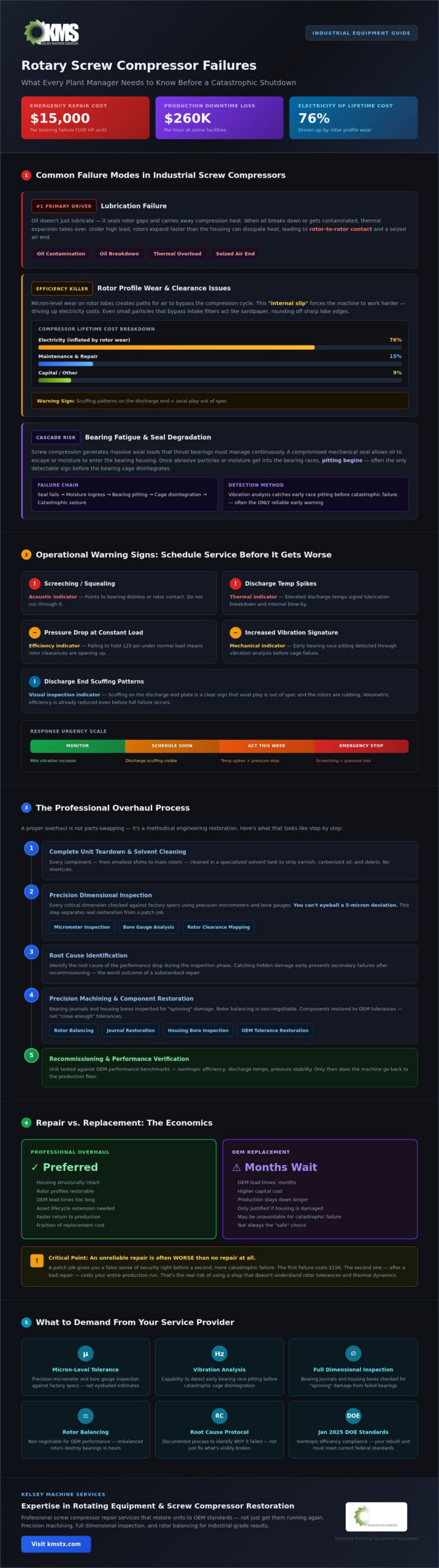
A single unplanned bearing failure on a 100 HP rotary screw compressor can trigger $15,000 in emergency repair costs, but that is nothing compared to the $260,000 per hour some facilities lose in production downtime. It’s a nightmare scenario every plant manager fears, especially when OEM lead times for new units are stretching into months. You know that a quick patch job isn’t enough when your entire production line depends on a steady 125 psi. You need professional screw compressor repair services that actually understand the tight tolerances and thermal dynamics involved in high-stakes industrial restoration.
We recognize that an unreliable repair is often worse than no repair at all. It gives you a false sense of security right before a second, more catastrophic failure occurs. This technical guide explains the critical requirements for restoring industrial units to OEM standards while minimizing operational downtime. We will break down the necessity of precision machining, the impact of the January 2025 DOE isentropic efficiency standards, and how a structured overhaul can extend your asset lifecycle. It is about moving beyond simple parts replacement to achieve a true engineering restoration that holds up under pressure.
Key Takeaways
- Learn how to evaluate the structural integrity of your compressor housing to determine if a full mechanical restoration is more cost-effective than a total replacement.
- Discover the precision steps involved in professional screw compressor repair services, including why micrometer inspections and rotor balancing are non-negotiable for OEM performance.
- Identify the specific acoustic and thermal indicators, like screeching or discharge temperature spikes, that signal internal wear before it leads to catastrophic production downtime.
- Understand the primary drivers of lubrication failure and how maintaining extremely tight rotor tolerances can extend your equipment’s lifecycle and restore peak efficiency.
Common Failure Modes in Industrial Screw Compressors
Industrial screw compressors are precision instruments disguised as heavy iron. The entire system relies on the microscopic clearance between the male and female rotors. If that gap changes by even a few microns, you aren’t just losing air; you’re inviting a mechanical collision. Understanding Rotary-screw compressor technology is the first step in diagnosing why a unit is underperforming. Most facilities wait until a total breakdown to look for screw compressor repair services, but the smart money is on catching these failure modes early.
Lubrication failure is the primary driver of most emergency calls. Oil doesn’t just lubricate; it seals the gaps and carries away the heat of compression. When the oil breaks down or becomes contaminated, thermal expansion takes over. Under high loads, the rotors can expand faster than the housing can dissipate heat, leading to rotor-to-rotor contact. This isn’t a theoretical risk. It’s a reality that ends in a seized air end and a massive repair bill.
To better understand how these components are handled during a professional teardown, watch this video on the maintenance and assembly process:
Rotor Profile Wear and Clearance Issues
Micron-level wear on the rotor lobes creates a path for air to bypass the compression cycle. This “internal slip” forces the machine to work harder to maintain pressure, driving up electricity costs, which account for roughly 76% of a compressor’s lifetime expense. Contaminant ingress is a major factor here. Even small particles that bypass the intake filter act like sandpaper on the rotor profiles, rounding off the sharp edges. If you see “scuffing” patterns on the discharge end, it’s a clear sign that axial play is out of spec and the rotors are rubbing against the end plate. This wear reduces volumetric efficiency long before the machine actually fails.
Bearing Fatigue and Seal Degradation
Screw compression generates massive axial loads that the thrust bearings must manage constantly. Mechanical seal failure often precedes bearing contamination, as a compromised seal allows oil to escape or moisture to enter the bearing housing. Once abrasive particles or moisture get into the bearing races, pitting begins. Identifying early signs of bearing race pitting through vibration analysis is critical. It’s often the only way to catch a problem before the bearing cage disintegrates. When you’re looking for screw compressor repair services, ensure the shop has the capability to perform a full dimensional inspection of the bearing journals and housing bores to ensure they haven’t been “spun” or damaged by a failed bearing.
The Technical Process of a Professional Compressor Overhaul
A professional overhaul isn’t just about swapping out bearings and slapping on a new coat of paint. It is a methodical engineering restoration that starts with a complete unit teardown. Every component, from the smallest shim to the main rotors, gets cleaned in a specialized solvent tank to strip away varnish, carbonized oil, and debris. Once the parts are clean, the real work begins. We use precision micrometers and bore gauges to check every critical dimension against factory specs. You can’t eyeball a five-micron deviation, and this level of detail is what separates high-quality screw compressor repair services from a shop that just “fixes” things.
During this inspection phase, we identify the root cause of the performance drop. For a deeper look at the technical benchmarks we use during these evaluations, the U.S. Department of Energy provides an excellent technical resource on Common Failure Modes in Industrial Screw Compressors. Identifying these issues early in the teardown prevents us from missing hidden damage that could cause a secondary failure after the machine is commissioned.
Precision Machining and Component Restoration
Rotor journals and seal areas often take the brunt of the abuse in a high-load environment. When we find wear or scoring, we don’t just scrap the rotor. We utilize industrial hard chrome plating to build the surface back up before grinding it to restore perfect concentricity. In cases where OEM parts are on a six-month lead time, we’ll often perform custom machining to fabricate bushings or sleeves. This approach keeps your project moving without sacrificing the structural integrity of the air end. It’s about restoring the machine’s ability to hold pressure, not just making it spin again.
Dynamic Balancing and Rotor Alignment
This is where many shops fall short. Screw compressor rotors often spin at 3600 RPM or higher, and at those speeds, even a tiny imbalance creates massive centrifugal forces. These forces will chew through your new bearings in a matter of weeks. Every rotor set we handle undergoes precision dynamic balancing to ensure operational stability. We use multi-plane balancing to verify the unit stays quiet and vibration-free throughout its entire speed range. Finally, we verify the alignment between the air end and the prime mover to prevent parasitic vibration from entering the system.
The reassembly process requires strict discipline. We follow OEM torque sequences and clearance settings to the letter to guarantee the unit hits its rated efficiency. If your equipment is struggling to maintain pressure or making unusual noises, our team can provide the technical compressor repair needed to get your plant back to full capacity. High-quality screw compressor repair services should always return a machine that looks and performs like it just came off the assembly line.
Evaluating the Economics: Repair vs. Replacement
Deciding whether to overhaul an existing air end or invest in a new machine is one of the most critical financial choices a maintenance manager faces. It’s easy to look at a quote for screw compressor repair services and compare it to the sticker price of a new unit, but that’s an incomplete calculation. You have to account for the “hidden” costs of replacement. New machines often require significant piping modifications, footprint adjustments, and electrical upgrades to accommodate different motor efficiencies or drive types. These installation costs can sometimes equal 20% to 30% of the unit’s purchase price, a factor often overlooked in the initial budget.
Lead times are another major variable in the equation. A professional restoration usually takes a few weeks to complete. In contrast, sourcing a new OEM unit in the current market can take several months due to supply chain constraints. If your facility is losing money every hour the line is down, that time gap is often the deciding factor. A repair gets you back to full capacity much faster than waiting for a shipping container to arrive from overseas.
When a Housing is Beyond Economical Repair
The decision starts with the casing. We look for stress cracks or severe cavitation in the main housing. While “stitching” or welding cast iron is possible in some low-pressure applications, it’s rarely a reliable long-term fix for the high-pressure environment of a screw compressor. We evaluate if the housing bores can be bored and sleeved successfully without compromising the wall thickness. If the structural integrity of the casting is gone or the rotor-to-housing clearances can’t be restored to OEM specs, the unit is beyond economical repair. In these cases, we’ll be the first to tell you that a replacement is your only safe path forward.
Lifecycle Extension and Warranty Reliability
A properly refurbished unit can match the MTBF (Mean Time Between Failures) of a new machine. This is because we aren’t just replacing parts; we’re correcting the clearance issues and imbalances that caused the original failure. Obtaining a comprehensive warranty on both labor and parts is non-negotiable. It gives you the same peace of mind as a new purchase but at a fraction of the capital expense. Integrating a structured program for rotating equipment maintenance is the best way to protect this investment. By catching vibration or temperature spikes early, you ensure the restored unit reaches its full design life. Choosing professional screw compressor repair services is about maximizing the value of your existing assets while maintaining the highest levels of reliability.
Operational Indicators: When to Schedule Service
You don’t need a PhD in acoustics to know when an air end is in trouble, but you do need to pay attention to the subtle shifts in operational data. Waiting for a high-temperature shutdown is a reactive strategy that usually leads to expensive screw compressor repair services. By the time the control panel throws a fault code, the internal damage is often extensive. Proactive monitoring focuses on the early warning signs that show up in the vibration profile and the discharge air temperature before they lead to a catastrophic seizure.
Discharge temperature spikes are a classic indicator of internal air recirculation. When rotor profiles are worn or clearances have opened up, compressed air slips back to the suction side. This air is already hot, and re-compressing it drives temperatures even higher. If you see a steady 5 to 10 degree climb over a month without a change in ambient conditions, your volumetric efficiency is dropping. You’re paying more for less air, and you’re cooking your lubricants in the process. This thermal stress eventually breaks down the oil’s molecular structure, leaving the bearings vulnerable to rapid wear.
Vibration Analysis and Acoustic Signatures
Vibration analysis is the gold standard for predicting bearing failure. It’s important to differentiate between motor-related vibrations, such as electrical unbalance, and air-end mechanical issues like rotor rub or bearing race pitting. High-frequency acoustic monitoring can often catch a seal leak or a failing bearing cage long before it registers on a standard vibration sensor. By establishing a baseline when the machine is healthy, you can spot frequency peaks that indicate specific component wear. If you’re seeing increased amplitude at the rotor mesh frequency, it’s a clear signal that the rotors are no longer tracking perfectly. Catching this early allows for a planned intervention rather than an emergency shutdown.
Oil and Lubrication Health Monitoring
If you’re noticing these indicators, don’t wait for the unit to seize. Our team can help you interpret this data and provide the necessary compressor repair to keep your facility running smoothly. Identifying these issues early is the key to minimizing the scope of work and getting the most out of your screw compressor repair services.
Kelsey Machine Services: Expertise in Rotating Equipment
Kelsey Machine Services (KMS) stands as a technical leader in the restoration of high-performance rotating equipment. We don’t just specialize in one brand; our team provides technical restoration for all major industrial screw compressor manufacturers. Whether you’re running a Sullair, Ingersoll Rand, or Atlas Copco, we understand the specific engineering nuances required to bring these machines back to life. Our facility is purpose-built for heavy machining, dynamic balancing, and precision assembly. We know that when a compressor goes down, the clock is ticking on your profitability. That’s why we’ve streamlined our screw compressor repair services to prioritize rapid turnaround times without cutting corners on technical accuracy.
Comprehensive Machine Shop Capabilities
Having a full-scale machine shop under the same roof as our assembly floor is a massive advantage for our clients. It means we don’t have to wait on third-party vendors to turn a rotor journal or fabricate a custom sleeve. If a part is obsolete or has an impossible lead time, we can often manufacture it in-house to match original OEM specifications. This capability is backed by our extensive industrial machine spare parts inventory, which allows us to respond to failures with surgical precision. Our technicians use their decades of field experience to ensure every tolerance and surface finish meets the rigorous demands of industrial service.
24/7 Emergency and Field Service Response
Sometimes, the logistics of pulling a 500 HP air end and shipping it to a shop aren’t feasible in the first few hours of a crisis. Our field service team provides on-site troubleshooting and diagnostics to determine the best course of action. If the unit can be repaired in place, we’ll do it. If it needs to come to our facility for heavy machining, we’ll coordinate the transport. Our emergency machine repair protocols are designed specifically for the high-stakes environment of the Gulf Coast’s industrial corridor. We recognize that unplanned downtime isn’t just an inconvenience; it’s a threat to your facility’s operational integrity.
When you partner with KMS, you’re getting more than just a repair shop. You’re getting a team of specialists who understand the science of rotating equipment. We utilize empirical data and precise measurement to ensure your restored assets perform at peak efficiency for years to come. Choosing the right screw compressor repair services means choosing a partner who treats your equipment with the same gravity and technical focus that you do. We’re here to solve your most complex mechanical challenges and keep your plant running at full capacity.
Restoring Operational Reliability to Your Air System
Managing high-stakes industrial equipment requires a balance of technical precision and economic foresight. We’ve explored how identifying early indicators like vibration spikes and thermal shifts can prevent a total air-end seizure. A professional overhaul isn’t just a patch; it’s an engineering restoration that utilizes precision machining and dynamic balancing to meet OEM standards. By choosing specialized screw compressor repair services, you’re investing in an asset lifecycle extension that avoids the massive lead times and capital costs associated with new unit procurement.
With over 40 years of industrial rotating equipment experience, Kelsey Machine Services provides the technical expertise needed to handle your most complex restoration projects. Our facility is fully equipped for in-house precision machining and dynamic balancing, ensuring every component meets exact tolerances. We also offer 24/7 emergency field service support to keep your operations running through the toughest challenges. It’s about more than just fixing machines; it’s about providing a warranted solution you can trust under pressure.
Contact Kelsey Machine Services for an Expert Repair Quote to get your facility back to peak efficiency. Your equipment is the backbone of your production, and we’re ready to help you protect it.
Frequently Asked Questions
How long does a typical industrial screw compressor repair take?
A typical industrial screw compressor repair usually takes between two to four weeks. This timeline accounts for a complete teardown, solvent cleaning, and the precision measurement of all internal clearances. If we find that the rotors require industrial hard chrome plating or if we need to fabricate custom bushings, we’ll update you on how that impacts the final delivery date.
Is it possible to repair rotors that have made contact?
Yes, rotors that have made contact can often be restored through industrial hard chrome plating and precision grinding. We build up the worn or scored surfaces and then grind them back to the exact OEM profile. However, if the contact was violent enough to warp the rotor shaft or cause deep structural cracks, the component might be beyond saving and require a full replacement.
What is the difference between a minor service and a major overhaul?
A minor service focuses on external maintenance like changing oil, filters, and separator elements to keep the machine running. In contrast, a major overhaul involves a complete teardown of the air end to replace all bearings and seals while inspecting the rotors for wear. Major screw compressor repair services restore the internal clearances that are critical for maintaining the unit’s original volumetric efficiency.
Can you repair screw compressors from different manufacturers?
We provide technical restoration for all major industrial screw compressor brands, including Sullair, Ingersoll Rand, Atlas Copco, and Gardner Denver. Our shop is equipped with the specialized tooling and dimensional data required to work on various air end designs. You don’t need to go back to the original manufacturer for a high quality repair that meets or exceeds factory standards.
How do you ensure the compressor meets original performance specs after repair?
We ensure performance by strictly adhering to OEM clearance specifications and using precision micrometers for all final inspections. Every rotor set undergoes dynamic balancing to eliminate vibration that could lead to premature failure. After reassembly, we verify that the unit holds pressure and operates within the correct temperature range to guarantee it hits its rated cfm and efficiency targets.
What are the most common causes of premature bearing failure in screw compressors?
High axial loads and improper belt tensioning are major contributors to bearing fatigue in these units. When the thrust bearings are forced to work beyond their design limits, the heat generated can lead to cage failure. Regular vibration monitoring helps us catch these issues before they turn into a seized air end, allowing for a planned repair rather than a catastrophic breakdown.
Do you provide on-site troubleshooting before removing the equipment?
Yes, our field service team provides on-site troubleshooting to diagnose issues before you commit to pulling the machine. We use vibration analysis and thermal imaging to determine if the problem is in the air end, the motor, or the external piping. This step often saves time and money by identifying simple fixes that don’t require shop transport for screw compressor repair services.
What kind of warranty is provided on a refurbished air end?
We provide a comprehensive warranty on both labor and parts for all refurbished air ends to give you peace of mind. While specific terms can vary based on the scope of the project and the components replaced, our goal is to ensure the machine performs reliably for the long haul. This warranty reflects our confidence in the precision machining and assembly work performed in our facility.