Sticking with the original manufacturer just because their name is on the nameplate is often the most expensive way to guarantee your equipment underperforms. You’ve likely dealt with the frustration of a six-month lead time for a proprietary part or a service contract that feels more like a hostage situation than a partnership. It’s a common reality in heavy industry where legacy machines are often labeled obsolete by the manufacturer long before their mechanical life is actually over. Finding viable alternatives to OEM for equipment repair isn’t just about saving a few bucks; it’s about regaining control over your production schedule and your bottom line.
We understand that reliability is your primary concern when moving away from factory-backed service. This guide explores how specialized engineering alternatives can actually outperform original equipment manufacturers in lead times, technical precision, and overall equipment longevity. You’ll discover how independent experts restore critical assets like centrifuges, gearboxes, and pumps to better-than-original specifications. We will also examine the benefits of having direct access to technical experts who prioritize your uptime over a rigid corporate sales script.
Key Takeaways
- Identify when to shift from basic parts replacement to full technical refurbishment to solve recurring mechanical failures.
- Navigate the “warranty myth” and learn how detailed Teardown & Inspection (T&I) reporting ensures your third-party repairs meet or exceed original standards.
- Evaluate the true cost of downtime by comparing rigid OEM schedules against the flexible capacity of specialized machine shops.
- Explore how specialized engineering serves as one of the most effective alternatives to OEM for equipment repair, especially for legacy or “obsolete” assets.
- Discover how superior alloys and precision machining can actually improve equipment longevity beyond the factory’s original design.
What Are the Primary Alternatives to OEM for Equipment Repair?
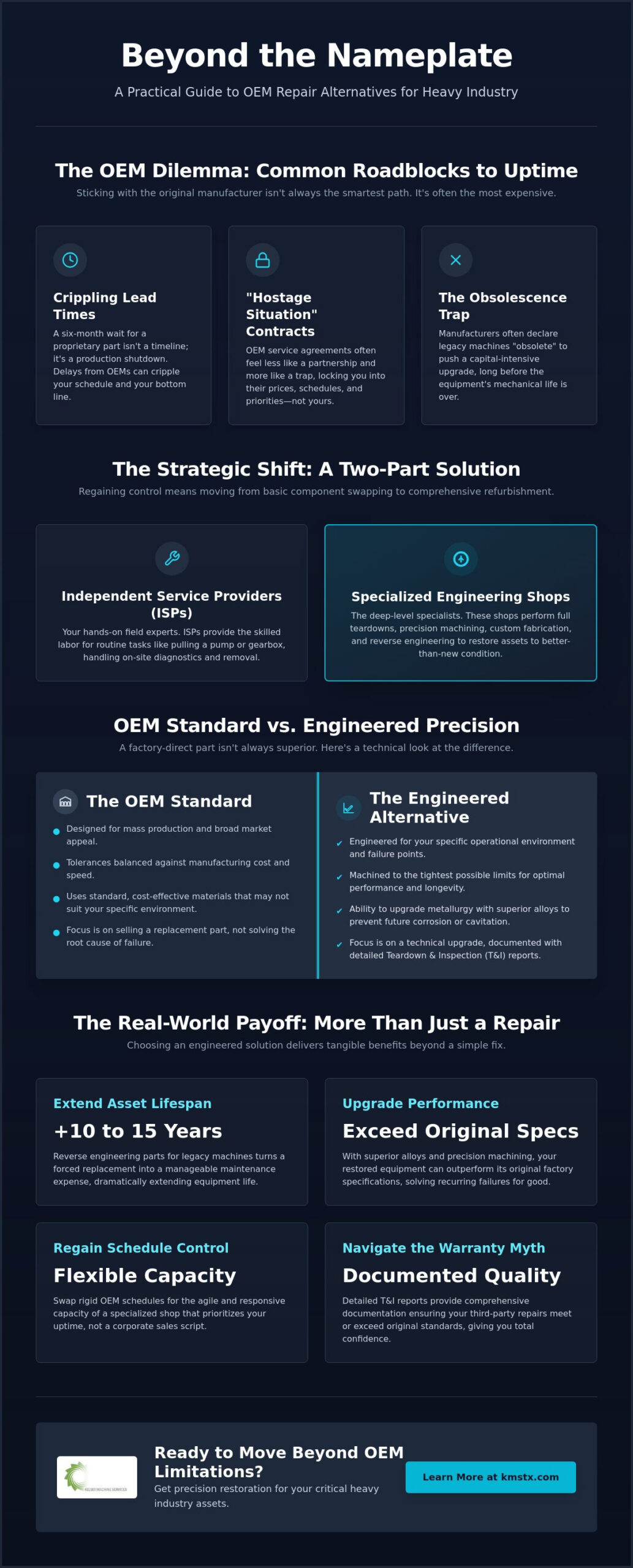
For decades, the standard operating procedure for critical rotating equipment was simple: if it breaks, you call the manufacturer. However, the rigid nature of OEM service contracts and escalating costs have forced a shift in strategy across heavy industry. Today, the primary alternatives to OEM for equipment repair involve a move toward Independent Service Providers (ISPs) and specialized engineering shops. This isn’t just about finding cheaper parts. It’s about a fundamental shift from basic component swapping to comprehensive technical refurbishment and modernization.
Industry veterans are increasingly pivoting away from exclusive OEM agreements in 2026 because the traditional model often prioritizes new equipment sales over the maintenance of existing assets. When you choose an engineered solution over a standard aftermarket part, you aren’t just getting a copy; you’re getting a component designed to fix the specific failure points of the original. This movement is supported by the growing Right to Repair movement, which advocates for broader access to the tools and data needed to keep machinery running without manufacturer interference.
To better understand how these service models differ, watch this helpful video:
Independent Service Providers (ISPs) vs. Specialized Machine Shops
Not all independent providers are built the same. ISPs typically focus on field service, providing the labor to pull a pump or a gearbox. They are great for routine tasks, but they often lack the heavy-duty machining centers required for complex restoration. Specialized machine shops handle the deep-level work. They perform full teardowns, inspections, and custom fabrication. For critical assets like centrifuges or compressors, you need a partner who can balance field expertise with high-precision shop capabilities.
Escaping the OEM Obsolescence Trap
One of the biggest pains in heavy industry is the “obsolescence” tag. An OEM might decide to stop supporting a specific model to push you toward a capital-intensive upgrade. This is a trap. Independent shops use reverse engineering to manufacture high-quality parts for legacy machines that the OEM has abandoned. By focusing on the metallurgy and tolerances of the actual application, these shops can often extend the life cycle of a machine by 10 to 15 years. It turns a forced equipment replacement into a manageable maintenance expense.
Technical Benchmarking: OEM Standards vs. Precision Engineering
The assumption that a factory-direct part is always the superior choice often falls apart under technical scrutiny. OEMs design for mass production and broad market appeal, which means their material choices and tolerances are balanced against manufacturing costs. In contrast, independent engineering shops can focus on the specific operational environment of your machine. When you explore alternatives to OEM for equipment repair, you gain the ability to upgrade metallurgy. For example, if a standard pump impeller keeps cavitating or corroding, a specialized shop can fabricate a replacement using a superior alloy that the manufacturer doesn’t offer. This isn’t just a repair; it’s a technical upgrade.
Precision machining in an independent shop often exceeds factory standards because the focus shifts from ‘standard’ tolerances to ‘optimal’ performance. While a manufacturer might accept a broader range of clearances to speed up assembly, an expert machinist works to the tightest possible limits to ensure longevity. The Future of Third-Party Maintenance is built on this ability to verify and document every micron of accuracy. Every critical dimension is recorded during the teardown and verified again during final assembly to ensure the asset meets or exceeds original specifications.
Dynamic Balancing and Operational Stability
For high-speed rotating equipment, vibration is the primary enemy of bearing life and seal integrity. This is why precision dynamic balancing services Houston are non-negotiable for assets like high-speed decanter centrifuges. While an OEM might balance a rotor to a “good enough” factory level, an independent shop can target much tighter G-force ratings. Scientific verification through ISO 1940-1 protocols is utilized to ensure every component is balanced to a specific grade, often reaching G1.0 or better for sensitive applications. This level of precision significantly reduces harmonic vibration and extends the mean time between failures.
Custom Machining and Component Fabrication
Standardized parts don’t always account for the unique wear patterns of a machine that has been in service for a decade. Specialized shops use CNC technology to achieve micron-level accuracy when fabricating one-off components like shafts or seal sleeves. This allows for custom fits that compensate for housing wear, effectively restoring the machine to a “better than new” state. We’ve seen many cases where a custom-machined seal outperformed the factory original simply because it was designed for the actual fluid and pressure conditions of the site. If your equipment is struggling with recurring failures, it might be time to consult with a technical expert about an engineered solution.
Evaluating the Risks: Reliability, Warranty, and Certification
The biggest hurdle for many maintenance managers considering alternatives to OEM for equipment repair is the fear of voiding a factory warranty. It’s a common misconception that often keeps operations locked into high priced service contracts. In the industrial world, the legal reality is much more flexible than a sales rep might lead you to believe. Navigating the business puzzle of equipment repair requires looking past the scare tactics and focusing on actual performance data. High end independent shops don’t just fix machines; they provide performance warranties that often match or exceed what the factory offers.
Transparency is the best way to manage risk. When an OEM performs a repair, you often get a generic invoice and a “passed” sticker. A specialized independent shop provides a comprehensive Teardown and Inspection (T&I) report. This includes material traceability for every alloy used and documented metallurgical integrity. You aren’t just taking their word for it; you’re getting a data backed record of the entire restoration process. This level of documentation is critical for maintaining your own internal quality standards and insurance requirements.
Teardown, Inspection, and Failure Analysis
A professional industrial centrifuge repair Texas doesn’t start with a wrench; it starts with a camera and a microscope. We focus on root cause failure analysis to determine why the asset stopped working in the first place. Was it a lubrication failure, an imbalance issue, or a metallurgical mismatch? Moving beyond a simple “fix it” mentality to a “prevent it” strategy is what keeps your plant running. Detailed digital reporting with photographic evidence gives you a permanent, transparent record for your maintenance history.
Quality Assurance and Testing Protocols
Reliability is proven in the test bay, not on the sales floor. Independent providers utilize hydrostatic testing, spin testing, and load testing to certify that the equipment is ready for the field. You should demand that any alternative provider follows strict shop standards that meet or exceed original equipment manufacturer performance benchmarks. This verification process ensures that when the asset is reinstalled, it performs exactly as expected under full operational load. It’s about building trust through empirical results rather than brand names.
Decision Framework: When to Choose an Alternative Provider
Deciding when to step outside the manufacturer’s ecosystem requires a technical matrix rather than a gut feeling. While the default choice is often the factory, smart maintenance managers use a specific framework to determine if alternatives to OEM for equipment repair offer a better path forward. This decision shouldn’t be based solely on the repair quote; it’s about the total cost of ownership and the operational reality of your plant. Use these five steps to evaluate your next major overhaul:
- Step 1: Evaluate Equipment Criticality. Calculate your hourly cost of downtime. If a machine is the heartbeat of your production line, a faster turnaround time is worth more than a factory nameplate.
- Step 2: Compare Lead Times. Ask the OEM for an honest shipping date for proprietary parts. Then, compare that against an independent shop’s ability to manufacture or source those components from their own inventory.
- Step 3: Analyze Asset Age. If your equipment is more than a decade old, the OEM might have moved it to ‘legacy’ status, meaning technical support is likely minimal and parts are overpriced.
- Step 4: Assess Customization Needs. Determine if you need the machine to perform exactly as it did on day one, or if you need engineering upgrades to handle current site conditions that the original design didn’t account for.
- Step 5: Review Brand Track Record. Ensure the alternative provider has documented experience with your specific rotating assets, whether you’re running Bird, Alfa Laval, or Sharples systems.
Lead Time vs. Cost: The True ROI of Alternatives
The financial impact of a 12 week OEM lead time compared to a 3 week independent shop turnaround can be staggering. If your production line is sitting idle, the ‘cheaper’ factory part becomes the most expensive component you’ve ever bought. Sourcing industrial machine spare parts Texas from a shop with a large on site inventory allows you to bypass global supply chain bottlenecks. It’s about getting the asset back into the process as quickly as possible without sacrificing the technical integrity of the repair.
Custom Solutions for Unique Operational Challenges
Standard OEM parts are designed for a ‘typical’ environment, but your site might deal with extreme pH levels or high concentrations of abrasives that cause premature failure. Independent shops have the flexibility to work with your engineers to modify equipment for higher throughput or better separation efficiency. They can perform 24/7 emergency work that corporate OEMs often decline due to rigid scheduling. If you need a partner who understands the day to day realities of your operation, contact our engineering team to discuss a tailored restoration plan for your critical assets.
Kelsey Machine Services: Precision Restoration for Heavy Industry
Kelsey Machine Services has spent over four decades specializing in the technical overhaul of rotating machinery. We don’t view ourselves as just one of the many alternatives to OEM for equipment repair; we see our role as a technical partner dedicated to improving your asset’s performance. Our commitment is simple: we restore your equipment to original factory specifications or better. We understand that in heavy industry, a nameplate is less important than the tolerances and metallurgical integrity of the actual machine.
Our team takes a direct, expert approach to every project. We speak the language of the shop floor because that’s where the real work happens. You won’t deal with layers of corporate sales reps who have never seen the inside of a centrifuge. Instead, you get direct access to the engineers and machinists who are actually performing the work. This transparency builds trust and ensures that the final product meets the practical realities of your daily operations. We focus on empirical data rather than marketing flair.
Comprehensive In-House Capabilities
We maintain full control over the repair cycle through our extensive in-house capabilities. Whether it involves a full centrifuge overhaul or precision gearbox refurbishment, every step of the process happens under one roof. This allows for single-source accountability that OEMs often lack. Our facility is equipped for:
- Centrifuge and Gearbox Repair
- Pump, Compressor, and Blower Repair
- Hydraulic Drive Repair
- In-house Dynamic Balancing
- Custom Machining for obsolete or proprietary components
- Extensive Spare Parts Inventory
Every project includes transparent reporting. You receive full visibility into the teardown, the failure analysis, and the final testing results. This data driven approach ensures that there are no surprises when the equipment returns to your facility. We utilize scientific reporting to shift the focus from the shop as an actor to the technology and the results themselves.
A Partner in Reliability and Uptime
Top tier industrial operations trust us with their most critical rotating assets because we prioritize their uptime. Our massive inventory of critical spare parts means we can often bypass the long lead times that plague standard manufacturers. When a failure occurs at an inconvenient hour, our 24/7 emergency response ensures that your downtime is minimized. We don’t just fix what’s broken; we apply engineered precision to make sure it stays fixed. It’s about building a legacy of technical heritage and innovation.
If you are ready to move beyond the limitations of factory service, Contact Kelsey Machine Services today. Let’s discuss your specific equipment restoration needs and how we can help extend the life of your most valuable assets through methodical, research driven refurbishment.
Optimizing Your Asset Life Cycle with Engineering Precision
Choosing alternatives to OEM for equipment repair is about more than just reducing maintenance costs; it’s a strategic move to improve the technical reliability of your rotating assets. By prioritizing precision engineering and superior metallurgy over brand nameplates, you can escape the obsolescence trap and restore your machinery to better than original condition. We’ve explored how a methodical approach to teardown and inspection, combined with custom machining, ensures that your critical gearboxes, pumps, and centrifuges remain operational long after the factory has moved on to newer models.
With 40+ years of industrial expertise and a large inventory of ready to ship spare parts, our team focuses on minimizing your downtime through empirical results. We understand that your production schedule doesn’t follow a standard 9 to 5, which is why we provide 24/7 emergency field service to keep your facility moving when it matters most. Don’t let rigid factory contracts or long lead times dictate your plant’s productivity. Get a Technical Quote for Your Equipment Repair and take the first step toward a more reliable, data driven maintenance strategy. Your equipment has years of productive life left; it just needs the right partner to unlock it.
Frequently Asked Questions
Will using an alternative repair provider void my equipment warranty?
No, choosing an independent provider typically won’t void your equipment warranty unless the manufacturer can demonstrate that the third-party repair directly caused a subsequent failure. In the heavy industrial sector, you have the right to select your service partner based on technical merit. High-end shops back their work with performance warranties that often provide more comprehensive coverage for the specific restoration than the original factory’s limited terms.
How do independent shops ensure the quality of replacement parts?
Quality is maintained through strict material traceability and precision machining protocols that match or exceed factory standards. Every component, from a centrifuge scroll to a pump shaft, is fabricated using alloys selected for your specific operating environment. These parts undergo rigorous dimensional verification and testing before installation. This ensures that every replacement part has the documented metallurgical integrity required to handle the stresses of heavy industrial use.
Can an independent shop handle ‘obsolete’ equipment that the OEM no longer supports?
Yes, independent shops excel at restoring legacy machines that the original manufacturer has abandoned to push new equipment sales. By utilizing reverse engineering and custom machining, a specialized shop can manufacture high-quality parts for gearboxes, blowers, and pumps that are no longer in production. This approach allows you to extend the life cycle of your existing assets by 10 to 15 years while avoiding unnecessary capital expenditures.
What are the typical lead time differences between OEMs and independent providers?
Lead times for independent shops are generally much shorter, often reducing a three-month OEM wait to just a few weeks. Manufacturers frequently prioritize new equipment production over repair parts, leading to extensive delays. Specialized shops utilize a large inventory of ready-to-ship spare parts and flexible scheduling to get your assets back online. This responsiveness is one of the most effective alternatives to OEM for equipment repair when downtime costs are high.
Do independent shops provide the same level of technical documentation as OEMs?
Independent providers often provide more detailed technical documentation than the generic reports issued by many factory centers. You should receive a comprehensive Teardown and Inspection (T&I) report that includes failure analysis, photographic evidence, and final testing data. This transparency gives you a permanent, data-backed record of the repair. It’s about providing the technical proof you need to satisfy internal maintenance protocols and insurance requirements.
What should I look for when vetting a non-OEM repair facility?
Look for a facility with full in-house capabilities, particularly precision dynamic balancing and custom machining. It’s critical to verify their experience with your specific equipment brands, such as Bird or Alfa Laval. A trustworthy shop should offer transparent reporting and have a large on-site inventory of critical spare parts. Always ask about their testing protocols, like hydrostatic or spin testing, to ensure the asset is field-ready before it leaves their floor.
Can independent providers perform on-site troubleshooting and maintenance?
Yes, established independent shops provide field service teams for on-site troubleshooting and emergency repairs. These technicians can perform vibration analysis and initial diagnostics to determine the root cause of a mechanical issue. If the equipment doesn’t need a full shop overhaul, they can often perform the necessary maintenance right on your production floor. This immediate response helps prevent minor wear from turning into a catastrophic failure that shuts down your entire line.
Are the tolerances in an independent shop as precise as the factory’s?
Tolerances in a specialized machine shop are at least as precise as the factory’s, and they are often tighter. OEMs design for mass assembly, while independent engineers focus on the specific operational reality of a single machine. By utilizing CNC technology and precision balancing, shops can achieve micron-level accuracy that reduces vibration and heat. These alternatives to OEM for equipment repair focus on optimal fit rather than just standard factory clearances.