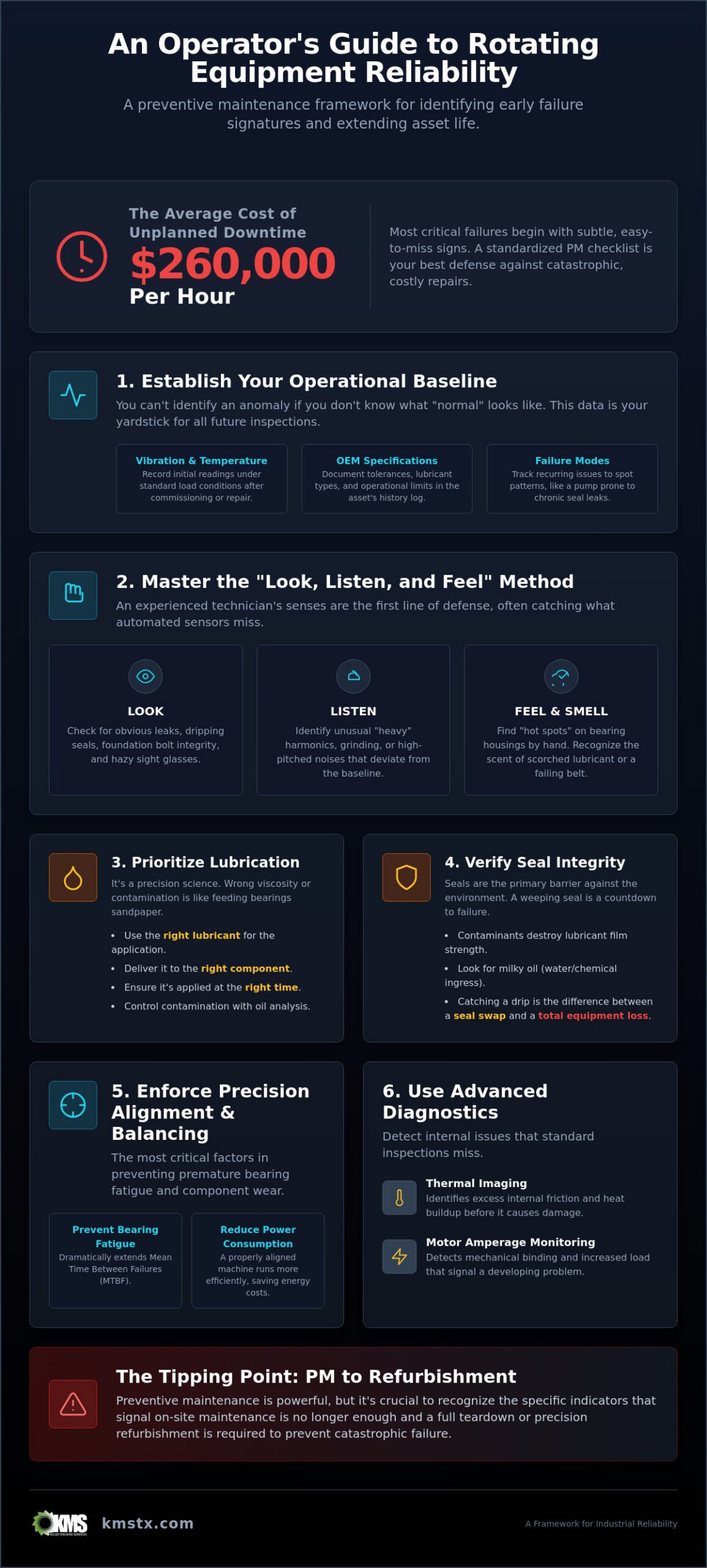
Did you know that the average cost of unplanned downtime for industrial manufacturers has climbed to $260,000 per hour in 2026? That’s a massive hit to the bottom line, especially when most of those failures start with subtle signs that are easy to miss. Implementing a standardized preventive maintenance checklist for rotating equipment is the best way to catch these issues before they escalate. You’ve likely felt the frustration of a premature bearing failure or a blown seal that could’ve been caught if the team knew exactly what to look, listen, and feel for during their rounds. It’s tough training new technicians to spot these mechanical signatures before they turn into a midnight emergency repair call.
This guide provides a comprehensive framework designed to help you identify early failure signatures and significantly extend the Mean Time Between Failures (MTBF) of your critical assets. We’ll break down inspection tactics that align with the latest ISO 18436-2 and API 687 standards. This ensures your team has the shop-floor-ready tools to keep your pumps, gearboxes, and centrifuges running reliably for the long haul.
Key Takeaways
- Establish baseline operational data so you can accurately identify subtle mechanical anomalies before they lead to secondary damage.
- Learn how to use a preventive maintenance checklist for rotating equipment to verify seal integrity and ensure the right lubricant reaches the right component at the right time.
- Understand why precision alignment and dynamic balancing are the most critical factors in preventing premature bearing fatigue and reducing power consumption.
- Discover how to use thermal imaging and motor amperage monitoring to detect internal friction and mechanical binding that standard inspections miss.
- Identify the specific indicators that signal when on-site maintenance is no longer enough and a full teardown or precision refurbishment is required.
Foundations of a Rotating Equipment Preventive Maintenance Program
Preventive maintenance isn’t just a chore to check off a list. It’s a systematic approach to inspecting moving assets to identify wear before it causes secondary damage to housings, shafts, or adjacent components. When we discuss the Foundations of Preventive Maintenance, we’re talking about staying ahead of the physics that want to tear your machines apart. Centrifugal force, friction, and misalignment are the primary drivers of degradation in any rotating asset. If you don’t have a solid preventive maintenance checklist for rotating equipment, you’re essentially waiting for these forces to win. Small leaks lead to big bills; catching a minor seal drip today prevents a catastrophic bearing failure next month.
To better understand this concept, watch this helpful video:
Structuring your maintenance intervals is the first step in building a reliable program. Not every machine needs a weekly teardown. You should base your schedule on asset criticality. High-consequence assets, like a primary process pump, get daily walk-arounds. Secondary blowers or backup compressors might only need quarterly deep-dives. This tiered approach ensures your labor is spent where it actually reduces risk.
Establishing Your Operational Baseline
You can’t identify an anomaly if you don’t know what “normal” looks like. During the commissioning phase or after a precision repair, you must record initial vibration and temperature readings under standard load conditions. This data becomes your yardstick. You should also document OEM specifications for tolerances and lubricant types right in your history log. Tracking recurring failure modes helps you spot if a specific pump is prone to seal issues or if a gearbox consistently runs hot due to its environment. Without this history, you’re just guessing.
The ‘Look, Listen, and Feel’ Method
Technology is great, but a veteran technician’s senses are often the first line of defense. Standardizing sensory inspections helps your team catch obvious leaks or unusual harmonic noises that electronic sensors might filter out. We train technicians to identify “hot spots” on bearing housings by hand before they reach a critical temperature that triggers a control room alarm. You should also learn to recognize the specific scent of scorched lubricant or a failing drive belt. These are immediate failure signatures. Catching a “heavy” harmonic or a vibrating foundation bolt early can save a shaft that would otherwise be destined for the scrap pile. It’s about being proactive, not reactive.
The Critical Lubrication and Seal Integrity Checklist
Lubrication is often treated as a secondary task, but it’s actually a precision science. If you’re using the wrong viscosity or a dirty grease gun, you’re essentially feeding your bearings a diet of sandpaper. A comprehensive preventive maintenance checklist for rotating equipment has to prioritize getting the right lubricant to the right place at the right time. Modern research, like this systematic review of proactive maintenance, shows that oil analysis and contamination control are the most effective ways to stop wear before it starts. It’s not just about volume; it’s about the chemistry and cleanliness of the fluid that keeps your assets moving.
Seal integrity is the other side of the coin. Seals don’t just keep product inside the pipe; they act as the primary barrier against the environment. When a mechanical seal begins to weep, it’s only a matter of time before that process fluid finds its way into your bearing housing. Once that happens, your lubricant’s film strength is gone. In high-speed gearboxes or centrifuges, this leads to rapid thermal breakdown and catastrophic failure. You’ll often see the oil darken or turn milky as it mixes with water or chemicals. Catching this during a routine round is the difference between a simple seal swap and a total equipment loss. If your inspections reveal that a seal has moved past its service life, it’s worth reviewing your broader approach to rotating equipment maintenance to prevent a full-scale shutdown.
Lubricant Management and Contamination Control
- Check oil levels and clarity: Use the sight glass to look for emulsification or dark particulate matter. Cloudy oil usually indicates water ingress, while dark oil suggests high-heat oxidation or metal wear.
- Verify grease discharge: Make sure old grease is actually being purged from the relief ports. If you don’t see old grease coming out, you’re likely over-pressurizing the housing and risking a seal blowout.
- Start a sampling program: Routine chemical analysis of wear metals can tell you exactly which internal component is failing before the machine stops. It’s the best way to see inside a gearbox without opening it.
Mechanical Seal and Packing Inspections
- Inspect seal faces for weeping: A small amount of moisture might be normal for some designs, but any visible spray or puddle is a red flag. Look for salt or chemical buildup around the gland.
- Monitor seal flush systems: Check for proper flow and pressure stability. If the flush line is too hot to touch, your seal faces aren’t getting the cooling they need to survive.
- Evaluate packing glands: You need that controlled drip to keep the sleeve cool. If it’s bone dry or steaming, the packing is burning up and scoring your shaft.
Precision Alignment and Dynamic Balancing Requirements
If a rotor is out of balance, it’s essentially acting as a hammer, striking your bearings thousands of times every minute. No amount of high-quality lubricant can offset the physical destruction caused by an unbalanced mass. This is why utilizing dynamic balancing services Houston is arguably the most effective way to prevent premature bearing fatigue. Even a few grams of unbalance at high RPMs creates massive centrifugal forces that transfer directly into the housing and foundation. Your preventive maintenance checklist for rotating equipment must prioritize these geometric and mass-distribution factors to ensure the longevity of the entire drivetrain.
Misalignment is a silent thief of both energy and hardware. When shafts aren’t perfectly collinear, the coupling is forced to compensate, which induces a bending moment on the shaft. This flexes the metal with every rotation, leading to work-hardening and eventual fatigue failure. Beyond the mechanical risk, the hidden cost of misalignment shows up in your utility bills. It takes more amperage to turn a binding shaft than a free-spinning one. You’ll also notice that seal life is cut short because the faces are being forced to wobble rather than glide. Identifying “soft foot” conditions is a critical part of this process. If one motor foot isn’t sitting flat on the baseplate, tightening the bolt will distort the entire frame, pulling the internal clearances out of spec before the machine even starts.
In a modern shop-floor environment, laser alignment has largely replaced dial indicators for speed and precision. While a veteran might still prefer the “old school” sweep, laser systems provide a digital record that can be uploaded directly to your maintenance management software. This allows you to track if a specific asset is prone to shifting over time due to thermal expansion or foundation settling.
Vibration Analysis as a Diagnostic Tool
Overall vibration levels tell you that a machine is shaking, but spectral analysis tells you why. By looking at the frequency peaks, you can distinguish between a simple unbalance issue and a more complex bearing defect or electrical fault. You should set your alarm thresholds based on ISO 10816 standards, which provide a reliable framework for industrial machinery health. If you see a 1X peak climbing, it’s usually balance; a 2X peak often points toward misalignment. This data allows you to plan your repairs during scheduled windows rather than reacting to a total breakdown.
Structural Integrity and Fastener Checks
A machine is only as stable as what it’s bolted to. You need to regularly verify the torque on foundation bolts and motor mounts. Over time, vibration can cause “resonance,” where the support structure itself starts to amplify the machine’s natural frequencies. This leads to cracked baseplates and loosened grout. During your rounds, look for hairline cracks in the housing or baseplate that indicate long-term fatigue. If the foundation is failing, no amount of precision balancing will keep that machine quiet.
Operational Load and Thermal Analysis Checklist
Heat is the physical manifestation of friction, and in the world of heavy industry, it’s usually the first sign that something is going wrong. Using infrared thermography allows you to see internal friction points that are invisible to the naked eye. When you integrate thermal imaging into your preventive maintenance checklist for rotating equipment, you’re looking for temperature gradients that deviate from your established baseline. A gearbox running 20 degrees hotter than it did last month isn’t just “working hard”; it’s likely suffering from internal wear or a failing cooling system that can no longer dissipate heat effectively.
Monitoring motor amperage provides another layer of diagnostic data that often correlates with thermal issues. If a motor is pulling “heavy” amperage under a standard load, it’s fighting mechanical binding somewhere in the drivetrain. This could be a sign of the misalignment we discussed earlier or perhaps a pump impeller that’s beginning to rub against the wear rings. You also have to consider the impact of process changes. If your facility switches to a higher viscosity fluid without adjusting the equipment’s operational parameters, you’re putting an unplanned load on the motor and bearings that will shorten their lifespan.
Bearing Housing Temperature Monitoring
Establishing a “normal” range for each bearing type is critical because a roller bearing and a sleeve bearing won’t have the same heat signature. You’re looking for sudden spikes rather than gradual increases. A rapid jump in temperature is often a precursor to a cage failure or a complete loss of lubricant film. Thermal runaway occurs when a bearing’s heat generation exceeds the housing’s heat dissipation capacity, leading to an uncontrolled temperature rise that destroys clearances and lubricant viscosity simultaneously.
Drive System Performance
Don’t overlook the components that transfer power. Inspect V-belts for proper tension and signs of glazing; if you see “rubber dust” inside a coupling guard, it’s a clear indicator of excessive torsional vibration or a coupling insert that’s being shredded by misalignment. For heavy centrifuges, you also need to evaluate hydraulic drive pressures and fluid temperatures. If your thermal analysis indicates internal friction that can’t be solved with a simple oil change, it’s time to consult with a specialist about rotating equipment maintenance to prevent a total seizure.
When PM Reveals a Problem: Transitioning to Refurbishment
Even the most rigorous preventive maintenance checklist for rotating equipment will eventually reveal a problem that a grease gun or a laser alignment tool cannot solve. There is a “Point of No Return” where on-site adjustments can no longer compensate for internal wear or structural fatigue. When your vibration spectral analysis shows a worsening bearing defect despite perfect alignment, or when you’ve reached the limit of your shim packs, you’ve crossed the line from maintenance into repair. Continuing to operate in this state doesn’t just risk the asset; it risks the safety of your floor and the stability of your entire process.
Identifying the Need for a Full Teardown
You need to know the specific technical triggers for a shop pull. Look for signs of internal rotor damage or shaft run-out that exceeds your documented baseline. In high-speed applications, industrial centrifuge repair Texas becomes necessary when you identify bowl or scroll erosion that compromises the unit’s balance. You should also be wary of recurring failures. If you’re replacing the same mechanical seal every few months, there is likely a fundamental design issue or a shaft sleeve problem that requires a shop-level teardown to identify and correct.
The Role of Expert Restoration
A controlled shop environment provides a level of precision you can’t match on a plant floor. You get access to custom machining to restore critical fits and dynamic balancing that handles the entire rotating assembly. When a catastrophic failure occurs, emergency machine repair Gulf Coast requires a partner with a deep spare parts inventory and the technical expertise to perform a root cause analysis. The final goal of any restoration is a rigorous QC test that ensures the asset returns to service in “better than new” condition, ready to start its next lifecycle with a clean slate.
Securing Your Operational Reliability in 2026
Establishing a robust preventive maintenance checklist for rotating equipment is the most effective way to protect your bottom line from the rising costs of unplanned downtime. By focusing on baseline operational data and precision dynamic balancing, you’re not just reacting to problems; you’re actively extending the life of your critical assets. We’ve seen how subtle thermal spikes or harmonic changes signal the need for a transition from field maintenance to professional refurbishment. Catching these failure signatures early saves your budget. It prevents the $260,000 per hour losses that plague many industrial facilities.
When your inspections reveal internal wear that field adjustments can’t fix, you need a partner with the technical depth to restore your machines to OEM standards. We bring over 40 years of industrial repair expertise and full in-house machining and dynamic balancing capabilities to every project. We also provide 24/7 emergency response for critical infrastructure to ensure you’re never left stranded during a failure. Ready to optimize your reliability program? Request a Technical Consultation for Your Rotating Equipment today. Taking these proactive steps now ensures your plant stays productive and your equipment stays on the line for years to come.
Frequently Asked Questions
How often should I perform vibration analysis on rotating equipment?
Vibration analysis frequency should be determined by the criticality of the asset to your process. For high-consequence machines like primary process pumps, a monthly scan is standard; secondary blowers might only need a quarterly check. If you’re utilizing a preventive maintenance checklist for rotating equipment, you should also include daily “touch” checks to catch major shifts between formal spectral analysis rounds. This ensures you don’t miss a sudden bearing defect that develops between scheduled data collections.
What are the most common signs of bearing failure in a centrifuge?
The most common signs of centrifuge bearing failure include a sharp rise in housing temperature and a change in the machine’s harmonic hum. You might also notice increased radial vibration during the ramp-up or ramp-down phases. In decanter centrifuges, look for oil emulsification in the bearing housings; this suggests a seal failure has allowed process fluid to contaminate the lubricant. Catching these signs early prevents catastrophic damage to the bowl and scroll assemblies.
Can misalignment cause a motor to pull more amperage?
Yes, shaft misalignment creates a parasitic load that forces the motor to pull significantly more amperage than it would under a collinear state. This happens because the coupling is forced to flex with every rotation, creating mechanical binding that the motor must overcome. Monitoring motor amperage is a great way to verify your alignment health. If you see a steady climb in power consumption without a change in process load, your shafts are likely fighting each other.
What is the difference between preventive and predictive maintenance for rotating assets?
Preventive maintenance is a schedule-based approach, whereas predictive maintenance relies on real-time condition data to dictate when service is needed. A preventive maintenance checklist for rotating equipment often involves changing oil or seals based on run-hours. Predictive models use sensors to monitor vibration or heat, allowing you to run an asset longer if the data shows it’s still healthy. Both strategies are necessary for a well-rounded reliability program that effectively minimizes unplanned downtime.
How do I know if my industrial gearbox needs a full refurbishment?
You know a gearbox needs a full refurbishment when oil analysis consistently shows wear metals like bronze or steel despite regular fluid changes. Other red flags include excessive backlash in the gear set or a housing that runs hot even after you’ve verified the cooling system is clean. If on-site adjustments can no longer keep the noise or vibration within ISO 10816 limits, a shop teardown is required to restore internal tolerances and critical fits.
Why is dynamic balancing so critical for high-speed industrial blowers?
Dynamic balancing is essential because the centrifugal forces generated by high-speed blowers increase exponentially with the square of the speed. Even a few grams of unbalance at 3,600 RPM can create hundreds of pounds of force on your bearings. This leads to rapid fatigue and housing cracks. Precision balancing ensures that the center of mass aligns perfectly with the center of rotation, which is the only way to achieve long-term reliability in high-speed industrial assets.
What should be included in a daily walk-around inspection for pumps?
A daily walk-around for pumps should focus on seal integrity, oil levels, and suction or discharge pressure readings. You’re looking for any evidence of weeping at the mechanical seal or packing gland, as well as checking that the oil in the sight glass is clear and at the correct level. Listen for gravelly sounds that indicate cavitation. These quick checks are the first line of defense in catching minor issues before they become expensive emergency repair calls.
Is it safe to lubricate rotating equipment while it is in operation?
Lubricating equipment while it’s running is generally safe and often preferred, provided the machine is equipped with external grease ports and safety guards. In fact, adding grease while the bearing is rotating helps ensure the lubricant is distributed evenly across the rolling elements and races. It also helps purge old, contaminated grease out of the relief ports more effectively. Always follow your specific facility’s safety protocols and LOTO procedures when working near moving shafts.