You’ve spent weeks managing a critical outage, and now the centrifuge or high-speed blower is finally back on its base. The pressure to hit the start button is intense, especially when industrial downtime can cost your facility thousands of dollars every hour. However, the fear of a catastrophic failure upon restart often outweighs the rush to resume production. Without a standardized post-repair equipment validation process, you’re essentially crossing your fingers and hoping the “as-built” documentation matches the mechanical reality of the machine.
It’s a frustration every maintenance veteran knows well. You want to trust the shop work, but you need empirical proof that the asset won’t suffer infant mortality the moment it hits full load. This guide provides a repeatable engineering framework to transition your machinery from the shop back to the floor with total confidence. We’ll walk through a methodical three-stage protocol, including static visual checks, unloaded functional runs, and loaded performance testing. This approach ensures you actually secure the 30% to 50% cost savings that come with successful equipment refurbishment while keeping your reliability targets and safety standards firmly on track.
Key Takeaways
- Understand the critical difference between a basic mechanical repair and a technical validation to ensure your machinery performs under real-world operational loads.
- Implement a multi-stage post-repair equipment validation process that incorporates static dimensional verification and dynamic run-in protocols to catch issues before commissioning.
- Utilize a risk-based decision matrix to determine when a simple verification is sufficient and when a high-stakes asset requires a full validation framework.
- Standardize the handover between the repair shop and the plant floor by mandating essential documentation like material certifications and dynamic balancing reports.
- Learn how to minimize the risk of infant mortality in repaired assets by bridging the gap between mechanical shop work and operational reliability.
Understanding the Post-Repair Equipment Validation Process
Many shop managers assume a repair is finished the moment the parts are installed and the shaft turns freely by hand. That’s a risky assumption to make when production targets are on the line. Mechanical repair is simply the physical act of replacing components; validation is the engineering proof that those components will survive the thermal and mechanical stresses of your operational environment. A formal post-repair equipment validation process ensures that your asset isn’t just “fixed,” but is actually restored to a state of reliable service.
Relying on a machine that simply “looks good” often leads to infant mortality, where the equipment fails within hours or days of being put back into service. Reliability-Centered Maintenance (RCM) depends on empirical data, not gut feelings. By applying the principles of Verification and validation, maintenance teams confirm that every tolerance and clearance meets the rigorous demands of full-load production. This step is the only way to bridge the gap between a successful shop bench test and long-term plant floor reliability.
To visualize why a rigorous check is necessary after any major service, consider the parallels in this inspection overview:
Restoration vs. Simple Repair
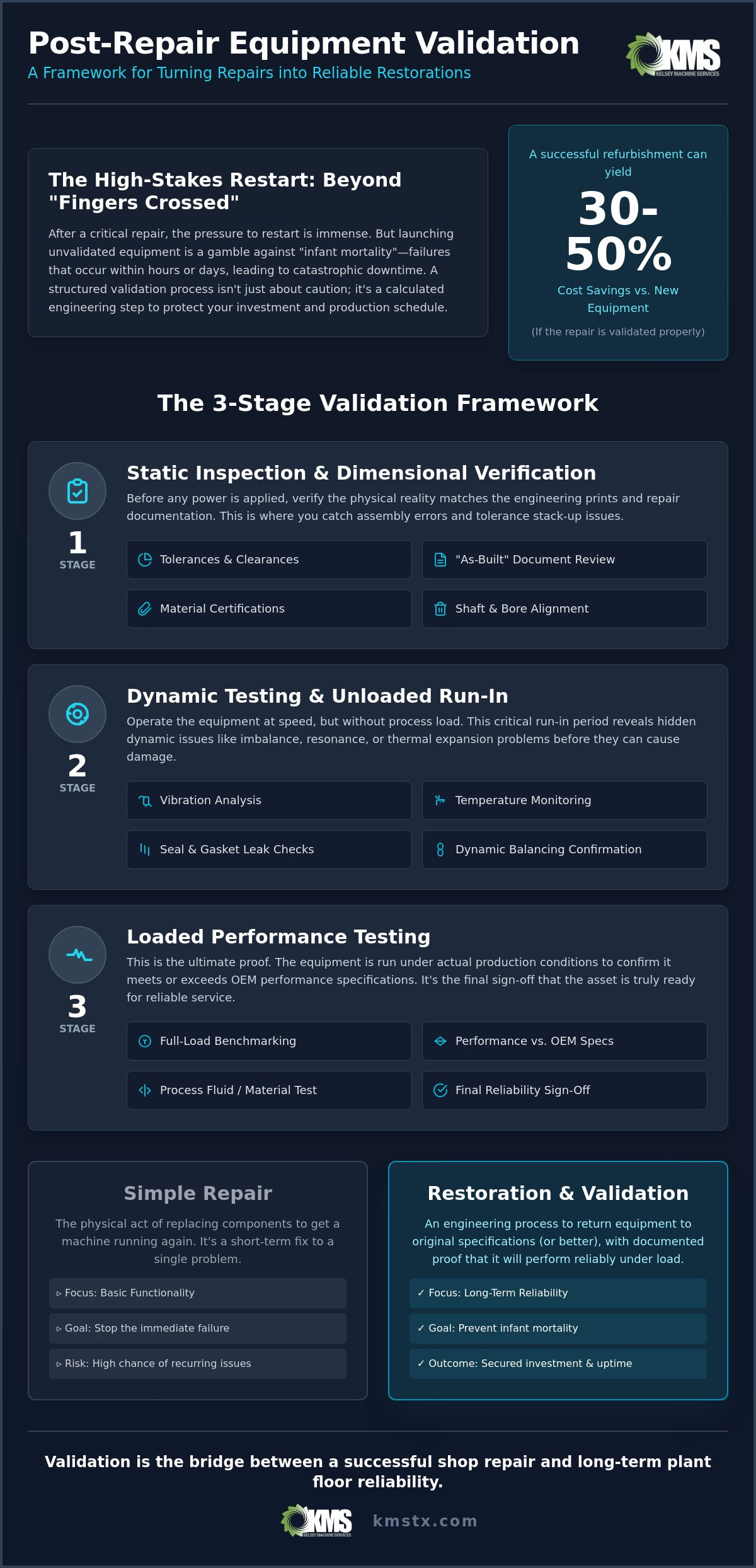
A simple repair might involve swapping out a bearing or a seal to get a pump running again. Restoration goes much deeper, aiming to return the equipment to its original OEM specifications or better. This level of rotating equipment maintenance involves precision machining to correct bore alignment and dynamic balancing to eliminate the hidden vibrations that cause premature wear. Validation proves this restoration was successful by documenting that the asset matches its “as-built” design criteria. Without this documentation, you have no baseline to measure future performance or troubleshoot recurring issues.
The Economic Impact of Validation Failure
The stakes are incredibly high when you restart a repaired gearbox or high-speed blower. If the asset fails shortly after commissioning, the cost isn’t just the second repair bill. It’s the lost production, the wasted labor, and the potential for collateral damage to connected systems. Research shows that refurbishing industrial machinery can result in cost savings of 30% to 50% compared to buying new, but those savings vanish if the machine doesn’t stay in the ground. Because industrial downtime can cost manufacturers thousands of dollars per hour, a rigorous post-repair equipment validation process acts as a vital form of financial insurance. It turns a “fingers crossed” restart into a calculated, low-risk engineering event that protects both your budget and your warranty.
The Multi-Stage Framework for Rotating Equipment Validation
Reliability isn’t something you can just hope for; it’s the result of a methodical, multi-stage engineering check. A robust post-repair equipment validation process moves beyond a simple “start-stop” test. It follows a structured sequence that starts with physical measurements and ends with full-load performance benchmarking. This framework ensures that every mechanical variable is controlled before the asset returns to the production line. While often associated with highly regulated sectors, the FDA Process Validation Guidelines promote a lifecycle approach that is equally applicable to heavy industrial assets, emphasizing that reliability must be built into the repair process rather than just checked at the end.
A comprehensive validation framework typically includes five distinct stages:
- Step 1: Static Inspection and Dimensional Verification: Checking all physical tolerances while the machine is stationary.
- Step 2: Dynamic Testing and Run-In Protocols: Operating the equipment at speed without load to check for mechanical interference.
- Step 3: Vibration Analysis and Spectral Diagnostics: Capturing a baseline vibration signature to identify any frequency-based anomalies.
- Step 4: Thermal Imaging and Lubrication Analysis: Monitoring heat dissipation and oil quality during the initial run-in period.
- Step 5: Load Testing and Performance Benchmarking: Verifying that the machine meets its design output under real-world operating conditions.
Static Inspection and Tolerance Checks
The first line of defense is a rigorous static check. This involves verifying shaft run-out, gear backlash, and bearing clearances against OEM specifications. Non-destructive testing (NDT), such as magnetic particle or dye penetrant inspection, is essential here to identify sub-surface cracks that might have survived the cleaning process. The ‘as-built’ state for an industrial gearbox is the verified physical configuration where all gear tooth contact patterns, backlash settings, and bearing floats precisely align with the original design specifications or documented engineered upgrades. If these numbers don’t match the design intent, the machine shouldn’t move to the next stage.
Dynamic Validation: Vibration and Balancing
Once the static measurements are confirmed, the machine moves to dynamic testing. This is where we look for the hidden forces that only show up at operational speeds. Getting these dynamic factors right is often the difference between a successful restart and another outage, which is why we integrate precision dynamic balancing services into every major rotating asset overhaul. By setting a baseline vibration signature now, you create a “digital twin” of the machine’s healthy state. This data is invaluable for identifying structural resonance issues or slight misalignments before the equipment is grouted into the plant floor. It’s much easier to correct a balance issue on the shop floor than it is once the machine is fully commissioned and surrounded by piping and electrical conduit.
Verification vs. Validation: Navigating the Decision Matrix
In the maintenance shop, it’s easy to treat “verification” and “validation” as synonyms. However, for a reliability engineer, they represent two very different levels of certainty. Verification is the process of confirming that the mechanical work was performed correctly; it answers the question, “Did we build it right?” Validation goes a step further by proving the equipment can actually perform its intended function under operational stress. It answers the question, “Will it work in the field?” Balancing these two is the core of an effective post-repair equipment validation process.
Not every repair justifies a full, multi-day validation protocol. A simple seal replacement on a redundant, low-speed pump might only require a basic verification of clearances and a leak check. Conversely, a full overhaul of a primary centrifuge or a high-torque gearbox demands a rigorous validation framework. The decision often comes down to asset criticality and the “invasive” nature of the repair. If the internal geometry of the machine was altered, such as through custom machining or shaft replacement, validation is no longer optional.
Determining the Scope of Revalidation
To determine how deep the validation should go, you must first analyze the ‘Change Scope’. Replacing a standard bearing with an identical part is a low-change event. Replacing a rotor or a set of gears is a high-change event that fundamentally resets the machine’s baseline. Maintenance teams should use historical failure data to guide this intensity. If a specific asset has a history of infant mortality or alignment drift, the validation scope must be expanded to include spectral vibration analysis and thermal monitoring. Many world-class facilities manage this through a Master Validation Plan (MVP), which pre-defines the testing requirements for every asset class before the repair even begins.
The Engineer’s Decision Tree
Standardizing the handover from the shop to the field requires a clear logic flow. Engineers should weight several factors when deciding the level of testing required. High-speed assets operating above 1,800 RPM or machines subjected to extreme torque loads automatically trigger a full dynamic validation. Similarly, any equipment handling hazardous materials or operating at high temperatures must undergo a documented performance benchmark. The following criteria help define the path:
- Asset Criticality: Is this machine a single point of failure for the process?
- Operational Intensity: Does the machine run at more than 80% of its design capacity?
- Repair Complexity: Were critical tolerances like bearing float or gear backlash adjusted?
- Regulatory Impact: Does the repair affect environmental compliance or safety certifications?
Documentation requirements must scale with this decision. While a partial verification might only require a signed-off checklist and a torque log, a full validation requires a comprehensive data package. This package typically includes material certifications for spare parts, dynamic balancing reports, and a multi-point vibration signature. By following this structured decision matrix, you ensure that your most critical assets receive the scrutiny they deserve without over-complicating minor repairs.
Implementation: A Practical Protocol for Maintenance Teams
Moving a machine from the repair shop back to the plant floor is often where the most critical errors occur. It’s not enough for the shop to say it’s ready; your field team needs a standardized handover that leaves no room for ambiguity. This phase of the post-repair equipment validation process focuses on the transition, ensuring that the physical installation matches the precision of the shop repair. If you don’t have a clear protocol for this handover, you risk undoing all the hard work put into the overhaul during the first hour of operation.
Documentation is the backbone of this protocol. You should expect a complete data package before the asset is even loaded onto the truck for delivery. This package must include material certifications, final dynamic balance reports, and detailed test logs from the shop run-in. These aren’t just pieces of paper for the file cabinet; they are your proof that the repair meets the engineering standards required for your facility. Without these records, you have no way to hold a vendor accountable or troubleshoot a premature failure.
Establishing Baseline Performance Metrics
A common mistake is comparing a restored machine’s performance to its pre-failure data. Once a machine has undergone custom machining or a full shaft replacement, its operational signature changes. You need to establish new baseline metrics immediately upon commissioning. Integrating this validation data into your plant’s CMMS allows you to track the asset’s health from “Day Zero” of its new life cycle. Establishing a clean baseline for vibration data provides a specific spectral reference that allows you to identify developing faults months before they lead to a secondary failure. This data is the only way to move from reactive repairs to a true predictive maintenance model.
The Validation Checklist for Plant Managers
The first 48 hours of operation are the most telling for any repaired asset. During this window, monitor bearing temperatures and vibration levels every few hours to ensure they stabilize within the expected engineering range. If you’re ready to upgrade your reliability standards and ensure your machinery is truly fit for service, contact us today to discuss our specialized Gearbox Repair and validation services.
Engineering Reliability: The Kelsey Machine Services Approach
At Kelsey Machine Services, we view a repair as a technical hypothesis that must be proven before the asset ever leaves our facility. It’s one thing to have a machine that spins; it’s another to have a machine that maintains its integrity under the fluctuating loads of a 24/7 production cycle. Our post-repair equipment validation process is designed to eliminate the “restart anxiety” that often plagues maintenance departments during critical outages. By integrating shop-floor precision with field-ready diagnostics, we ensure that every pump, blower, or gearbox we handle is ready for immediate, full-capacity service.
We don’t believe in “black box” repairs where you simply hope for the best. Instead, we provide a transparent engineering bridge between the repair shop and your operational floor. This commitment is rooted in our belief that a successful repair is only as good as the data that backs it up. Every asset we touch undergoes a rigorous series of checks that translate mechanical work into documented reliability, giving your team the confidence to hit the start button without hesitation.
Advanced Diagnostics and Shop Capabilities
Our facility is equipped with the specialized tools necessary to validate the most complex rotating assets. This includes utilizing high-speed dynamic balancing for centrifuge bowls and rotors, a step that is absolutely non-negotiable for a high-quality industrial centrifuge repair. We also perform full-load gearbox testing to simulate the actual torque and thermal conditions the machine will face in your plant. Our 40-year technical heritage isn’t just a number; it’s a massive library of baseline data and “lessons learned” that we apply to every validation, ensuring that our diagnostics are as accurate as they are thorough.
Your Partner in Asset Reliability
We understand that your primary goal isn’t just to fix a broken machine, but to reduce the total cost of ownership (TCO) across your facility. A rigorous post-repair equipment validation process is the most effective way to achieve this. By catching potential issues like resonance or bearing misalignment in our shop, we prevent the costly secondary failures that drive up maintenance budgets. We see ourselves as an extension of your reliability team, providing the warranted, validated mechanical solutions you need to keep your production targets on track.
If you’re tired of repairs that don’t hold up or documentation that leaves you guessing, it’s time for a different approach. We invite you to contact our engineering team today for a consultation on your next major overhaul. Let’s discuss how we can build a customized validation protocol that fits your plant’s specific reliability goals and ensures your critical assets stay in the ground where they belong.
Securing Long-Term Reliability for Your Repaired Assets
Transitioning from a major repair back to full production shouldn’t be a gamble. By implementing a thorough post-repair equipment validation process, you move beyond simple mechanical fixes to verified operational readiness. This approach ensures that documenting the “as-built” state and establishing new baseline vibration signatures become standard practice. These protocols turn the high-stakes pressure of a machine restart into a controlled, engineering-led event that protects your facility’s bottom line.
At Kelsey Machine Services, we back our work with over 40 years of industrial repair experience and specialized capabilities in dynamic balancing and vibration analysis. We understand that failures don’t wait for business hours; that’s why we provide 24/7 emergency support for your most critical assets. We are ready to help you bridge the gap between the repair shop and the plant floor with zero-fail confidence.
Taking the extra step to validate your equipment today is the best way to ensure it stays in service for the long haul.
Frequently Asked Questions
What is the difference between equipment verification and validation?
Verification is the process of confirming that the mechanical work was performed correctly, such as checking that bearing clearances and gear backlash match the design specs. Validation goes further by proving the machine actually performs its intended function under operational stress. Think of verification as “did we build it right” and validation as “does it work right in the field.”
How long does the post-repair validation process typically take?
The timeline depends entirely on the complexity of the asset and the required run-in period. A standard centrifugal pump might only need two to four hours of testing to verify seals and clearances. However, a high-speed centrifuge or a multi-stage gearbox often requires eight to 24 hours of monitored operation to ensure that bearing temperatures and vibration signatures have fully stabilized.
Is vibration analysis required for all repaired rotating equipment?
While you might skip spectral analysis for a small, low-speed auxiliary pump, it’s a non-negotiable step for any critical asset. High-speed blowers, compressors, and centrifuges should always undergo vibration analysis. This step ensures that the repair didn’t introduce hidden resonance issues or slight balance errors that could lead to premature failure once the machine is back in service.
Can validation be performed on-site or must it happen in the shop?
Validation can occur in either location, but shop-based testing is generally more effective for critical machinery. Performing the post-repair equipment validation process in a controlled shop environment allows technicians to make precision adjustments to balancing or alignment before the machine is shipped. On-site validation is often more difficult due to the constraints of process piping and electrical connections.
What documentation should I expect after a validated centrifuge repair?
You should receive a complete engineering data package that includes dynamic balancing certificates, material certifications for all wear parts, and a detailed run-in log. This documentation serves as your new reliability baseline. It’s essential for your maintenance records and provides the necessary proof of health required for internal audits and insurance compliance after a major overhaul.
Does every component replacement require a full revalidation?
Not necessarily. Replacing a standard consumable like an oil filter or an external gasket usually only requires a basic verification check. However, any repair that touches internal tolerances, such as a bearing replacement or custom machining of a shaft, should trigger a full post-repair equipment validation process. You don’t want to risk a catastrophic restart over a minor oversight during a complex repair.
How do I establish a baseline for a machine that has been out of service?
You establish a new baseline by capturing high-resolution data during the initial commissioning phase. Start with the shop’s validation logs as your “zero point,” then record vibration and thermal signatures at 25%, 50%, and 100% load once the machine is installed. This multi-point baseline helps you identify developing faults months before they cause another unplanned outage.
What happens if a piece of equipment fails the validation process?
If an asset fails, it must return to the repair bench for a full tear-down and root cause analysis. While a failure is frustrating, catching an issue during validation is actually a major win for your plant. It’s far better to identify a faulty bearing or a balance issue in the shop than to have the machine fly apart on the production floor.