A vertical centrifuge overhaul is a precision engineering project, not just a simple parts swap, requiring specialized dynamic balancing and structural NDT to be successful. You’ve likely dealt with the frustration of a machine that returns from a shop only to exhibit high vibration levels or premature bearing failure shortly after startup. It’s a common reality in heavy industry where the unique axial loads of vertical configurations are often misunderstood, leading to repeated, unplanned downtime.
We understand that extended delays due to parts lead times can stall your entire production line, especially with vertical units now making up over 31 percent of the industrial market. This guide will show you how to master the technical requirements of a vertical centrifuge overhaul to restore peak operational efficiency. We’ll cover the procedural steps for documented balance reports and how to align with the latest 2026 safety standards, such as Safety Alert 5/2026, to ensure your equipment is ready for reliable, 24/7 operation. By the end, you’ll have a clear roadmap to extend equipment lifespan and maintain a steady, trustworthy process.
Key Takeaways
- Learn why a true industrial restoration should target zero-hour OEM specifications rather than just fixing what’s broken.
- Master the technical steps of a vertical centrifuge overhaul, including documented teardowns and precision metrology for all wetted parts.
- Identify specific failure modes like spindle bearing fatigue and lubrication issues that are unique to vertical configurations.
- Apply the 50 percent “Repair vs. Replace” rule to aging assets and explore how modern hard-facing upgrades can boost your ROI.
- Understand the role of multi-plane dynamic balancing in eliminating post-repair vibration and ensuring 24/7 reliability.
Understanding the Scope of a Vertical Centrifuge Overhaul
An industrial overhaul is a comprehensive restoration process designed to bring a machine back to zero-hour OEM specifications. While routine maintenance keeps the lights on, a full vertical centrifuge overhaul involves stripping the unit to its frame and evaluating every single tolerance. It’s grounded in fundamental centrifuge principles, where centrifugal force is utilized for separation, but the execution changes significantly when the axis is vertical. You aren’t just replacing seals; you’re rebuilding the mechanical integrity of the entire system.
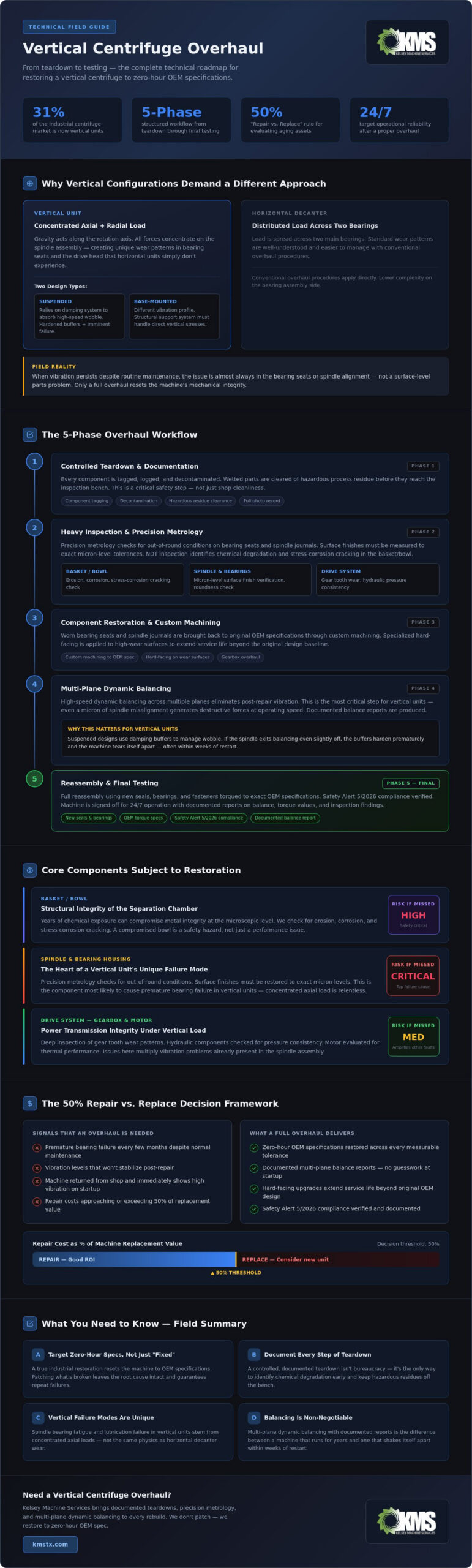
Gravity is your biggest enemy in a vertical setup. Unlike horizontal decanters where loads are distributed across two main bearings, vertical units concentrate massive axial and radial forces on the spindle assembly. This creates unique wear patterns in the bearing seats and drive head that don’t show up in other configurations. When vibration persists despite basic maintenance, a full vertical centrifuge overhaul is the only way to ensure structural integrity and long-term reliability.
To better understand the complexity of these internal assemblies, watch this technical breakdown of a vertical shaft overhaul:
Vertical vs. Horizontal Centrifuge Mechanics
Vertical designs are either suspended (pendant) or base-mounted. Each has a different vibration profile that influences how we approach the repair. Suspended units rely heavily on a damping system to absorb the “wobble” during high-speed rotation. If your damping buffers have hardened or the spindle is even slightly out of alignment, the machine will eventually tear itself apart. We don’t just look at the rotating parts; we examine the entire structural support system to ensure the drive head can handle the unique stresses of vertical operation.
Core Components Subject to Restoration
When performing an industrial centrifuge repair, we focus on several critical areas that go beyond a standard parts swap:
- The Basket or Bowl: We check for erosion, corrosion, and stress-corrosion cracking. Over years of service, the chemical environment can compromise the metal’s integrity, making it a safety hazard.
- Spindle and Bearing Housing: We use precision metrology to check for “out-of-round” conditions. Surface finishes must be restored to exact micron levels to ensure the bearings sit perfectly.
- Drive Systems: This includes a deep dive into the gearbox and motor. We look for gear tooth wear and check hydraulic components for pressure consistency.
An overhaul becomes necessary when you hit a point of diminishing returns with simple repairs. If you’re seeing premature bearing failure every few months or vibration levels that won’t stabilize, it’s time to look at the machine’s foundation. A properly executed overhaul eliminates these recurring headaches by resetting the clock on the equipment’s lifespan.
The Technical Refurbishment Process: From Teardown to Testing
A successful vertical centrifuge overhaul doesn’t start with a wrench; it starts with meticulous documentation. We begin with a controlled teardown where every component is tagged, logged, and decontaminated. This isn’t just for shop cleanliness. It’s a critical safety step to ensure that wetted parts are free of hazardous process residue before they reach the inspection bench. Following established Centrifuge Maintenance and Care standards helps prevent rotor failures by identifying chemical degradation early in the process.
Precision Inspection and NDT Protocols
We don’t guess about the structural health of your equipment. Our technicians utilize dye penetrant testing to hunt for micro-fractures in the basket welds that the naked eye can’t detect. We also deploy ultrasonic thickness testing to verify that erosion hasn’t compromised the basket walls. If the metal is too thin, the unit becomes a safety risk under high centrifugal loads. Our dimensional metrology tools measure runout and bearing fits down to 0.0001-inch accuracy to ensure every part fits exactly as the manufacturer intended.
The Criticality of Vertical Dynamic Balancing
Vertical units are much more sensitive to unbalance than horizontal decanters. Because they often feature tall, slender rotating assemblies, even a minor weight variance can create massive vibration at the spindle head. We use multi-plane balancing techniques to address weight distribution across the entire length of the assembly. If you’re struggling with vibration issues, our team provides precision dynamic balancing services that aim for ISO 1940-1 G2.5 balance grades. This level of precision is what allows for reliable, 24/7 high-speed operation without the premature bearing failure that plagues poorly balanced machines.
The final stage of any vertical centrifuge overhaul is the test run. We monitor temperature, vibration, and noise levels to ensure the restoration was successful. It’s about more than just getting the machine to spin; it’s about making sure it stays spinning for years to come.
Identifying and Mitigating Vertical Centrifuge Failure Modes
In a vertical configuration, the mechanical stresses are fundamentally different from those found in horizontal decanters. Gravity acts as a constant axial load on the spindle assembly, which means the bearings are under tension or compression even before the machine starts spinning. Identifying these specific failure modes early is the primary goal of a high-quality vertical centrifuge overhaul. If you miss a hairline fracture or a subtle lubrication issue during the inspection, you’re just setting the stage for a catastrophic failure later.
Vibration analysis is often the first line of defense, but it’s easy to misinterpret the data. While unbalance is a common culprit, vertical units are also prone to structural resonance and misalignment between the drive motor and the spindle head. Resonance occurs when the machine’s operating speed matches its natural frequency, leading to massive oscillations that can snap a spindle. During an overhaul, we don’t just look at the rotating parts; we examine the foundation and damping buffers to ensure they haven’t lost their ability to isolate these forces. Material erosion from process chemistry also plays a role, as thinning walls can shift the unit’s natural frequency over time.
Bearing and Lubrication Engineering
Vertical spindles face a unique challenge: axial thrust. The bearings must handle the weight of the basket and the product while simultaneously resisting radial forces. This dual-loading often leads to premature fatigue. Lubrication is equally tricky because gravity naturally pulls oil or grease away from the upper bearings. While some shops stick to traditional grease, many modern overhauls incorporate mist lubrication systems to ensure a constant, pressurized supply of oil to every friction point. If you hear a distinct “growling” or “clicking” during a test run, it’s a sign that the lubrication film has broken down and the bearing races are already pitted.
Structural Integrity and Stress Corrosion Cracking
Stainless steel baskets are standard in many industries, but they aren’t invincible. Stress corrosion cracking is a hidden danger where the combination of tensile stress and a corrosive environment creates microscopic cracks. These cracks often start at the base of the basket or near the welds. We look for “pitting,” which acts as a stress concentrator and can lead to a sudden, violent failure. When we perform a vertical centrifuge overhaul, we have to decide if a basket can be safely repaired or if it must be replaced. If the safety margin is compromised by erosion or deep pitting, replacement is usually the only responsible choice to protect your operators and maintain reliable 24/7 operation.
Maximizing ROI: Repair Strategies and Performance Optimization
Deciding whether to invest in an aging asset or pull the trigger on a new purchase is a constant challenge in heavy industry. The 50 percent rule is a standard benchmark; if the cost of a vertical centrifuge overhaul exceeds half the price of a new machine, replacement might seem logical. However, the raw cost of the hardware is only one part of the equation. You also have to account for the massive lead times currently affecting the global market. While a new industrial centrifuge can take anywhere from 26 to 52 weeks to arrive, a comprehensive overhaul typically gets your process back online in just 4 to 8 weeks.
A precision overhaul doesn’t just fix what’s broken; it can restore 95 to 100 percent of the machine’s original operating efficiency. By utilizing custom machining to reset tolerances and applying modern hard-facing technologies to high-wear areas, you’re essentially getting a zero-hour machine without the year-long wait. This strategy significantly reduces your Total Cost of Ownership (TCO) by extending the equipment’s lifespan and preventing the catastrophic failures that lead to expensive, unplanned downtime.
The Economic Case for Centrifuge Refurbishment
The speed of your recovery depends heavily on parts availability. Maintaining a strategic industrial machine spare parts inventory is one of the most effective ways to minimize overhaul lead times. When critical components like seals, bearings, and specialized fasteners are already on your shelf, the restoration process moves much faster. This proactive approach to procurement ensures that your vertical centrifuge overhaul isn’t delayed by supply chain hiccups, allowing you to focus on restoring peak operational capacity as quickly as possible.
Post-Overhaul Commissioning and Maintenance
The work isn’t finished once the machine is bolted back onto the floor. Proper commissioning is vital to ensure the long-term success of the restoration. We recommend establishing a new baseline for vibration and temperature monitoring immediately after reinstallation. This data acts as a “digital twin” of the machine’s healthy state, making it much easier to spot trouble down the road. Initial lubrication cycles are also critical; you’ll want to monitor the break-in period closely to ensure that all new bearings and seals are seating correctly. Based on what we find during the teardown, we can help you create a customized preventative maintenance schedule that targets your specific failure modes.
If you’re ready to restore your rotating assets to OEM standards, exploring our specialized Centrifuge Repair capabilities is the next logical step to protect your production timeline.
Engineering Reliability: The Kelsey Machine Services Approach
Reliability isn’t just a marketing term; it’s the result of precise engineering and decades of experience on the shop floor. At Kelsey Machine Services, we’ve spent over 40 years refining our approach to industrial centrifuge repair. We don’t believe in quick fixes that only address the symptoms of a failure. Instead, our team focuses on restoring every asset to OEM standards, ensuring that when a machine leaves our facility, it’s ready for years of dependable service. We provide documented performance warranties and balance reports because we know that in heavy industry, data is the only thing that builds real trust.
Whether you’re planning a scheduled vertical centrifuge overhaul or reacting to a sudden mechanical breakdown, you need a partner who understands the high stakes of downtime. We’ve built our reputation on being that partner for critical infrastructure across the region. When a primary separation unit goes down, it can bottleneck your entire production line. That’s why we maintain 24/7 readiness for emergency machine repair, giving you a direct line to technical experts who can diagnose and resolve complex rotating equipment issues under pressure.
Advanced Workshop Capabilities
Our workshop is a full-scale restoration facility equipped with the heavy machinery required for large-scale industrial assets. We utilize large-scale lathes and vertical boring mills to handle precision component restoration that most shops have to outsource. This in-house control allows us to maintain tighter tolerances on spindle journals and bearing seats. Along with our machining center, our specialized vertical balancing stands are specifically designed to handle the unique axial loads of tall, high-speed industrial rotors. By keeping these services under one roof, we eliminate the communication gaps and delays that often plague multi-vendor repair projects.
Field Support and On-Site Troubleshooting
Technical expertise shouldn’t be confined to the shop. We regularly dispatch expert technicians for on-site vibration analysis and diagnostic testing to identify issues before they require a full teardown. This proactive field support is backed by our massive spare parts inventory, which allows for a much faster turnaround than waiting on OEM factory lead times. We position ourselves as a high-level partner in your facility’s rotating asset reliability, helping you transition from reactive repairs to a strategic maintenance model. If you’re seeing signs of trouble in your separation process, contact us for a technical consultation on your next vertical centrifuge overhaul and let’s get your equipment back to peak performance.
Securing Your Long-Term Process Reliability
Executing a successful vertical centrifuge overhaul is a strategic investment in your plant’s future uptime. By prioritizing precision dynamic balancing and rigorous NDT protocols, you’re effectively eliminating the root causes of high vibration and premature bearing failure. We’ve explored how a detailed refurbishment can save you up to 44 weeks in lead time compared to ordering new units, all while restoring your assets to zero-hour OEM specifications. It’s about more than just a repair; it’s about resetting the clock on your most critical separation assets.
Kelsey Machine Services provides the technical foundation you need with over 45 years of rotating equipment expertise. Our shop features comprehensive in-house dynamic balancing and NDT capabilities to ensure every component meets strict industrial tolerances. If you face a sudden breakdown, our 24/7 emergency field service response is available to keep your operations moving. We’re here to help you move from reactive fixes to a reliable, data-driven maintenance strategy that protects your bottom line.
Request a Technical Consultation for Your Vertical Centrifuge Overhaul
Frequently Asked Questions
How long does a typical vertical centrifuge overhaul take?
A typical vertical centrifuge overhaul usually takes between 4 and 8 weeks to complete from the initial teardown to final testing. This timeline includes the decontamination of wetted parts, precision metrology, and any necessary custom machining or component restoration. While specific durations vary based on the extent of wear, it’s a significantly faster alternative to the 26 to 52 week lead times currently associated with new equipment delivery.
Can a vertical centrifuge be upgraded for better performance during an overhaul?
Yes, the restoration process is an ideal time to incorporate modern hard facing technologies and advanced materials. We can often upgrade high wear components with specialized coatings that weren’t available when the original machine was built. These enhancements specifically target erosion and corrosion resistance, which helps the machine maintain peak efficiency under more aggressive process conditions.
What is the difference between a repair and a full refurbishment?
A repair usually focuses on fixing a specific failed part to restore operation, whereas a full refurbishment or overhaul resets the entire machine to zero-hour OEM specifications. During a vertical centrifuge overhaul, we strip the unit to its frame and evaluate every tolerance. This comprehensive approach ensures that all internal clearances, bearing fits, and structural welds are restored; a simple repair can’t match the reliability that a full overhaul provides.
How often should a vertical centrifuge undergo a major overhaul?
Most industrial units require a major overhaul every 3 to 5 years, depending on the severity of the service and the chemical environment. However, we recommend using predictive maintenance tools like vibration analysis to determine the exact timing. If you see a steady rise in baseline vibration levels or frequent bearing temperature spikes, it’s a sign that the internal components are reaching the end of their reliable service life.
Why is dynamic balancing so critical for vertical units?
Dynamic balancing is vital because vertical configurations are more sensitive to weight variances than horizontal units due to their tall, slender rotating assemblies. Even minor unbalance creates massive centrifugal forces that put excessive stress on the spindle and upper bearings. Achieving an ISO 1940-1 G2.5 balance grade is essential for preventing the structural fatigue and premature mechanical failures that lead to expensive, unplanned downtime.
What NDT methods are used to check the safety of a centrifuge basket?
We primarily utilize dye penetrant testing and ultrasonic thickness testing to verify the structural integrity of the basket. Dye penetrant allows technicians to find microscopic cracks in the welds that could lead to a catastrophic failure under high speed rotation. Ultrasonic testing ensures that erosion hasn’t thinned the basket walls beyond safe limits. These protocols are mandatory for maintaining a safe operating environment in chemical and pharmaceutical facilities.
Is it better to repair an old vertical centrifuge or buy a new one?
The decision typically follows the 50 percent rule, where repair is favored if the cost is less than half of a new machine. Given the current global supply chain delays, overhauling an existing asset is often the most practical choice. You can restore up to 100 percent of original efficiency in a fraction of the time it takes to source new hardware, which significantly improves your overall return on investment.
What causes the most frequent failures in vertical industrial centrifuges?
Bearing fatigue and lubrication failures are the most common issues we see in vertical configurations. Because gravity naturally pulls oil and grease away from the upper spindle bearings, these parts are prone to running dry without a perfectly maintained delivery system. Additionally, the constant axial thrust unique to vertical setups puts specialized loads on the bearing races, which eventually leads to the pitting and growling that signal an imminent breakdown.