
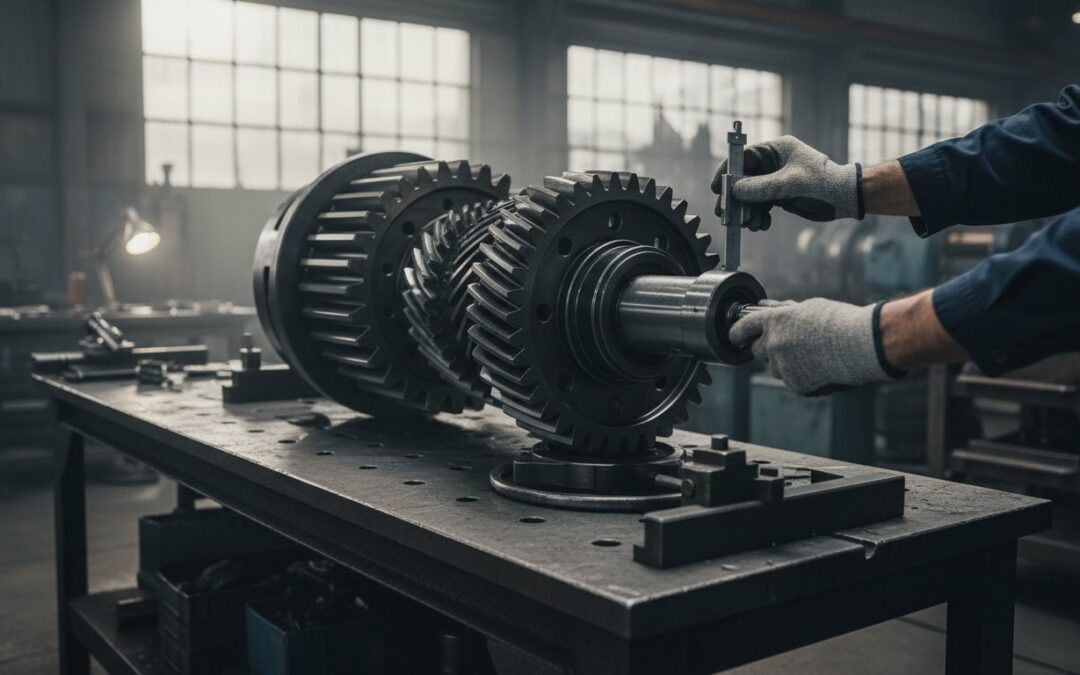
The most reliable gearbox in your facility likely isn’t the brand-new unit sitting on a shipping pallet, but the 12-year-old workhorse you’ve just sent out for a teardown. While a new OEM replacement often carries a 34-week lead time, professional gearbox refurbishment services can typically return an asset to original specifications in less than 25% of that window. We’ve all seen the frustration of a “repaired” unit failing after just 600 hours because a shop missed a housing misalignment or used subpar bearings. It’s a cycle that drains maintenance budgets and destroys your production targets.
You know that unplanned downtime isn’t just an inconvenience; it’s a $12,500-per-hour hit to your facility’s bottom line. This guide provides an expert-to-expert breakdown of the restoration process, comparing specific strategies to help you minimize downtime and extend asset life. We’ll walk through the technical milestones of a high-level rebuild, including documented proof of dynamic stability and load capacity, so you can stop guessing and start planning with confidence.
Key Takeaways
- Learn how gearbox refurbishment services go beyond standard repairs by restoring assets to original design tolerances through forensic analysis and component upgrades.
- Identify the technical criteria for choosing between a localized repair and a full refurbishment to maximize your equipment’s uptime and ROI.
- Discover the importance of forensic failure analysis in uncovering root causes during teardown to prevent chronic mechanical issues from resurfacing.
- Understand why specialized shop capabilities and engineering pedigree are more critical than geographic proximity when selecting a restoration partner.
- Gain insights into how a data-driven, engineering-led approach to restoration can significantly extend the operational life of your critical rotating assets.
Understanding the Strategic Value of Gearbox Refurbishment Services
Industrial gearbox refurbishment isn’t just a basic repair; it’s a rigorous engineering process that returns a unit to its original design tolerances. While routine maintenance focuses on lubrication and basic seal checks, refurbishment involves a complete teardown and inspection of every internal component. To grasp the mechanics involved, Understanding Gearbox Fundamentals clarifies how these systems manage torque and speed within a larger powertrain. This deep technical overhaul ensures housings are bored back to specification and gears are re-ground to meet the exact geometry required for efficient power transfer.
For most plant managers, the decision comes down to the bottom line. Choosing professional gearbox refurbishment services typically results in cost savings of 40% to 60% compared to purchasing a brand-new unit. This financial advantage is amplified when dealing with legacy assets where a new unit might require expensive modifications to the existing foundation or piping. Refurbishment solves the end-of-life dilemma by modernizing the internals while keeping the external footprint identical. It’s a practical way to get another 15 to 20 years out of a proven housing.
To see the level of detail required in a complex restoration, watch this breakdown of a transmission overhaul:
The Role of Refurbishment in Asset Lifecycle Management
Extending the Mean Time Between Failures (MTBF) is the primary goal of precision engineering in the shop. By upgrading bearings and seals to modern materials during the rebuild, we often see the unit outperform its original factory specs. It’s a sustainable path that avoids the “discard and replace” cycle. This approach is critical when original equipment manufacturer (OEM) parts for 30-year-old assets are no longer in production. We can reverse-engineer components to keep the line running without the 26-week lead time often associated with custom new builds.
Refurbishment as a Preventive Reliability Strategy
Shifting from a reactive “break-fix” mentality to planned restoration intervals changes how a facility views its rotating assets. Instead of waiting for a catastrophic failure that causes 48 hours of unplanned downtime, smart operators schedule gearbox refurbishment services during planned turnarounds. This shift treats the gearbox as a long-term asset rather than a consumable part. Documenting these restorations provides a clear data trail that improves plant-wide reliability metrics. It helps maintenance teams predict future budgets with 90% accuracy, moving away from emergency purchase orders and toward predictable operational costs.
Key benefits of this strategic approach include:
- Reduction in capital expenditure by reusing high-mass castings.
- Elimination of foundation modifications required for newer, differently-sized models.
- Opportunity to integrate modern vibration sensors and monitoring ports during the rebuild.
Refurbishment vs. Repair vs. Replacement: A Comparative Analysis
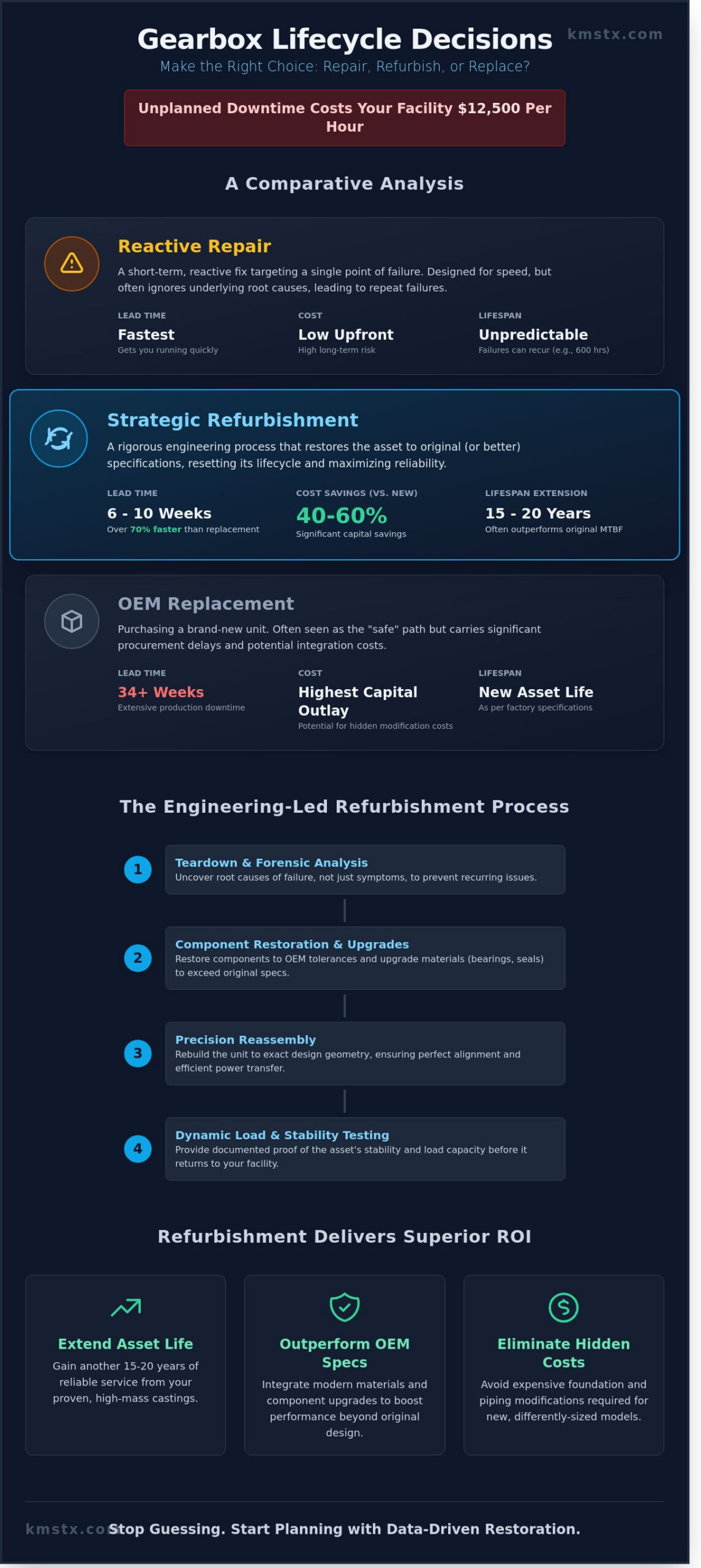
Most maintenance teams treat gearbox issues as a binary choice: fix it or buy a new one. This narrow perspective ignores the high-value middle ground of refurbishment. A standard repair is typically a reactive measure. It targets a specific failure point, like a single pitted gear tooth or a blown seal, to resume operations quickly. It’s an operational expenditure (OpEx) designed for speed, but it rarely addresses the systemic issues that caused the failure in the first place.
Refurbishment is a far more rigorous technical process. It involves a total teardown, exhaustive cleaning, and a forensic evaluation of every internal component. By utilizing data from the Gearbox Reliability Collaborative, engineers can identify design weaknesses and implement component upgrades that exceed the original equipment manufacturer (OEM) specifications. While a repair might get you through the month, professional gearbox refurbishment services are designed to reset the asset’s lifecycle clock entirely.
Replacement is often viewed as the "safe" path, but it carries significant procurement risks. For large-scale industrial units, lead times for new replacements currently range from 26 to 52 weeks. If your plant loses $15,000 per hour during a shutdown, waiting a year for a new unit isn’t a viable strategy. Refurbishment typically cuts that downtime by 70%, returning a precision-engineered asset to the floor in 6 to 10 weeks.
Comparing Costs and Lead Times
Choosing between CapEx for a new unit and OpEx for refurbishment requires a hard look at the total cost of ownership. A new gearbox might cost $250,000, but the associated lead-time risks often dwarf the purchase price. Refurbishment generally costs between 40% and 60% of a new unit. Over a 10-year horizon, the ROI of a refurbished unit often exceeds a new one because the process corrects inherent design flaws discovered during the industrial gearbox failure analysis phase.
Technical Reliability and Warranty Considerations
Reliability isn’t just about the unit spinning; it’s about how long it stays spinning under load. A simple repair might come with a 90-day limited warranty. In contrast, a comprehensive refurbishment often carries a 12 to 24-month warranty, matching or even exceeding the original OEM guarantee.
We’ve seen refurbished units achieve 15% better thermal ratings by upgrading to modern synthetic lubrication paths and high-performance seals. If your asset is critical to your 24/7 operations, you should consult with a technical specialist to evaluate your specific load requirements before committing to a replacement that might not arrive for months.
The Technical Lifecycle of an Industrial Gearbox Refurbishment
High-quality gearbox refurbishment services follow a rigorous five-step technical roadmap designed to return a unit to its original or upgraded performance specifications. The process starts with a forensic evaluation to prevent repeat failures. We focus on an inbound inspection that goes beyond a simple visual check. Our team performs forensic failure analysis to isolate why a unit failed, whether it was a 15% overload or a chronic lubrication breakdown. This “zero-base” approach means every single bolt, shim, and spacer is measured against OEM specifications. After a full teardown, components undergo precision cleaning using industrial-grade solvents and media blasting to prep surfaces for deep-level non-destructive testing.
Forensic Teardown and Diagnostic Inspection
Our technicians utilize Magnaflux and ultrasonic testing to identify microscopic cracks in shafts and gears that aren’t visible to the naked eye. We document specific wear patterns to determine if the failure stemmed from shaft misalignment or improper gear mesh. When performing industrial asset restoration, engineers must account for subsurface fatigue and contact stresses. This data-driven approach ensures we aren’t just fixing symptoms. We solve the root engineering flaw to extend the asset’s mean time between failures. For units that require ongoing monitoring to prevent future catastrophic failures, implementing professional gearbox inspection services provides the forensic analysis needed to detect micro-fractures and lubrication degradation before they escalate into site-wide emergencies.
Precision Component Restoration and Machining
Once the damage is quantified, we restore shaft journals and bearing housings to their original interference fit specifications. If a gear is obsolete or lead times are excessive, we utilize reverse engineering and CNC technology to cut new components with exact tooth geometry. Precision is non-negotiable. Integrating dynamic balancing services is a critical step to eliminate centrifugal forces that cause premature bearing wear. We typically target G2.5 balance grades to ensure the unit runs without vibration under high-torque conditions.
Final Testing and Quality Assurance Protocols
The final phase involves reassembly and rigorous spin testing. We monitor noise levels and vibration signatures to confirm mechanical harmony across the entire gear train. During these test runs, oil analysis and temperature monitoring validate that seals are seated correctly and heat dissipation is within the 5% margin of design limits. Every client receives a comprehensive “as-built” technical report. This document includes dimensional data, NDT results, and test bench performance metrics, providing a transparent record of the gearbox refurbishment services performed and a baseline for future maintenance.
Selecting a National Partner for Critical Gearbox Restoration
Proximity is often a trap in industrial maintenance. While it’s tempting to send a failed unit to the nearest shop, the technical requirements of high-stakes machinery usually outweigh the convenience of a short drive. A facility without a 100-ton hydraulic press or a large-scale horizontal boring mill won’t be able to execute gearbox refurbishment services to OEM standards. You need a partner with the specialized tooling to handle 50,000-pound housings and the metrology equipment to verify tolerances within 0.0005 inches. High-stakes restoration requires 24/7 emergency support because a mill stoppage can cost upwards of $20,000 per hour. If a provider doesn’t have a field service team ready to deploy within 12 hours, they aren’t a true national partner.
Reliability also hinges on parts access. A top-tier shop maintains a $2 million inventory of common bearings and seals. They don’t just wait for a supplier to ship a part; they have the relationships to source hard-to-find components or the engineering capability to manufacture them in-house when a lead time is 26 weeks out.
Vetting the Service Provider’s Engineering Depth
Don’t settle for generalities. Ask for documented history with specific brands like Falk 2000 series, Lufkin N-series, or Flottweg centrifuges. If a shop outsources its gear grinding or case boring, they’re adding risk and extra margin to your bill. Look for shops where the leadership actually knows how to read a micrometer. Family-owned, expert-led operations often maintain a level of quality control that larger, private-equity-owned conglomerates lose. This tribal knowledge is what ensures a gearbox survives its first 10,000 hours of post-service operation.
Logistics and Turnaround Time Management
Moving a 30-ton gearbox across the country isn’t like shipping a standard pallet. National providers use specialized low-boy trailers and handle all heavy-haul permitting in-house. They’ll give you a realistic 6-week timeline instead of a 2-week promise that they’ll eventually break. This refurbishment period is the ideal time to review your rotating equipment maintenance protocols. Integrating these plans ensures the unit isn’t damaged by poor alignment or lubrication issues during re-installation. A solid partner reduces total downtime by 25% through better project management, not by cutting corners on the assembly floor.
Ready to restore your critical assets with engineering precision? Consult with our engineering team for specialized gearbox support.
Maximizing Reliability with Kelsey Machine Services
Since 1982, Kelsey Machine Services (KMS) has focused on the restoration of heavy industrial rotating machinery. We don’t just swap parts; we apply an engineering-led methodology to every project that enters our facility. This data-driven approach ensures that our gearbox refurbishment services meet or exceed original equipment manufacturer (OEM) standards. We’ve spent 42 years refining our process to handle the most demanding power transmission challenges in the energy and manufacturing sectors.
Downtime costs are often measured in thousands of dollars per hour. To mitigate this, we maintain a 24/7 emergency response protocol and stock a deep inventory of bearings, seals, and shafts for major brands. Our warehouse includes over 5,000 distinct line items, ensuring we can begin repairs immediately rather than waiting weeks for overseas shipping. Every unit we rebuild undergoes rigorous performance testing. This includes full-speed spin tests and vibration signature analysis to verify mechanical integrity before it leaves the shop floor. We’ve found that this level of verification reduces infant mortality rates in refurbished units by 15% compared to standard field repairs.
The KMS Technical Advantage
We specialize in “OEM+” results. This means we don’t just replicate the old failure points. Our engineers often identify opportunities to upgrade metallurgy or tighten tolerances by 0.0005 inches to improve heat dissipation and load distribution. Our in-house precision machining shop allows us to fabricate obsolete components that are no longer available from the original manufacturer. You’ll receive a comprehensive documentation package for every asset, detailing every measurement taken during the 100% teardown and inspection phase.
Partnering for Long-Term Asset Health
Our specialized repair facilities support industrial operations across the United States. We believe in a “no-surprises” communication model. You won’t get stuck talking to a middleman who doesn’t know a planetary gear from a sun gear. Instead, you’ll have direct access to the technicians and engineers actually working on your equipment. This transparency has helped 85% of our long-term partners see a 20% reduction in repeat failures over a five-year window. Contact Kelsey Machine Services for a technical consultation on your gearbox refurbishment needs to see how we can stabilize your operational uptime.
Securing the Future of Your Industrial Rotating Assets
Maintaining peak operational efficiency requires more than just reactive fixes when a unit fails. You’ve seen how choosing gearbox refurbishment services over basic repairs or costly replacements can significantly extend a machine’s lifecycle while keeping your maintenance budget in check. It’s all about precision. When you leverage 45+ years of industrial mechanical expertise, you aren’t just getting a patch job. You’re getting a comprehensive restoration that utilizes in-house machining and dynamic balancing to ensure every component meets or exceeds original equipment manufacturer specifications.
Downtime doesn’t follow a 9-to-5 schedule; that’s why 24/7 emergency field service support is a non-negotiable requirement for critical operations. By partnering with a team that controls the entire process under one roof, you eliminate the risks associated with third-party delays and inconsistent quality. It’s time to move beyond temporary fixes and invest in the long-term health of your powertrain. We’re ready to help you restore your assets to peak performance. Request a Technical Quote for Gearbox Refurbishment today and keep your facility running at full capacity.
Frequently Asked Questions
What is the typical turnaround time for a full gearbox refurbishment?
A standard industrial gearbox refurbishment typically requires 2 to 4 weeks from the initial teardown to final load testing. Complex planetary units or those requiring custom gear cutting often extend this timeline to 8 or 12 weeks depending on material availability. We prioritize minimizing downtime by maintaining a stock of common bearings and seals. If your housing requires line boring, expect an additional 5 business days for precision machining.
How much does gearbox refurbishment cost compared to buying new?
Gearbox refurbishment services generally cost between 40% and 60% of the price of a brand new replacement unit. This price point includes the replacement of all bearings and seals, gear grinding, and case restoration. Choosing refurbishment over replacement saves an average of $15,000 on mid sized helical units. It also eliminates the 20 to 30 week lead times currently common for new OEM equipment orders.
Can you refurbish a gearbox if the original manufacturer is out of business?
We can refurbish gearboxes even if the original equipment manufacturer is no longer in business or no longer supports the model. Our team uses coordinate measuring machines to map gear geometry and tooth profiles with 0.001 inch precision. This data allows us to manufacture custom replacement components that meet or exceed the original specifications. Over 30% of our restoration projects involve legacy brands that haven’t produced parts since 1995.
What is the difference between a gearbox rebuild and a refurbishment?
A rebuild usually focuses on replacing failed components like a single broken gear or a set of bearings to get the unit running again quickly. Refurbishment is a more comprehensive process where every internal part is inspected and brought back to AGMA Class 12 standards. We strip the housing to bare metal, check for stress fractures using dye penetrant testing, and ensure all clearances match original factory tolerances.
Do you provide a warranty on refurbished industrial gearboxes?
Most refurbished units come with a 12 month warranty that covers both parts and labor for the entire assembly. For critical high speed applications, we often extend this coverage to 24 months if our team manages the initial installation and lubrication setup. This guarantee is backed by rigorous load testing on our 500 horsepower dyno. It provides the same level of protection you’d expect from a new unit purchase.
How do I know if my gearbox is a candidate for refurbishment or if it is scrap?
Your gearbox is likely scrap if the main housing has structural cracks or if the total cost of repair exceeds 70% of the price for a new unit. We perform an initial non destructive testing scan to check for internal fatigue in the casting. If 3 or more gear sets require full replacement, the economics often shift toward buying new. We provide a detailed strip and advise report within 48 hours.
Do you offer on-site removal and re-installation services for refurbished units?
Our field service teams provide 24/7 on-site removal and re-installation for units weighing up to 50,000 pounds. We handle the rigging, laser alignment, and initial oil flushing to ensure the unit starts under optimal conditions. Proper alignment reduces vibration by up to 40% compared to standard bolt down methods. This hands on approach ensures the gearbox refurbishment services we provide translate into long term reliability for your plant.
What technical documentation is provided after the refurbishment is complete?
You’ll receive a comprehensive technical data package that includes a root cause failure analysis and a final run test report. This documentation tracks bearing clearances, gear backlash measurements, and vibration spectrum analysis from the final dyno test. We also include a 5 step maintenance schedule tailored to your specific operating environment. This data helps your team prevent the same failure from recurring 3 or 5 years down the road.