
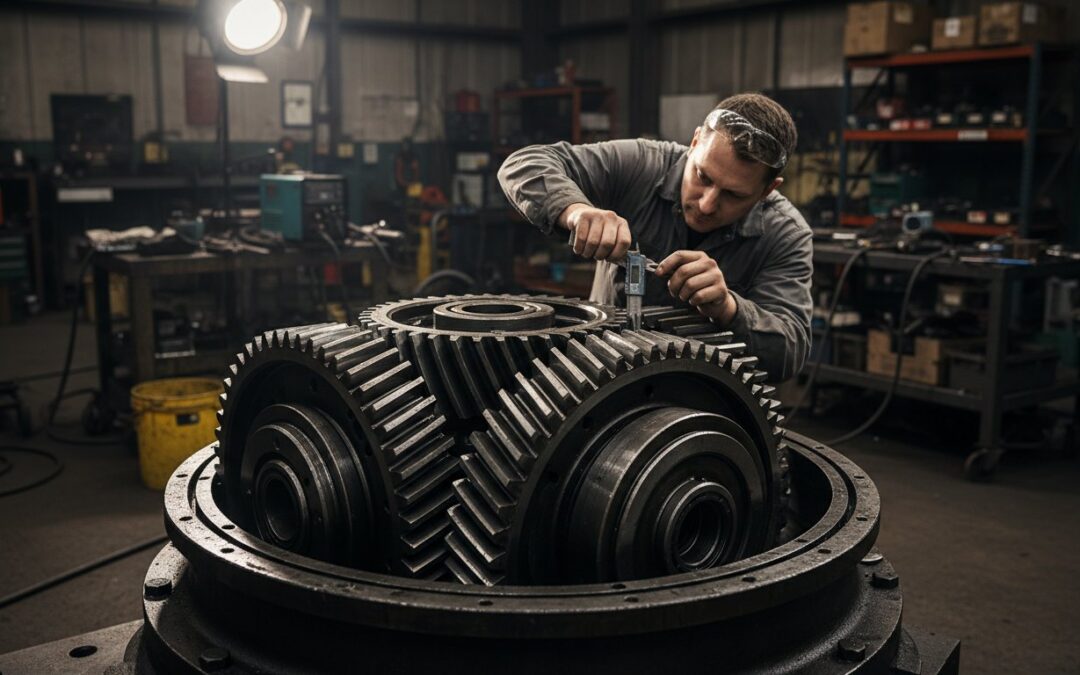
A 2023 industry analysis revealed that 60% of gearbox failures stem from root causes that weren’t addressed during the initial repair. You’ve likely felt the sting of a component that was supposedly “good as new” failing just 4,000 hours into its second life. It’s a common pain point in high-torque environments where transparency during the refurbishment process is often as thin as the gear oil. When you’re managing a facility, you need more than a quick fix; you need a guarantee that your industrial gearbox repair Houston partner is looking at the metallurgy, not just the surface scratches.
This guide provides a technical roadmap to move your maintenance strategy from reactive patching to engineered restoration. We’ll break down the forensic failure analysis required to identify exactly why a unit failed and provide a clear framework for the repair versus replace dilemma. You’ll gain an understanding of the 12-step refurbishment process and the specific testing protocols that ensure operational stability before the equipment is ever reinstalled on your shop floor.
Key Takeaways
- Learn why forensic failure analysis using vibration and thermal diagnostics is the critical first step in identifying root causes before any restoration begins.
- Discover how professional industrial gearbox repair Houston services utilize systematic documentation and technical reporting to ensure assets return to peak operational reliability.
- Master the decision-making framework for evaluating repair versus replacement, specifically for legacy equipment where OEM parts are no longer available.
- Understand how precision machining and dynamic balancing eliminate parasitic vibration and restore obsolete components to their original engineering specifications.
- Gain a deeper perspective on torque transmission fundamentals to better manage the long-term health of your facility’s heavy rotating assets.
The Fundamentals of Industrial Gearbox Engineering and Operational Reliability
Industrial gearbox repair isn’t just about replacing a worn gear or a leaking seal; it’s a rigorous technical restoration of the transmission (also called a gearbox) to its original engineering intent. In heavy rotating assets, the efficient transfer of torque determines the success of the entire production line. When you’re dealing with high-torque loads, any misalignment leads to heat and eventual fatigue. A simple patch job won’t cut it when the equipment is running at 3,600 RPM for 24 hours a day.
For facilities seeking industrial gearbox repair Houston, understanding the difference between a quick fix and a comprehensive overhaul is vital. Reliability isn’t just a buzzword. It’s a metric that directly impacts the bottom line. According to industry data from 2023, unplanned downtime in heavy manufacturing can cost upwards of $22,000 per hour. Investing in a proper restoration ensures that the unit doesn’t just run, but thrives under the stresses of modern industrial demands.
To better understand the scale and precision involved in this process, watch this overview of a professional exchange program:
The Interdependence of Gearbox Components
Mechanical engineering relies on the harmony of three core elements: bearings, gear sets, and housing alignment. A failure in one is a failure in all. For instance, a bearing with a 0.003-inch runout error will cause uneven tooth contact on the gear sets. This leads to micro-pitting and eventual gear failure. When performing industrial gearbox repair Houston, we treat the unit as a single, integrated drivetrain where every tolerance must be perfect to achieve systemic reliability.
Standards of Technical Restoration
Engineering-led refurbishment goes beyond basic repair by analyzing why the component failed in the first place. This process involves verifying that every dimension meets or exceeds OEM specifications, often using AGMA (American Gear Manufacturers Association) standards as a baseline. Basic shops might just swap parts, but a technical restoration involves laser alignment and precision bore resurfacing. Industrial gearbox repair is the comprehensive engineering practice of restoring an asset to its optimal performance specifications to maximize its operational lifespan and prevent costly mid-cycle failures.
Forensic Evidence: Analyzing Common Mechanisms of Industrial Gearbox Failure
When a gearbox lands on the shop floor, the first instinct for many is to start tearing it down. However, jumping straight to replacement parts without a proper industrial gearbox failure analysis is a recipe for repeat failures. In my experience, roughly 70% of gearbox repairs fail prematurely because the shop treated the symptom rather than the underlying disease. Effective diagnostics rely on empirical data like vibration analysis and thermal imaging. High-frequency vibration signatures often pinpoint bearing defects long before a technician can hear them; meanwhile, thermal imaging identifies localized heat soak that indicates poor lubrication or excessive friction. Environmental factors like silica dust or moisture contamination accelerate this wear, turning a minor issue into a total seizure. If you’re looking for industrial gearbox repair Houston experts, ensure they start with a forensic mindset rather than just a wrench.
Surface Fatigue and Gear Pitting
Surface fatigue is often the silent killer of gear teeth. We look specifically for macropitting and micropitting, which represent different stages of material fatigue. Micropitting, often appearing as a frosted or matte finish, occurs when the lubrication film is too thin to separate the asperities of the mating gear surfaces. This is where AGMA gear failure terminology becomes critical for standardized reporting and accurate diagnosis. If the lambda ratio drops below 1.0, you’re looking at metal-on-metal contact. Over time, these microscopic pits coalesce into larger craters, eventually compromising the metallurgical integrity of the hardened tooth case and leading to tooth breakage.
Bearing Failure and Misalignment
Bearings are the most vulnerable components in any power transmission system, often bearing the brunt of improper axial or radial loads. When a housing distorts even by 0.005 inches, it can throw the entire gear train out of alignment, leading to uneven tooth loading and rapid wear. This is why we advocate for rigorous rotating equipment maintenance. Catching a misaligned shaft during a routine check prevents the catastrophic housing cracks that make an industrial gearbox repair Houston project significantly more expensive. If you aren’t checking your bore tolerances during the rebuild, you’re just guessing at the reliability of the machine.
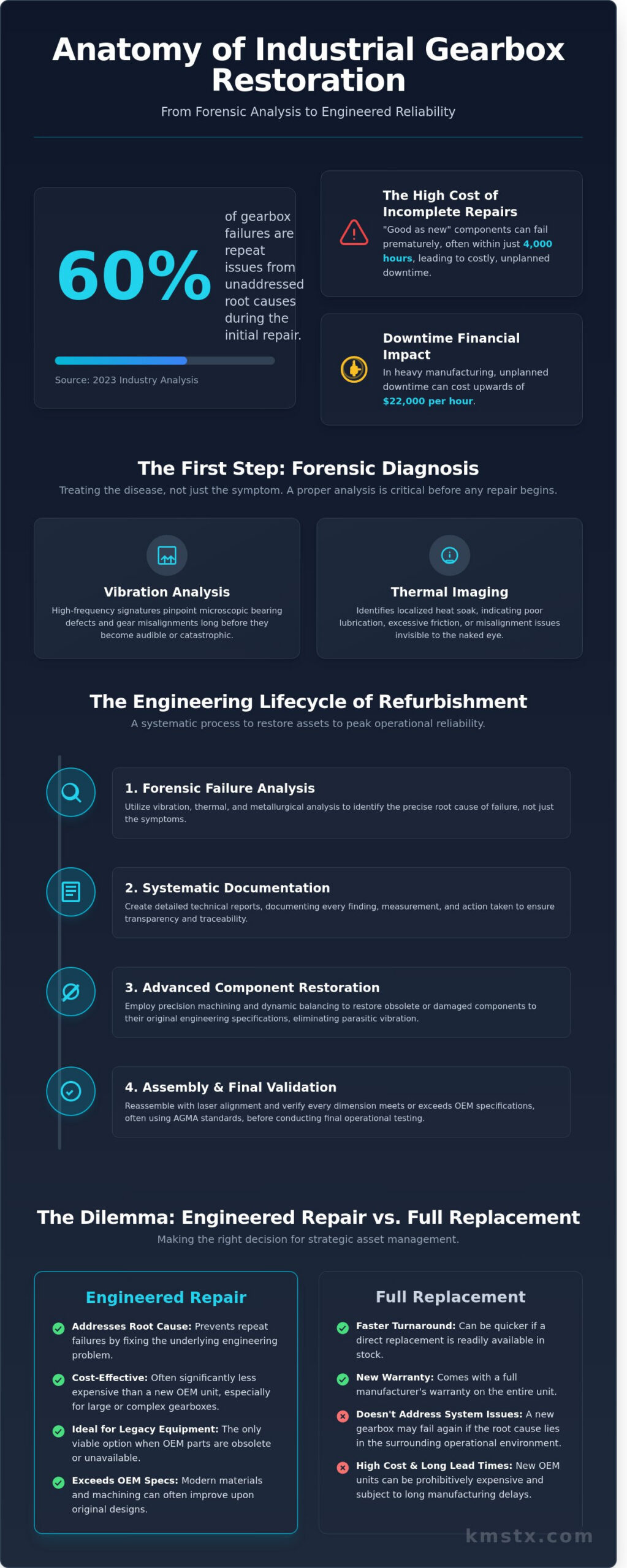
The Engineering Lifecycle of Professional Gearbox Refurbishment Services
A disciplined, systematic workflow is the only way to transform a worn asset back into a reliable piece of machinery. Professional gearbox refurbishment services follow a rigorous sequence where every micron of clearance is accounted for. This lifecycle begins with comprehensive documentation; it’s the foundation of a technical report that tracks an asset’s history and predicts its future reliability. Without a detailed paper trail of measurements and NDT results, you aren’t repairing a gearbox, you’re just guessing. Every stage of the project must be logged to ensure that the final product meets or exceeds its original design parameters.
Deconstruction and Forensic Inspection
The process starts with a full teardown. We don’t just look at the casing; every gear, shaft, and housing undergoes high-pressure chemical cleaning to strip away decades of oxidized oil and sludge. This step is vital because it reveals the true state of the metal. Our gearbox inspection services utilize non-destructive testing (NDT), such as magnetic particle and liquid penetrant inspections, to identify hairline fractures that would otherwise lead to a catastrophic failure within months of service. By referencing Gear Failure Modes and Analysis standards from ASM International, technicians can determine if a chip resulted from fatigue, misalignment, or lubrication starvation. Dimensional checks then verify every bore and journal against original drawings, often finding that tolerances have drifted by more than 0.005 inches over years of heavy operation.
Component Restoration and Precision Reassembly
Once the forensic data is collected, the restoration phase begins. This isn’t a simple parts-swap. It often involves precision gear cutting and grinding to return tooth geometry to its original involute profile. For those managing industrial gearbox repair Houston based operations, the selection of high-performance seals and bearings is a priority, often opting for modern materials that exceed the original 1990s specifications. During reassembly, setting the backlash and endplay is the most critical step. If the backlash is off by even 0.002 inches, you’ll see heat spikes and accelerated wear. Before the unit is cleared for site reintegration, it must pass a full-speed load test. This validates that vibration levels stay below 0.15 inches per second (ips), proving the unit is ready for the rigors of the field. This methodical approach ensures that when the gearbox returns to service, it doesn’t just run; it performs with the same efficiency it had on day one.
Strategic Asset Management: Evaluating Gearbox Repair vs. Full Replacement
Deciding whether to overhaul a failing unit or invest in a new one requires more than a simple glance at a quote. Engineers must weigh the immediate capital expenditure against long-term operational stability. In many cases, the decision is forced by the reality of legacy equipment. When a gearbox has been in service for 25 years, the original equipment manufacturer (OEM) may no longer support the model or might have exited the market entirely. This makes sourcing off-the-shelf components impossible. Specialized industrial gearbox repair Houston facilities fill this gap by utilizing forensic teardowns to understand why a component failed before manufacturing a superior replacement part in-house.
Lead times represent the most critical variable in this equation. Current 2024 supply chain data indicates that procurement for new, large-scale industrial drives often spans 26 to 52 weeks. Conversely, a comprehensive engineering restoration typically requires only 4 to 8 weeks. For a facility losing $10,000 per hour in lost production, that 40-week difference is unacceptable. Total Cost of Ownership (TCO) also includes the “hidden” costs of replacement, such as modifying concrete foundations, rerouting piping, and updating electrical couplings to fit a modern unit’s footprint. These integration costs can sometimes double the initial purchase price of a new gearbox.
The Economic Threshold of Repair
The “60% rule” serves as a baseline for most asset managers. If the cost of restoration exceeds 60% of the price of a new unit, replacement is usually prioritized. However, this rule fluctuates based on the availability of reverse engineering. By using coordinate measuring machines (CMM) and 3D laser scanning, technicians can identify and correct original design flaws. This modernization adds value that a standard “like-for-like” replacement cannot match. The only hard stop for repair is usually catastrophic housing failure. If the main cast-iron casing has suffered extensive structural cracking or severe heat warping, the integrity of the bearing bores cannot be guaranteed, making replacement the only safe path forward.
Risk Mitigation and Warranty
Reliability concerns often drive engineers toward new equipment, yet expert machine shops often provide warranties that exceed OEM standards. While a factory warranty might cover 12 months, a high-end domestic repair partner frequently offers 24-month or 36-month guarantees because they’ve overseen every micron of the rebuild. Choosing industrial gearbox repair Houston providers allows for real-time inspections and eliminates the logistical risks of international shipping. Strategic refurbishment allows engineers to rectify inherent design weaknesses, such as inadequate bearing lubrication channels or inferior metallurgy, effectively producing a unit that outperforms the original OEM specifications. This process transforms a simple fix into a proactive asset upgrade.
Ready to evaluate your critical drive systems for restoration? Consult with our engineering team for a technical assessment
Advanced Restoration Techniques: Precision Machining and Dynamic Balancing
Restoring a gearbox to its original design specifications requires more than basic mechanical assembly. When managing complex industrial gearbox repair Houston projects, the focus shifts to engineering restoration. Obsolete components often present a challenge because OEMs may no longer support legacy models. Custom machining allows us to bridge this gap by fabricating replacements that meet or exceed the original material properties. By integrating advanced metallurgy, we can apply specific heat treatment processes to gear teeth, ensuring they achieve a surface hardness of 58 to 62 HRC while maintaining a ductile core for shock resistance. This metallurgical control is vital for preventing the brittle fractures that lead to catastrophic housing failures.
Engineering expertise serves as the final logical step in ensuring operational longevity. It’s not enough to simply replace a gear; the entire system must be analyzed for wear patterns that suggest underlying alignment or lubrication issues. By utilizing precision grinding and specialized coatings, we can extend the service life of a rebuilt unit far beyond its original factory expectations. This technical approach transforms a standard repair into a comprehensive reliability upgrade, providing the durability needed for 24/7 industrial operations.
The Science of Dynamic Balancing
Parasitic vibration is a primary driver of premature bearing failure. When a gear set rotates at high speeds, even a few grams of imbalance create massive centrifugal forces. We use two-plane dynamic balancing to neutralize these forces, which is critical for centrifugal drives where speeds often exceed 3,600 RPM. By achieving a balance grade of G1.0, we eliminate the oscillations that destroy lubricant films. It’s the difference between a unit that lasts a decade and one that fails in 18 months.
Custom Fabrication and Reverse Engineering
Reverse engineering is the standard when documentation is missing. We use CMM mapping to determine exact gear geometry, including pressure angles and pitch diameters, from worn samples. CNC machining then facilitates the creation of components with tolerances held within 0.0002 inches. This level of precision ensures perfect tooth contact patterns during industrial gearbox repair Houston, reducing heat generation during high-torque operation. It’s a data-driven process that removes the guesswork from restoration.
Reliability in rotating equipment depends on technical precision and empirical data. For a technical consultation on your critical rotating assets, contact Kelsey Machine Services to discuss your specific engineering restoration needs.
Maximizing Asset Lifecycle Through Engineering Precision
Maintaining the integrity of your rotating equipment requires more than a standard patch; it demands a forensic approach to failure analysis and precision restoration. By identifying specific wear patterns and utilizing advanced dynamic balancing, your facility can avoid the high costs of premature replacement. For facilities requiring industrial gearbox repair Houston services, the focus remains on technical accuracy and restoring units to their original or improved specifications. We’ve spent over 40 years refining these engineering processes to ensure that legacy brands and modern units alike meet the demands of critical infrastructure.
When downtime isn’t an option, having access to 24/7 emergency support and specialized reverse engineering capabilities makes the difference between a minor setback and a total operational halt. Our team understands the realities of the shop floor and the data required to keep your assets moving reliably. Don’t let a failed gear set compromise your production schedule when a proven engineering solution is available. Consult with our engineering team for expert industrial gearbox restoration and get your equipment back into service with confidence.
Frequently Asked Questions
What are the most common signs of imminent gearbox failure in industrial settings?
Imminent failure is typically signaled by a 15% increase in operating temperature or abnormal vibration signatures detected during routine monitoring. You’ll often find metallic particulates exceeding 50 microns in the oil filtration system during a 30-day check. If you notice a 5-decibel increase in gear mesh noise, it’s time to pull the unit before a catastrophic seizure occurs.
How does forensic failure analysis improve the longevity of a gearbox repair?
Forensic failure analysis identifies the specific root cause, such as 35% of failures stemming from improper lubrication or 20% from shaft misalignment. By examining fatigue patterns on gear teeth, we can modify the rebuild specs to prevent the same issue from happening again. This approach extends the mean time between failures by up to 50% compared to simple parts replacement.
Is it possible to repair a gearbox if the original manufacturer no longer supports the model?
You can absolutely repair obsolete gearboxes by using reverse engineering techniques like 3D laser scanning to recreate original gear geometries. Since 25% of industrial units in Houston are legacy models, shops often manufacture custom components to AGMA 12 standards when OEM parts aren’t available. This ensures the unit meets or exceeds its original performance ratings from 30 years ago.
What is the difference between a standard overhaul and a professional gearbox refurbishment?
A standard overhaul focuses on replacing seals and bearings, while a professional gearbox refurbishment restores every component to original tolerances. Refurbishment involves line boring the housing and precision grinding gears to ensure 100% tooth contact. This comprehensive industrial gearbox repair Houston process provides a service life that mirrors a new unit’s 20-year design cycle.
How long does a typical industrial gearbox refurbishment process take?
A typical industrial gearbox refurbishment requires 14 to 28 days from initial teardown to final load testing. Lead times depend heavily on component availability, as custom gear cutting can add 10 days to the schedule. If you’re working with a standard 500 HP parallel shaft unit, expect the engineering and assembly phases to take roughly 120 man-hours.
Can dynamic balancing really prevent future bearing failures?
Dynamic balancing prevents bearing failure by reducing centrifugal forces that cause 45% of premature wear in high-speed shafts. By balancing rotating assemblies to G2.5 standards, you eliminate the harmonic vibrations that fatigue bearing cages and races. This precision step ensures the load is distributed evenly across the 360-degree contact surface of the bearing during operation.
What technical documentation should be provided after a gearbox is repaired?
You should receive a comprehensive data package including a 5-page failure analysis report and a certified test run log. This documentation must list final backlash measurements, tooth contact patterns, and vibration spectral data collected during the 4-hour break-in period. These records provide a vital baseline for your future predictive maintenance programs and insurance compliance.
How do you determine if a gearbox housing is still structurally sound for reuse?
We determine housing integrity using Non-Destructive Testing (NDT) methods such as Magnetic Particle Inspection (MPI) to find cracks invisible to the naked eye. Technicians also measure bore alignment to within 0.001 inches using a coordinate measuring machine. If the housing shows less than 5% material loss from cavitation or corrosion, it’s typically safe for resurfacing and reuse in the field.